ISLAMABAD: Less than a week after the government hiked the prices of petroleum products by a whopping Rs55, the Oil and Gas Regulatory Authority (Ogra) on Thursday notified a massive 19-22 per cent increase in the price of regasified liquified natural gas (RLNG) for sales at the distribution stage by the two Sui gas companies for the month of March.
The increase was mainly because of increase in terminal charges amid lower import molecules and minor increase in import price, the dataset from the authority showed.
The rare increase (19-22pc) in RLNG price for March has come following a minor 0.5pc increase in February and two consecutive monthly reductions in December (6pc) and January (5pc). The prices had cumulatively increased by 4.4pc in October and November.
The Karachi-based Sui Southern Gas Company Limited (SSGCL) serves consumers in Sindh and Balochistan and its system losses at the distribution stage stand at 12.55pc, compared to 10.6pc a couple of months earlier.
On the other hand, the Lahore-based Sui Northern Gas Pipelines Limited (SNGPL) provides gas to consumers in Punjab and Khyber Pakhtunkhwa. Its system losses at the distribution stage were also reported at almost 9pc compared to 7.47pc in October.
According to Ogra’s notification, the RLNG sale price for SNGPL at the transmission stage went up by 19.3pc to $12.49 per million British thermal units (mmBtu) for March from $10.47 mmBtu in February. It was $10.41 per mmBtu in January 2026, $10.92 per mmBtu in December 2025 and $11.24 per mmBtu in September.
The sale price at the distribution stage for SNGPL was, thus, increased by 19.6pc to $13.55 per mmBtu for March against $11.335 per mmBtu in February. It was previously $11.27 per mmBtu in January, $11.83 per mmBtu in December and $12.24 per mmBtu in November.
On the other side, the RLNG sale price for SSGCL has been increased at the transmission stage by 22pc to $11.12 per mmBtu for March from $9.03 per mmBtu in February. It was $8.98 per mmBtu in January, $9.47 per mmBtu in December and $9.86 per mmBtu in September.
The sale price at distribution stage for the company was also increased by 22pc to $12.54 per mmBtu for March against $10.27 per mmBtu in February. It was $10.21 per mmBtu in January, $10.77 per mmBtu in December and $11.01 per mmBtu in September.
The regulatory authority said the increase in RLNG price was due to the “increase in the delivered ex-ship (DES) price, import-related cost and terminal charges”.
The unaccounted for gas (UFG) for both companies at the distribution stage has gone up since January.
Ironically, the RLNG distribution prices for SSGCL ($12.54 per mmBtu) and SNGPL ($13.55 per mmBtu) are almost $3.3 and $4.25 per mmBtu higher than the average DES, respectively.
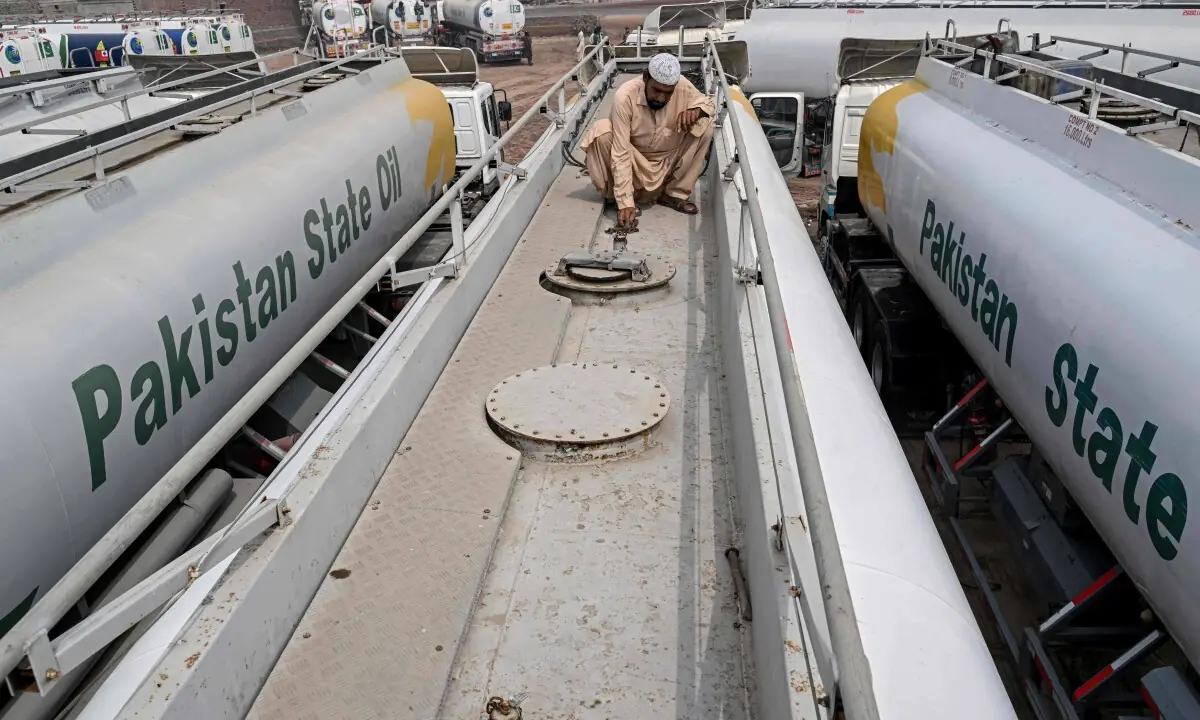
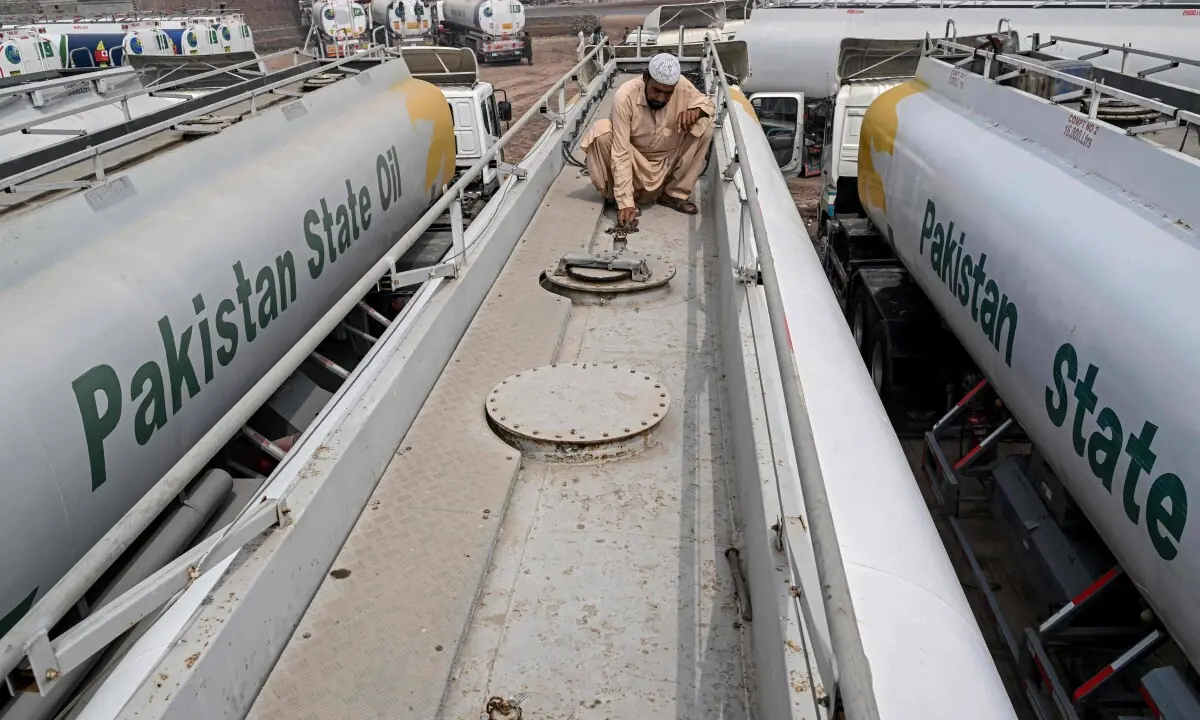
This is mainly because of the fact that both LNG importers – Pakistan State Oil (PSO) and Pakistan LNG Ltd (PLL) – and port authorities also charge hefty profit margins on account of retainage and margins at the rate of 3.77pc of the DES price on top of 8.97pc losses of SNGPL and 12.55pc losses of SSGCL.
The basket RLNG price was based on a total of only two cargoes in March against eight cargoes each in February 2026 and March 2025 due to a force majeure declared by Qatar after its gas facilities came under attack and close of the Strait of Hormuz.
Both cargoes were imported under two LNG contracts between PSO and Qatar Gas at an average of about $7.68 per mmBtu (DES price), compared to $7.45 per mmBtu last month, but still significantly lower than $8.9 per mmBtu in March last year.
The DES price was at $7.52 per mmBtu in January, $7.87 per mmBtu in December and $8.15 per mmBtu in November. Of the two, one cargo was procured at $8.72 and another at $6.65 per mmBtu.
PLL, one of the public sector entities responsible for LNG imports, did not import any cargo. It had imported one cargo a couple of months ago after a gap of almost a year at the rate of $7.65 per mmBtu through its old contract with a private entity. The development had come following reports that PLL, established almost a decade ago for LNG imports, had become redundant and a net burden on public money as it could not import energy over the past year despite its executives and board of directors enjoying hefty remunerations and associated perks and privileges.