Morning opening: How to get out of there?
Jakub Krupa
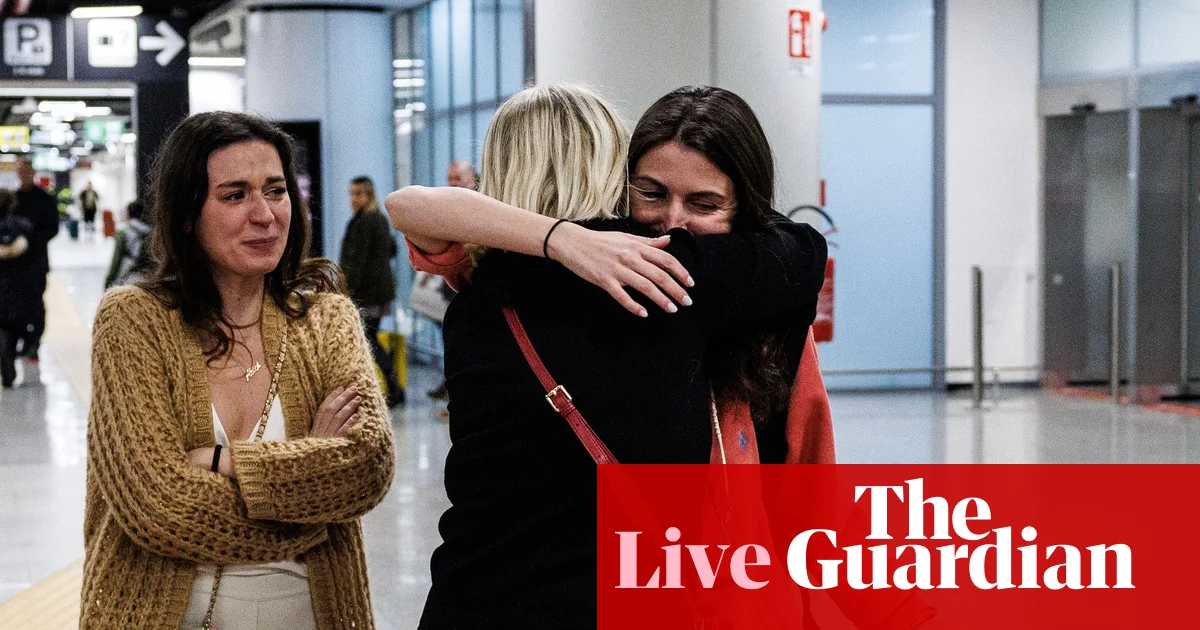
The first wave of European travellers stranded by the Middle East conflict returned home overnight, securing seats on the few remaining flights out of the region.
British, Czech, Italian and Polish media reported first successful returns from Oman and the United Arab Emirates after just a few carriers managed to take off and leave the affected area.


Hundreds of thousands are still believed to be in the region with countries stepping up their evacuation plans, with many countries continuing to advise them to shelter in place until the situation improves.
The European Commission said late on Monday it was working on “stepping up support for Member States’ evacuation and repatriation efforts.”
Expect more details to emerge soon, but the increasingly complex and challenging security situation in the region does not make it any easier.
Separately, France has pledged to send anti-missile and anti-drone systems to Cyprus after a British airbase on the island was attacked by drones, the Cyprus News Agency said. Earlier, Greece sent four F-16 fighter jets and two frigates to assist with the island’s defence.
Later today, our attention will shift towards the US as German chancellor Friedrich Merz is expected at the White House for his much-awaited meeting with the US president, Donald Trump.
Lots for us to cover.
It’s Tuesday, 3 March 2026, it’s Jakub Krupa here, and this is Europe Live.
Good morning.
Key events
Italian defence minister apologises for Dubai trip which left him stranded in first hours of war
The family of the Italian defence minister, who was embarrassingly left stranded in Dubai in first hours of the war, has returned to Italy on last night’s return flight to Rome Fiumicino airport, local media reported.
As we reported yesterday, Guido Crosetto returned on Sunday on an Italian state flight, which sparked further criticism, as hundreds of other Italians remain stuck in Dubai while he was evacuated alone.
To avoid further backlash, he left his family in Dubai and flew back by himself. He has said he paid for the flight out of his own pocket. “I paid triple with my own money,” he said, citing he had to go to Dubai ‘‘for personal reasons.’’
But his family has now returned to Italy last night, joining over 120 tourists flying out from Oman, Corriere della Sera reported.
Meanwhile, Crosetto was left red-faced as he was questioned in parliament about his Dubai trip and its timing, ultimately apologising for his error of judgment, Corriere said.
Opposition lawmakers also argued that the fact that he was caught wrong-footed in Dubai meant that Italy had not been told about the US plans to attack Iran, despite prime minister Meloni’s close relationship with the US president, Donald Trump.
But as it turns out, Crosetto was not the only EU minister stuck in Dubai, with the Czech sports minister Boris Šťastný also left stranded in the Gulf, making a complicated trip back last night.
Greek defence minister visits Cyprus amid calls for reinforcements
Greek defence minister Nikos Dendias is in Cyprus today, after the Greek government’s decision to send reinforcements to help protect the island.
Four Greek F-16 arrived in Cyprus last night, stationing at Andreas Papanderous Paphos base, with two frigates also believed to be on their way.
He will meet with the Cypriot president Nikos Christodoulides and later with his Cypriot counterpart Vasilis Palmas.
France also said it would send anti-missile and anti-drone systems. Cyprus also reportedly requested further assistance from Germany, with local media reporting that a decision is expected “imminently.”
Spain reasserts its sovereignty, right to defend international law after refusing to let US use Spanish bases for Iran strikes

Sam Jones
in Madrid
The Spanish government appears to be reacting to some of the overnight criticism from Israel over its refusal to allow the US to use jointly operated bases in southern Spain to carry out strikes on Iran.
Óscar López, Spain’s digital transformation minister – and Pedro Sánchez’s former chief of staff – has insisted that Spain is a “serious country” and a reliable Nato member.
Speaking to reporters in Barcelona on Tuesday morning, López said: “Spain is a serious country and a reliable partner, and it is also a country that loves international law and peace.”
In remarks reported by the Spanish news agency Efe, the minister said Spain’s position on the Iran offensive was very clear. “Spain, of course, exercises its sovereignty and defends international law and a rules-based order,” he said.
On the question of evacuating Spanish citizens currently stranded in the Middle East, López said the government was in constant touch with embassies in the region, adding that the aim was “to be able to evacuate citizens gradually, depending on how airspace reopens”.
Israel criticises Spain’s Sánchez for refusing to let US use Spanish military bases to strike Iran
Sam Jones
in Madrid
Israel has hit back at the Spanish government’s refusal to give the US permission to use jointly operated military bases on its territory to attack Iran, accusing the Spanish prime minister, Pedro Sánchez, of being on the wrong side of history.
Sánchez has explicitly condemned the US and Israel’s “unilateral military action” against Iran, warning that it is contributing to “a more hostile and uncertain international order”. The rebukes have been reinforced by his government’s refusal to allow the US to use bases in Rota and Morón for the continuing strikes against Iran.
In a post on X on Monday evening, Israel’s foreign minister, Gideon Sa’ar, accused Sánchez – a staunch critic of Israel’s prosecution of the war in Gaza – of pandering to terrorists and oppressive regimes.
“First, Hamas thanked Sánchez,” wrote Sa’ar. “Then the Houthis thanked Sánchez. Now Iran thanks him. Is that being on the “right side” of history?”
Sa’ar also retweeted criticism of Sánchez from the US Republican senator Lindsey Graham, who wrote:
“The current government in Spain is becoming the gold standard of pathetically weak European leadership that has lost its moral way, apparently reluctant to condemn the terrorist regime in Iran and have nothing but criticism for the United States.”
On Saturday, Sánchez said Donald Trump and Benjamin Netanyahu’s offensive was making the world less stable and called for a lasting political solution to the conflict.
He returned to the theme in a speech in Barcelona on Sunday.
“Today, more than ever, it’s vital to remember that you can be against a hateful regime – as Spanish society is as a whole when it comes to the Iranian regime – and, at the same time, against an unjustified and dangerous military intervention that is outside international law,” he said.
Morning opening: How to get out of there?

Jakub Krupa
The first wave of European travellers stranded by the Middle East conflict returned home overnight, securing seats on the few remaining flights out of the region.
British, Czech, Italian and Polish media reported first successful returns from Oman and the United Arab Emirates after just a few carriers managed to take off and leave the affected area.
Hundreds of thousands are still believed to be in the region with countries stepping up their evacuation plans, with many countries continuing to advise them to shelter in place until the situation improves.
The European Commission said late on Monday it was working on “stepping up support for Member States’ evacuation and repatriation efforts.”
Expect more details to emerge soon, but the increasingly complex and challenging security situation in the region does not make it any easier.
Separately, France has pledged to send anti-missile and anti-drone systems to Cyprus after a British airbase on the island was attacked by drones, the Cyprus News Agency said. Earlier, Greece sent four F-16 fighter jets and two frigates to assist with the island’s defence.
Later today, our attention will shift towards the US as German chancellor Friedrich Merz is expected at the White House for his much-awaited meeting with the US president, Donald Trump.
Lots for us to cover.
It’s Tuesday, 3 March 2026, it’s Jakub Krupa here, and this is Europe Live.
Good morning.