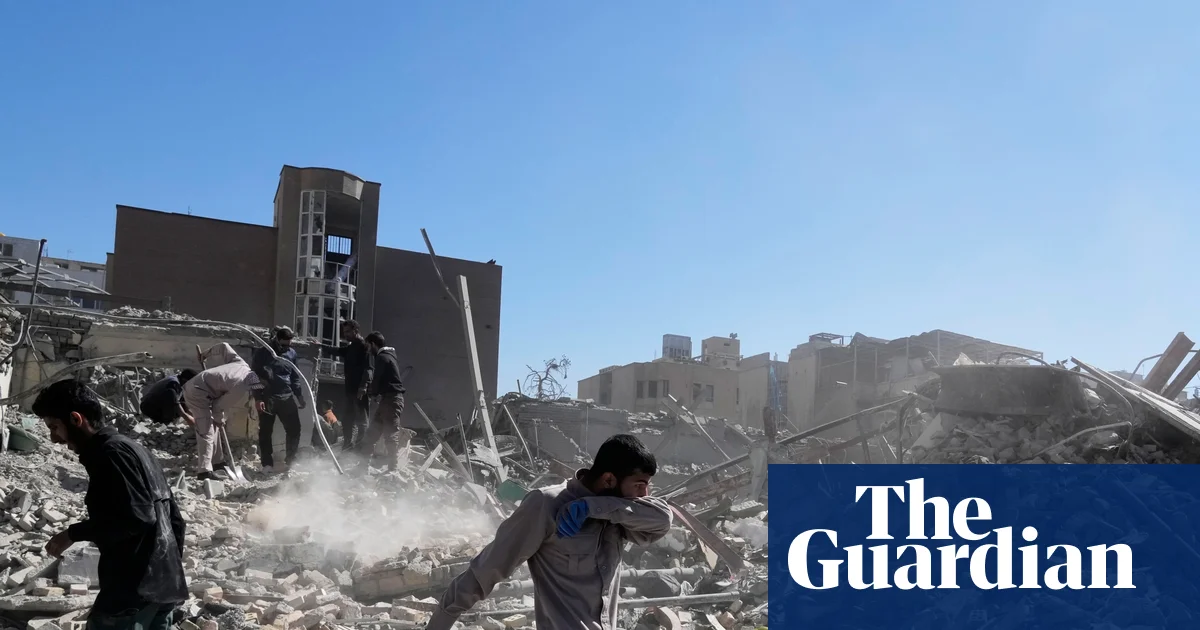
A US-Israeli war against Iran that began on Saturday with bombing and missile attacks that killed Iran’s supreme leader, Ali Khamenei, has exploded into a regional conflict, with Tehran retaliating by launching strikes across the Middle East.
On Tuesday, Israel’s military launched a ground invasion of Lebanon, where it has been carrying out intense strikes after Iran’s ally, Hezbollah, fired rockets across the frontier.
US and Israeli strikes on Iran have continued non-stop, killing hundreds of people. And in the Gulf, multiple Iranian attacks were reported on Tuesday, including a drone attack that hit the US embassy in Saudi Arabia’s capital, Riyadh. Other strikes hit Oman, Qatar and the United Arab Emirates, where authorities said they were dealing with an “advanced fire” in the port.
Europe has also been dragged into the conflict, with Cyprus announcing two separate drone attacks that targeted a British base on the Mediterranean island.
US and Israeli attacks
On Saturday, Israel announced the beginning of what it called Operation Lion’s Roar, which an Israeli military official said was intended to “degrade the regime’s capabilities”. The attack was launched in tandem with what the US called Operation Epic Fury.
Strikes since then have hit key security and political targets in Tehran, including Khamenei’s residence, and ballistic missile caches elsewhere in the country.
Cities across Iran have been hit, in what an Israeli military official said was a much more wide-ranging campaign than the previous US-Israeli attack on Iran in the 12-day war last summer. Israel claimed to have killed at least 40 senior Iranian commanders in the first day of attacks.
Satellite imagery taken on Monday showed new damage to the nuclear facility at Natanz, which was also hit by the US last year.
On Tuesday the Iranian Red Crescent Society said the death toll in the country stood at 787.
In what appeared to be the worst mass casualty event of the campaign on Iran so far, almost 165 people were killed and at least 95 wounded in a strike on a girls’ school in Minab, in the southern Hormozgan province, according to state media. There is an Islamic Revolutionary Guard Corps base in the same city.
Authorities have instructed citizens to flee big cities for safety. Many security institutions and officials are located in residential areas of Iran, making civilian casualties likely.
Iranian retaliation
Despite the apparent loss of a significant portion of its senior military and political leadership, Iran has bombed targets in the Gulf – particularly in countries allied with Washington – and unleashed waves of ballistic missiles towards Israel.
In Israel, where several locations were hit by Iranian missiles, 11 people were killed, including eight people in the town of Beit Shemesh, which was struck by a missile on Sunday afternoon.
Iran’s retaliation pushed far past previous unwritten red lines that had largely excluded the Gulf from previous conflict with Israel and the US.
Iran struck targets including luxury hotels in Dubai and Bahrain and airports in Dubai, Kuwait and Bahrain. Smoke was seen rising above Dubai’s Palm Jumeirah island on Monday, and photographs showed damage to buildings in Bahrain.
It also struck a port facility in Oman and a ship north-west of Muscat, as the Iranian military broadcast radio warnings to ships intending to cross the strait of Hormuz.
Saudi Arabia’s Ras Tanura oil refinery came under attack from drones, with defences downing the incoming aircraft.
A new front in Lebanon
The speed at which the conflict turned regional was dizzying.
Lebanon was drawn into the regional war on Monday after a rocket attack on Israel by Hezbollah, an Iranian ally based there that said it wanted to “avenge” the killing of Khamenei. Israel quickly responded with large-scale strikes, including on the capital, Beirut, and on Tuesday ordered troops into southern Lebanon.
Israeli airstrikes have killed 52 people and displaced at least 30,000 in Lebanon in two days. Despite a 2024 ceasefire deal, Israel has conducted regular airstrikes on the country.
In the first strike to reach US allies in Europe, a drone hit Britain’s Akrotiri airbase in Cyprus. Two more drones had been intercepted en route, the Cyprus government said.
The chaos of the conflict became apparent when Kuwait mistakenly shot down three American F-15E Strike Eagles. All six pilots ejected safely and were reported to be in a stable condition.
Separately, four US service members have been killed in action as part of US military operations against Iran, US Central Command has said, without providing details.
Cancelled flights, closed trade routes
Strikes on Gulf countries and the wider region left travellers stranded as major hubs in Dubai and Qatar were closed.
Flights around and through the region were cancelled or delayed and it was unclear when the airspace above Gulf countries would reopen.
World markets were rattled by the fighting and oil prices soared after the effective closure of the strait of Hormuz, one of the most important arteries for global trade that runs between Gulf states and Iran.