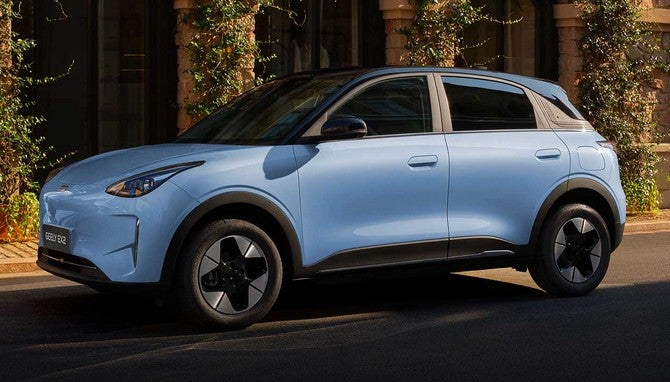
Chinese automakers reported strong sales growth in Southeast Asia last year, with their combined deliveries in Thailand, Indonesia, Malaysia and the Philippines surging by 95% to over 377,450 units from 193,510 in 2024, according to preliminary data released by local industry sources.
Overall sales in these four markets were just slightly lower at 2.71 million units in 2025, meaning that Chinese automakers doubled their combined share of the region’s markets last year to 14%, from 7% in 2024, mainly at the expense of underperforming Japanese automakers including Honda, Nissan and Daihatsu.
While Thailand was the third-largest market in Southeast Asia last year, it was the largest market for Chinese brands with over 140,000 sales, accounting for 23% of total vehicle sales. Indonesia was the second-largest market in the region for Chinese automakers with over 128,000 sales and a market share of 16%, followed by Malaysia with 59,990 units (7%) and the Philippines with 48,960 units (11%).
These market shares only include vehicles sold under Chinese brands and do not reflect partnerships between domestic brands and Chinese automakers, including Malaysia’s Proton which produces a significant number of vehicles based on platform technologies derived from its 49.9% Chinese shareholder Zhejiang Geely Holding Group, and smaller-scale partnerships such as that between Indonesia’s Hartono Istana Electronic (Polytron) and China’s Skyworth Automobile and also that between Thailand’s Energy Absolute (EA) and EVE Energy/Sunwoda Mobility.
The strong growth seen in the region by Chinese brands last year has been driven by surging demand for battery electric vehicles (BEVs), a segment that Chinese automakers have come to dominate globally over the last few years. BEV sales in the four markets surveyed rose by 105% to an estimated 264,000 units last year, with sales in Thailand surging by 80% to over 120,000 units, followed by Indonesia with 143% growth to almost 107,000 units, Malaysia with 30,850 units (+109%) and the Philippines with 5,890 units (+90%). Chinese automakers accounted for roughly 90% of these sales.
BEV demand in the region has been driven by generous government incentives, including tax discounts for consumers and investment incentives for vehicle manufacturers, which have encouraged a rising number of Chinese brands to enter these markets and localize production, as they face sluggish demand and cut-throat competition in their home market. While some markets in the region reduced some BEV incentives at the beginning of 2026, including for built-up imports, most Chinese vehicle manufacturers have established strong dealer networks in the region and have already localized vehicle production.