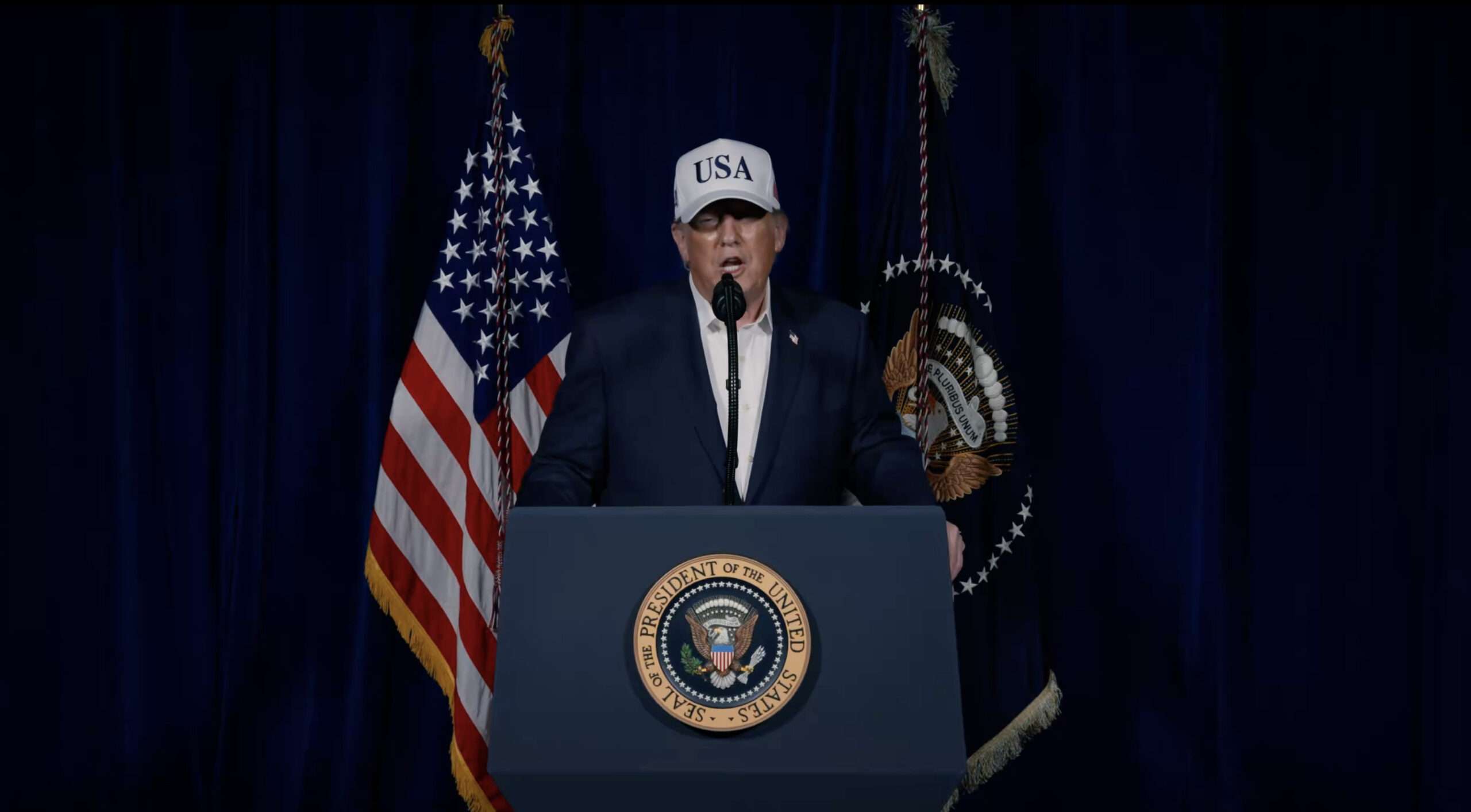
Fighting forever: President Donald Trump has always pitched himself as the peace candidate. This was not only in contrast to Democratic opponents. It was also meant as a contrast with the Republican Party in the years before Trump.
One example: In his 2019 State of the Union address, Trump said that as a candidate, he pledged a new approach: “Great nations do not fight endless wars.”
The message was clear: The old GOP, the GOP of George W. Bush and John McCain, would drag America into forever wars in places like the Middle East. Trump would not.
Over the weekend, Trump launched a new war in the Middle East. And now he says that “wars can be fought forever.”
The Reason Roundup Newsletter by Liz Wolfe Liz and Reason help you make sense of the day’s news every morning.
The president was responding to worries that American forces don’t have sufficient munitions to fight an extended war. The missile math, in which U.S. forces are fending off low-cost drones with very expensive interceptors that are in rapidly dwindling supply, doesn’t look great. Before the war, Pentagon insiders raised concerns about limited munitions supplies.
But Trump says we shouldn’t worry. On Truth Social he wrote: “The United States Munitions Stockpiles have, at the medium and upper medium grade, never been higher or better.” The U.S., he wrote, has “a virtually unlimited supply of these weapons.”
“Wars can be fought ‘forever,’ and very successfully, using just these supplies.”
Sit with that one for a moment. Wars can be fought forever.
Wasn’t Trump supposed to make America great? And didn’t he say that great nations don’t fight endless wars?
Imminent threat? Why is America even in this war? On this week’s Reason Roundtable, I spoke with Nick Gillespie, Katherine Mangu-Ward, and Matt Welch about the missing case for the war. Watch here:
In the days since strikes began, Trump and his team have offered multiple competing and contradictory justifications. One explanation he and some supporters have given is that striking Iran was necessary to prevent an imminent threat to American lives.
There are reasons to doubt this argument. As CNN reported on Sunday, citing multiple sources, “Pentagon briefers acknowledged to congressional staff in a briefing Sunday that Iran was not planning to strike US forces or bases in the Middle East unless Israel attacked Iran first, undercutting the administration’s argument Saturday that Tehran was planning to potentially strike the US preemptively and posed an imminent threat.”
But Secretary of State Marco Rubio is defending the argument that there was indeed a live threat to Americans in the Middle East. “There was absolutely an imminent threat,” he said yesterday. “We knew that if Iran was attacked—and we believe that they would be attacked—that they would immediately come after us, and we were not going to sit there and absorb a blow before we responded.” Rubio also said: “We knew that there was going to be an Israeli action, we knew that that would precipitate an attack against American forces, and we knew that if we didn’t preemptively go after them before they launched those attacks, we would suffer higher casualties.” This is not a direct contradiction of the CNN report. But it does suggest that the threat they were supposedly concerned about was retaliation against a strike.
Some people, including Kentucky GOP Rep. Thomas Massie, one of the few Republicans to loudly oppose the war, have taken this to mean that Israel effectively forced America’s hand.
The administration admits ???????? dragged us into the ???????? war that’s already cost too many American lives and billions of dollars. Before it’s over, the price of gas, groceries, and virtually everything else is going to go up. The only winners in ???????? are defense company shareholders. https://t.co/MR75j2ytCB
— Thomas Massie (@RepThomasMassie) March 2, 2026
Given the fuzzy messaging about the reasons and objectives for the war, it’s hard to know for sure. But what’s clear is that Trump had war with Iran on his mind long before last weekend.
Trump had been discussing a joint attack on Iran with the Israeli government long before the war was launched over the weekend, according to The New York Times, and America spent weeks building up troops and military firepower in the region. Trump was quite obviously contemplating and preparing for a larger war.
Iran is a bad actor, a regional bully, and an oppressive, authoritarian nightmare of a country. But despite the White House insisting that the objectives are clear, the administration’s incoherent, constantly shifting arguments, explanations, and legal justifications for this war don’t hold up.
Point break: Without a clear rationale for starting the war, it’s going to be difficult to find an off-ramp.
So is there an endgame? And how long will this war last? Trump says perhaps four to five weeks, though that’s far from a hard-and-fast commitment.
Rubio is even less clear. “We have objectives,” he said yesterday. “We will do this as long as it takes to achieve those objectives, and we will achieve those objectives. The world will be a safer place when we’re done with this operation.”
Both Rubio and Trump signaled that even more aggressive action was coming, with Trump telling CNN’s Jake Tapper that there was a “big wave” on the way, and Rubio saying, “The hardest hits are yet to come from the U.S. military.”
There are many reasons to hope this conflict ends sooner rather than later. It’s not just the munitions math, the lack of constitutional process, or the absence of strategic clarity. It’s that Americans are dying in a war of dubious legality for which no one seems to be able to offer a good justification.
Scenes from Washington, D.C.: It snowed in D.C. yesterday. By the weekend, the temperature will be in the upper 70s. It might even hit 80. In the nation’s capital, even the weather is polarized.
Quick Hits
- “No president in the modern era has ordered more military strikes against as many different countries as Donald Trump,” reports Axios.
- The State Department warns Americans in more than a dozen Middle Eastern countries: “Depart now.”
- The suspect in an Austin, Texas, mass shooting wore clothing with an Iranian flag and the words “Property of Allah.” Police are investigating the shooting as a terrorist attack.
- Israeli intelligence hacked nearly every traffic camera in Tehran to track Iranian leadership.
- Data centers head north to the Arctic Circle.
- A New York bill would prohibit AI chatbots like Claude and ChatGPT from giving legal advice.
- “John Adams took a tankard of hard cider with his breakfast every day. James Madison reportedly drank a pint of whiskey every day. Thomas Jefferson said he wasn’t much of a user of alcohol—he only had three or four glasses of wine a night, OK?” Justice Neil Gorsuch said on our founding drinkers.
- Once the Paramount/Warner Bros. merger goes through, the new company will combine the HBO and Paramount+ streaming services.
- In The Wall Street Journal, Emma Camp, until recently of Reason, argues that loneliness is a choice. She threw 27 (!) house parties at her home in D.C. last year. Now, after relocating, she’s throwing them in New York. I speak from experience when I say: Emma makes a mean cocktail, and she throws a good shindig.