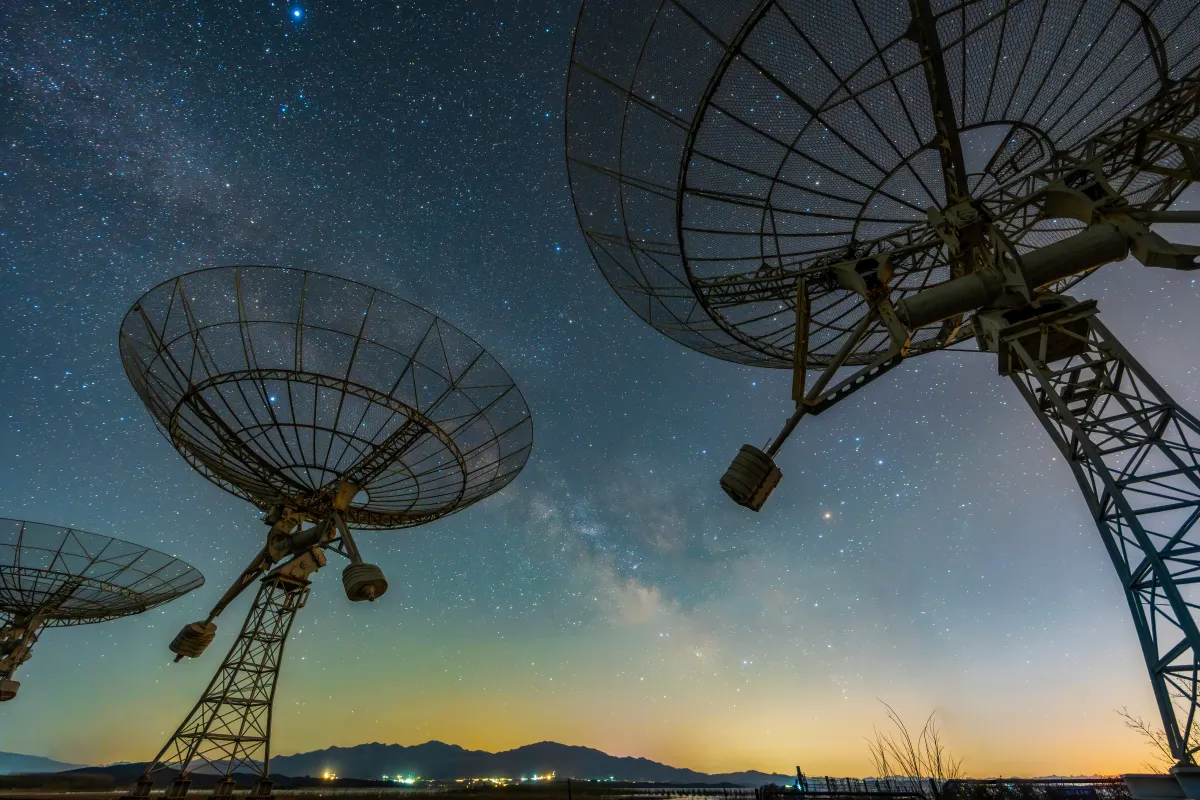
Astronomers in South Africa have just identified the most distant, brightest cosmic laser ever recorded, shining from over eight billion light years away.
This powerful radio signal, HATLAS J142935.3–002836, comes from a violent galaxy merger. It is so distant that we are seeing it as it was when the universe was less than half its current age. It is both the most distant and luminous known signal.
The source is a hydroxyl megamaser—an intense burst of radio emission produced when two galaxies crash together. These cosmic collisions compress gas and stimulate large reservoirs of hydroxyl molecules to amplify radio emission.
These emissions act like a naturally occurring laser, but at a much longer wavelength—about 18 centimetres. The laser is so luminous that it warrants the classification gigamaser, instead of megamaser.

Despite its distance, the record-breaking cosmic gigamaser produced a surprisingly strong signal, which is thanks to the combined power of MeerKAT radio telescope and a phenomenon known as strong gravitational lensing, which was theorized by Einstein, that astronomers were able to record.
Dr. Thato Manamela, postdoctoral researcher at the University of Pretoria and lead author of the new study, described the discovery as truly extraordinary.
“We are seeing the radio equivalent of a laser halfway across the universe,” he said. “Not only that, during its journey to Earth, the radio waves are further amplified by a perfectly aligned, yet unrelated foreground galaxy. This galaxy acts as a lens, the way a water droplet on a windowpane would, because its mass curves the local space-time.”
MeerKAT’s advanced design played a crucial role in the discovery. However, while the telescope is built to detect faint radio signals at centimeter wavelengths, detection alone is not enough.
Astronomers must carefully calibrate and analyze terabytes of information using sophisticated algorithms and scalable computing platforms, before any breakthrough discoveries are possible.
Beyond breaking a distance record, the newly discovered gigamaser could become a powerful probe of galaxy evolution.
“This is just the beginning,” said Dr. Manamela. “We don’t want to find just one system—we want to find hundreds to thousands.
“Here at the University of Pretoria, we are carrying out systematic surveys of the universe, building the required computational pipelines and algorithms to open this observational frontier ahead of, and ultimately with, the Square Kilometer Array.”
Do you have a tip on a science story that Newsweek should be covering? Do you have a question about gigamasers? Let us know via science@newsweek.com.
Reference
Manamela, T. E., Deane, R. P., Blecher, T., Heywood, I., Kemball, A. J., & Obreschkow, D. (2026). MeerKAT discovery of a high-redshift strongly-lensed hydroxyl gigamaser (arXiv:2602.13396). arXiv. https://doi.org/10.48550/arXiv.2602.13396