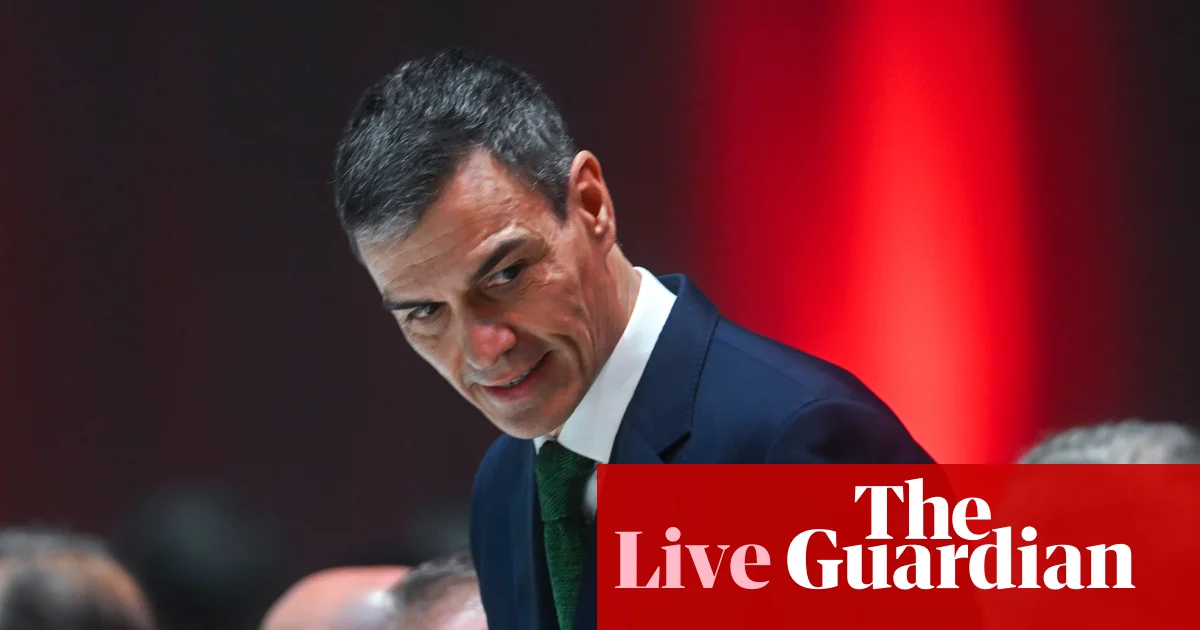
‘No to war,’ Spain’s Sánchez says in response to Middle East crisis
Sánchez says Spain’s position is “clear and consistent” and the same as it was in response to Ukraine and Gaza.
Madrid opposes “the breakdown of international law that protects us all,” and the assumption that “the world can only solve its problems through conflicts and bombs.”
He says he opposes “repeating the mistakes of the past.”
“The Spanish government’s position can be summarised …: no to war,” he says.
He then draws comparisons with the invasion of Iraq in early 2000s.
Key events
‘Blunt rejection’ of US-Israeli attack on Iran and ‘call to learn from mistakes of the past’ – snap analysis

Sam Jones
in Madrid
Sánchez’s defiant speech may have been made in response to Trump’s threat to cut off all trade with Spain, but his words were also aimed every bit as much at other EU leaders (and at Spain’s political class).
The PM was keen to stress that his government’s refusal to facilitate the attacks on Iran was firmly in line with its stance on Ukraine and Gaza.
He repeatedly insisted that a long and unpredictable war with Iran would only bring more death, more global uncertainty and more economic upheaval.
Not for nothing did he invoke the 2003 invasion of Iraq – the massively controversial and counterproductive military adventure that was so enthusiastically backed by Spain’s conservative prime minister at the time, José María Aznar:
“A war that, in theory, was said to be waged to eliminate Saddam Hussein’s weapons of mass destruction, bring democracy, and guarantee global security, but which, in reality, seen in retrospect, produced the opposite effect. It unleashed the greatest wave of insecurity our continent has suffered since the fall of the Berlin Wall.”
While no one could predict the exact course of the Iran conflict, he added, “what we do know is that a fairer international order will not emerge from it. Nor will it produce higher wages, better public services, or a healthier environment”.
In one of the most pointed passages of the speech, Sánchez also took aim at those who use war as a diversionary tactic, or as a means of enriching their cronies:
“It is absolutely unacceptable that those leaders who are incapable of fulfilling this duty use the smokescreen of war to hide their failure and, in the process, line the pockets of a select few – the same ones as always; the only ones who profit when the world stops building hospitals and starts building missiles.”
All in all, the speech is a blunt rejection of the US and Israel’s strikes and a call for Europe to learn from the mistakes of the past, to stand together, and to respect international law.
His words stand in sharp, and uncomfortable, contrast to the more weaselly utterances of others.
Let’s see how his fellow leader respond to the call in the final section:
“The government of Spain stands with those it must stand with. It stands with the values that our parents and grandparents enshrined in our constitution.
Spain stands with the founding principles of the European Union. It stands with the Charter of the United Nations. It stands with international law and, therefore, stands with peace and peaceful coexistence between countries and their harmonious coexistence.
We stand with many other governments that share our views, and with millions of citizens throughout Europe, North America, and the Middle East, who ask not for more war or uncertainty, but more peace and prosperity. Because the former only benefits a few. And the latter benefits us all.”
Very punchy speech from Sánchez in response to Trump’s criticism – snap analysis

Jakub Krupa
Very punchy speech from Sánchez there as he set out Madrid’s position on the Iran war very clearly, mounting a defiant defence of international law and values.
But the lines that stick out most are the ones that effectively form a response to Donald Trump’s comments last night as he says Spain “will not be complicit in something that is bad for the world … simply out of fear of reprisals from someone.”
No prizes for guessing who is he thinking about there.
In another passage, he also spoke about the government’s obligation to “improve people’s lives, … not to worsen then,” with a bruising line on some leaders using “the smokescreen of war” when they can’t meet that basic obligation. Ouch.
His warnings about the unintended consequences and the risk of things escalating too far will also resonate with many.
Spain’s position ‘not naive, but consistent,’ Sánchez says, as he refuses to be ‘complicit’ just ‘out of fear of reprisals’
Sánchez says his position is not naive – and says “what is naive is thinking that violence is the solution” or that “democracies or respect between nations can come from ruins.”
He says Spain’s position is “not at all naive, but consistent.”
In the closest comments to directly criticising Trump, he says:
“We will not be complicit in something that is bad for the world and that is also contrary to our values and interests simply out of fear of reprisals from someone.”
He says Spain has “absolute confidence in the economic, institutional and I would even say more strength of our country.”
He says Spain is not alone in this view, which he says is enshrined in the EU, UN, and other international treaties.
He says that war would only “benefit a few,” while peace and more prosperity would “benefit us all.”
And he ends his speech here.
Spain’s Sánchez calls for end of hostilities as he warns against risk of escalation and playing ‘Russian roulette with fate of millions’
Sánchez says that Spain will leverage its position as an EU and Nato member state to demand a cessation of hostilities and a return to diplomatic talks.
He says “we must demand a firm resolution from the United States, Iran, and Israel to stop [this conflict] before it is too late.”
He adds that “one illegality cannot be met with another, because that is how the great disasters of humanity begin.”
He warns that “very often, major wars erupt due to a chain of events that spiral out of control because of miscalculations, technical failures, or unforeseen circumstances.”
In a strong passage, he specifically warns against “playing Russian roulette with the fate of millions of people.”
He says Spain and partners should consistently uphold the same values they argue for in Ukraine, Gaza, Venezuela or Greenland.
“The question is not whether or not we support the ayatollahs. No one does. Certainly not the Spanish people, and certainly not the Spanish government. The question, instead, is whether or not we stand on the side of international law and, therefore, on the side of peace,” he says.
Spain studying measures to help people affected by Middle East crisis
Sánchez says the government is “studying scenarios and possible measures” to help people affected by the crisis, drawing lessons from the pandemic and the US tariff crisis.
He also says Spain will work with other partners to “advocate for peace and compliance with international law.”
He also says that as the world focuses on Iran, it must not forget Ukraine and Palestine, and says Spain will keep pushing for “a just and lasting peace” there, too.
Iran war will not bring stability, cause economic disruptions, and push energy prices, Spain’s Sánchez warns
Sánchez says that the Iraq war led to a rise in terror and in migration and left the word less safe.
He says the Iran war will not bring stability either, cause economic disruptions, and push energy prices higher.
He says Spain will seek to help its citizens stranded in the region, but caveats that by saying it won’t be an easy task as the region’s airspace remains unsafe.
“But our citizens can rest assured that we will protect them and bring them home safely,” he says.
‘No to war,’ Spain’s Sánchez says in response to Middle East crisis
Sánchez says Spain’s position is “clear and consistent” and the same as it was in response to Ukraine and Gaza.
Madrid opposes “the breakdown of international law that protects us all,” and the assumption that “the world can only solve its problems through conflicts and bombs.”
He says he opposes “repeating the mistakes of the past.”
“The Spanish government’s position can be summarised …: no to war,” he says.
He then draws comparisons with the invasion of Iraq in early 2000s.
Spain’s Sánchez speaking on Middle East crisis, Trump’s comments
Spain’s Pedro Sánchez is speaking now.
He begins by summarising the events of the last few days after “the United States and Israel attacked Iran, which in turn responded by indiscriminately bombing nine countries in the region, including a British base located in Cyprus.”
I will bring you the key lines.
Spain to respond to Trump’s threats as senior EU commissioner criticises ‘deeply disruptive’ comments
Sam Jones
in Madrid
Spain’s prime minister, Pedro Sánchez, is due to make a statement at 9am local time to respond to Donald Trump’s extraordinary threat to cut of all trade with Spain over its refusal to allow two jointly operated bases in its territory to be used in the US’s ongoing strikes against Iran.
Last night, a European Commission spokesperson said: “The Commission will always ensure that the interests of the European Union are fully protected.”
Teresa Ribera, a former Spanish deputy prime minister who now serves as the EU’s green transition chief, has also pointed out that the EU’s external trade is negotiated as a bloc and that the European Commission is the relevant authority on the issue.
Speaking to Spain’s Cadena Ser radio just after 8am, Ribera said:
“At this moment, it isn’t possible to establish trade reprisals or separate trade relations … I think the most surprising thing about this fact is that the American federal government is aware of this, and therefore it is necessary to insist, as the spokesperson for the European Commission did last night, that the trade negotiations of each and every one of the 27 member states of the EU are the responsibility of the Commission, and it is not possible to create a division or fragmentation among the member states.”
Ribera also said Trump’s threat to cease trading with Spain was reminiscent of his recent threat to seize control of Greenland.
“What we’re seeing is very similar to what happened just a month ago with those threats – also in a boastful tone – regarding Greenland. And the truth is, there was an immediate reaction from our EU partners, from the European Commission, and from the markets. I think that the instability; the tension generated by this way of relating to, or speaking about third parties – whether it’s about Starmer, Macron, or Pedro Sánchez – is deeply disruptive, not only for societies, for peace, for cooperation, but also for the economy. And it has immediate consequences for the overall economic activity of everyone.”
Other Spanish politicians have been more forthright. In a social media post last night, Yolanda Díaz, a deputy prime minister and Spain’s labour minister, wrote:
“Spain doesn’t take to being blackmailed or lectured by an aggressor country. We’re a country of peace. If the US wants an ally, let them begin by respecting our sovereignty and international law.”
But the Spanish government’s stance on the Iran strikes has been criticised by its opponents, who have accused Sánchez of posturing.
“Different opinions are welcome,” said Alberti Núñez Feijóo, the leader of Spain’s conservative People’s party. “What is no longer open to debate is that the government’s foreign policy is consistently irresponsible and that frivolity has consequences … We cannot jeopardise our security, our stability, and our position in the world in an attempt to win a few votes domestically.”
Morning opening: Spain faces Trump’s criticism and threats over Nato spending, use of bases
Jakub Krupa
Spain’s prime minister Pedro Sánchez is about to respond to harsh criticism from Donald Trump this morning after the US president said last night that “Spain has been terrible” on Iran and claimed to instruct his officials to “cut off all dealings with Spain.”
His comments were sparked by Spain’s insistence the US should not use their joint military bases in southern Spain for its operations in Iran, and Madrid’s reluctance to ramp up defence spending, as agreed within Nato.
Speaking alongside German chancellor Friedrich Merz, Trump said:
“First of all, it started when every European nation, at my request paid 5 percent, which they should be doing. And everybody was enthusiastic about it. Germany, everybody, and Spain didn’t do it, and now Spain actually said that we can’t use their bases. …
We could use their bases if we want, we could just fly in and use it. Nobody’s going to tell us not to use it, but we don’t have to, but they were unfriendly. And so, I told him we don’t want – Spain has absolutely nothing that we need other than great people, they have great people, but they don’t have great leadership.”
Curiously, Merz not only didn’t come to the rescue to an EU ally, but joined in as he said:
“The answer on that is quite simple. We are trying to convince Spain to catch up with the 3 percent or 3.5 percent, which we agreed on in Nato, and as the president said, it’s correct. Spain is the only one who is not willing to accept that, and we are trying to convince them that this is a part of our common security that we all have to comply with these numbers. … So, Spain has to comply with that.”
After leaving the White House, he sounded a bit differently, telling reporters:
“I said that Spain is a member of the European Union and we negotiate about tariffs with the United States only together or not at all. There is no way to treat Spain particularly badly.”
These comments sparked a big reaction over in Spain, and Sánchez is about to respond publicly in an “institutional statement.”
I will bring you all the key lines here.
Later, we will keep an eye on the latest on Cyprus and security situation in the region, about European evacuation flights from the Middle East, the EU’s Industrial Accelerator Act, and other key news from across the continent.
It’s Wednesday, 4 March 2026, it’s Jakub Krupa here, and this is Europe Live.
Good morning.