Anthropic has been experiencing significant growth, a rapid rise driven largely by enterprise demand for its AI systems. Roughly 80% of the company’s business now comes from enterprise customers, Anthropic CEO Dario Amodei told CNBC back in February, a contrast to its rival OpenAI whose products have drawn much of their early momentum from consumer adoption of ChatGPT. Its annual revenue run rate is nearing $20 billion, up from about $14 billion only weeks ago, according to sources, while its recent $30 billion funding in a new round valued the AI developer at roughly $380 billion.
But the AI startup’s sudden, high-stakes battle with the Trump administration will force both its customers and investors to ask: Can that momentum continue?
Defense contractors are dropping Anthropic’s technology after the severe response from the Trump administration saying last week it will designate the company a supply chain risk. This comes after it refused the Pentagon’s terms for use of its AI over safety concerns — and it is a designation previously used only for entities allegedly controlled by foreign governments like China and Russia when national security or espionage concerns are raised. The move by defense contractors is no surprise. “Most of our companies are actively involved in large defense contracts and so are very strict in their interpretation of the requirements,” Alexander Harstrick, managing partner at J2 Ventures, which backs startups in the space, told CNBC.
But other tech world executives say there will be, if not already, inevitable conversations in boardrooms across the corporate world about the Anthropic risk that extend far beyond the defense sector.
“The administration did not just pull Anthropic contracts. President Trump directed federal agencies to phase out Anthropic’s technology, and the Pentagon reportedly applied a ‘supply chain risk’ designation. That phrase matters,” said Spencer Penn, co-founder and CEO of AI-powered sourcing platform LightSource and a former executive at Tesla and Waymo.
‘This situation is different’
According to Penn, in the fast-evolving world of corporate enterprise adoption of AI large language models, the foundation model choices increasingly resemble infrastructure decisions rather than simple software purchases, meaning companies evaluate not just technical performance but reputational, geopolitical, and customer perception risks. “Boards care about that. Risk committees care about that. Customers absolutely care about that,” Penn said.
Anthropic did not respond to a request for comment.
The tensions between the government and Anthropic over AI safety and military use of its technology have helped the company’s brand with consumers. On Feb. 28, a day after the dispute, Anthropic’s Claude chatbot clinched the top spot on Apple’s rankings of top free U.S. apps, surpassing ChatGPT and leaving Google’s Gemini further down the rankings. But it is Anthropic’s coding assistant Claude Code that has become one of the company’s fastest-growing products, generating billions in annualized revenue as developers and large companies increasingly rely on AI tools to automate parts of their software development process, including tools designed to help developers write and review software and help run everyday business operations.
Anthropic has called the supply chain risk designation legally unsound, advised its commercial customers that they are “unaffected,” and indicated it plans to contest the decision in court. Many legal experts have agreed with Anthropic that statements from the government that the supply chain risk designation can limit other commercial activities by private companies rather than only what they can do under specific government procurement and use scenarios goes well beyond the statutory authority.
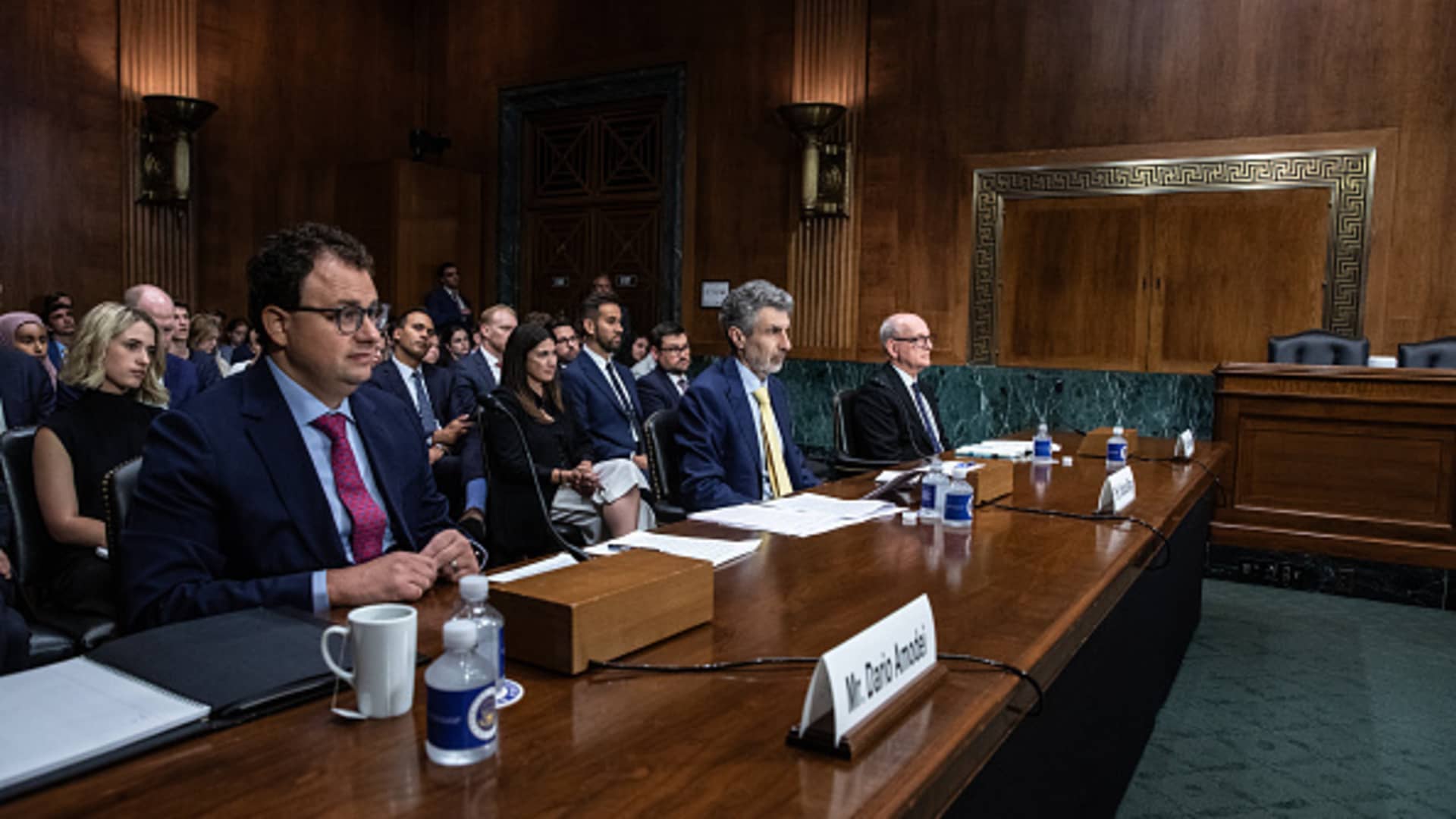
Dario Amodei, chief executive officer of Anthropic, left, during a Senate Judiciary Subcommittee on Privacy, Technology and the Law hearing in Washington, DC, US, on Tuesday, July 25, 2023.
Bloomberg | Bloomberg | Getty Images
Anthropic has received some support from within the tech sector ranks, and a trade group representing the industry wrote to Defense Secretary Pete Hegseth this week expressing concern over his designating a U.S. company a supply chain risk. But the government has given little indication to date it is going to ease its stance, even though Anthropic was a critical technology in successful military operations in Iran.
Anthropic’s assurances alone won’t satisfy many corporations. “Once a supplier is in the door and doing good work, most teams do not proactively go looking for a reason to reopen diligence. This situation is different,” Penn said.
“They closed the door. They didn’t want to do business with us,” Defense Department chief technology officer Emil Michael told CNBC’s Morgan Brennan this week. “I think their culture and their own constitution that has a soul and their own values really are not compatible. It’s sort of strange to want to do business with the Department of War, as they have for three years, but not want us to do Department of War stuff, so if that’s where we ended up and we finally faced that and they don’t want to do business with us, I think that’s their choice.”
Single-provider risk in the AI adoption race
Michael Murphy, partner and global AI readiness lead at consulting firm Adaptovate, which advises large companies on AI deployments, said Fortune 500 procurement teams move quickly when a key technology vendor faces regulatory scrutiny. “Any perceived compliance risk can ripple through their own regulatory obligations,” he said, also citing that the situation may enforce a broader shift already under way inside many organizations: avoiding reliance on a single AI provider.
The government has said its battle with Anthropic, and the controversial award of a new contract to OpenAI last week, was partly about addressing single vendor concentration. “We can’t be reliant on any one provider anymore, and that’s what was happening before I took this role on, and that’s gotta change,” DoD CTO Michael told CNBC.
That will now be an issue for many companies.
“Over-dependence on one AI vendor is increasingly seen as a risk,” Murphy said. “Many enterprises are already evaluating multiple providers simultaneously so they have redundancy in their AI stack.”
“The more mature enterprises understand that each vendor plays a different part of the larger puzzle. There is power in an ecosystem, but there is also lock-in risk,” said Joshua Morley, global head of AI, data, and analytics at the Adecco Group’s technology consulting arm.
In the end, the political and legal battle may accelerate the process that was already underway with corporate enterprise decision-makers diversifying their AI bets across companies in the space after early experimentation with a single vendor. Disney chief financial officer Hugh Johnston recently told CNBC that while its early work has been with OpenAI, the company expects that to broaden out. “We are very open on it. We will have a period of time where we are exclusively OpenAI, but a relatively short period of time. We need to let the models play out. I would be surprised if not multiple models rather than a single model going forward,” he said on CNBC’s “Squawk Box.”
“This looks more like short-term disruption than a structural shift,” Penn said. “Enterprises remain committed to deploying AI capabilities, but they may move toward more diversified ecosystems rather than relying on a single provider.”
The supply chain risk management classification can strongly affect contractors and subcontractors that rely on the technology, prompting companies to reassess contracts, delay deployments, or evaluate alternative AI vendors. If the designation appears durable, especially for companies with dual-use exposure across commercial and defense markets, Penn said he expects quiet evaluation of alternative foundation model providers. “Not necessarily because teams want to switch, but because concentration risk and eligibility risk are things serious procurement organizations are paid to manage,” he said. “Most enterprises are not going to make architectural shifts in days, but they will open a review immediately. Legal will assess what the directive actually requires. Compliance will evaluate exposure. Security will ask about contingency plans,” he added.
For Anthropic investors like Amazon, Microsoft, Nvidia, and sovereign wealth funds from around the world, the dispute could interrupt Anthropic’s rapid expansion. “Anytime the government takes aggressive action against a technology company, it creates risk,” said Brad Harrison, founder of Scout Ventures, an early-stage venture capital firm investing at the intersection of national security and critical technology Innovation. ”And the worst thing when you have significant momentum is a major risk requiring time and attention,” he said.
Ben Horowitz, co-founder and general partner at A16Z, which is an investor in Anthropic competitors OpenAI and xAI, told CNBC this week from its defense tech conference that “just a week ago, Anthropic was complaining the Chinese companies had stolen all their IP out of their model. Do you think the Chinese government is being restricted by DeepSeek in how they can use Anthropic technology? So we are very sympathetic to the position of the Department of War on this.”
Like many things with the current administration, policy signals can change quickly. “One constructive conversation between President Trump and Dario Amodei could soften the stance or further entrench it,” Penn said. Federal Communications Commission Chairman Brendan Carr told CNBC this week that Anthropic “made a mistake” in its dealings with the Department of Defense and should “try to correct course as best they can.”
For now at least, the unusually public nature of the dispute may accelerate risk conversations. “Typically, these kinds of eligibility issues move quietly through legal channels,” Penn said. “In this case it became headline news.”