The violence that unfolded at the US consulate in Karachi raises urgent legal questions about sovereignty, the use of force, and the narrow avenues for accountability under international law.
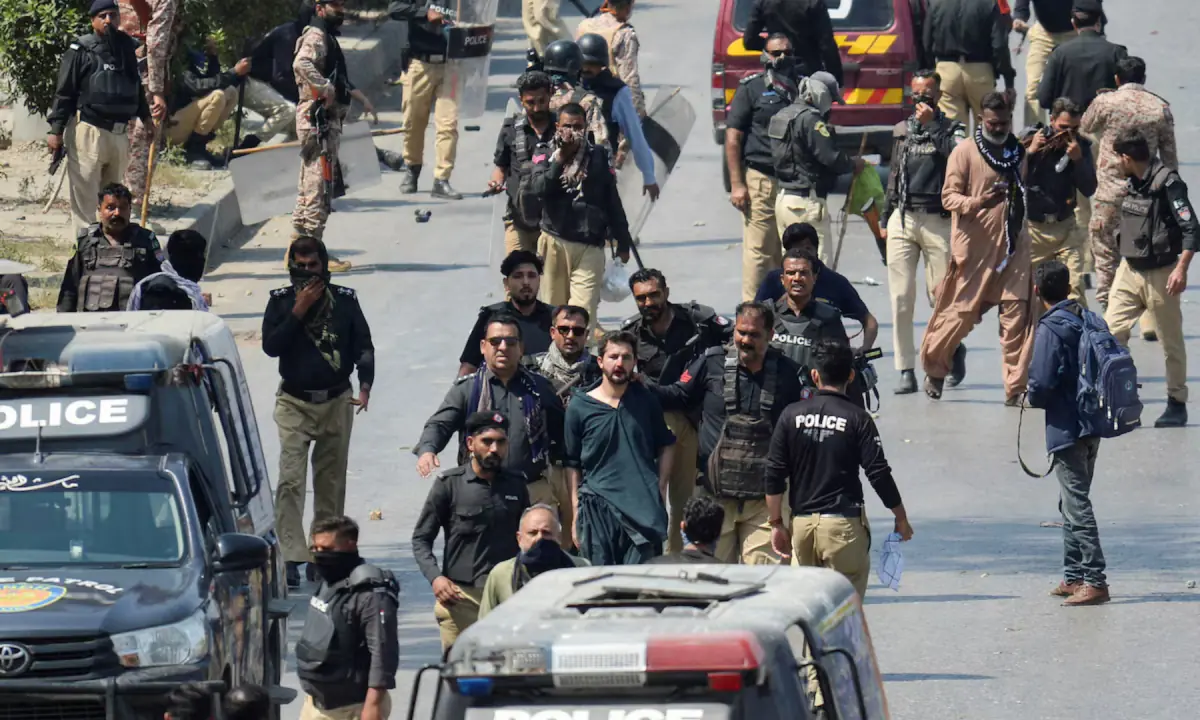
On the morning of March 1, 2026, the towering walls of the United States consulate in Karachi became the backdrop to a spectacle that was as political as it was perilous. Hundreds of protesters had gathered outside the gates, their anger fuelled by the assassination of Iran’s Supreme Leader Ayatollah Khamenei in strikes launched by Israel and the US, an event whose aftershocks have rippled well beyond Iran’s borders.
The chants against foreign intervention frayed into disorder as crowds surged forward, overwhelmed outer defences, and attempted to storm the diplomatic compound. In the ensuing melee, gunfire cracked through the air and by nightfall, at least 10 people had been killed, and dozens more were injured.
Later on Monday, US officials said the United States Marines had opened fire on demonstrators. They said it was unclear whether rounds fired by Marines struck or killed anyone, but they also did not know whether shots were also fired by others protecting the mission, including private security guards and local police.
When a foreign consulate becomes a site of bloodshed, the story does not end with casualty figures. It begins there. Thus, in the aftermath, a series of uncomfortable, technical, and urgent questions presses forward:
Is a US consulate in Karachi, as many casually assume, American sovereign territory? Or does it remain Pakistani soil, albeit protected by special legal status? What rules govern the use of lethal force by US Marines and other personnel assigned to guard the consulate? When protesters breach the premises, how do principles such as necessity and proportionality (terms often invoked but rarely unpacked) operate in practice?
And if civilians are killed by foreign security personnel within a diplomatic compound, which country has jurisdiction? What avenues of accountability, if any, does international law provide?
These questions sit at the heart of how diplomatic protection, state sovereignty, and the use of force intersect. And they demand careful answers.
The question of sovereign territory
According to Baqir Sajjad Syed, Foreign Affairs and National Security correspondent for Dawn, a fundamental point that many still get wrong is that a US consulate in Karachi is American sovereign territory. “It is not. It fully remains a part of Pakistan. Any other notion reflects a misunderstanding of the law,” he said, stressing that the confusion arises from a persistent myth that embassies or consulates somehow transform into “foreign soil”.
Oves Anwar, Director of the Research Society of International Law, concurred. “The belief that an embassy or consulate becomes the sovereign territory of the sending state is a common myth. Under international law, diplomatic and consular premises remain part of the host state.”
Having said that, he cited the Vienna Convention on Consular Relations, 1963 (VCCR), particularly Article 31, which grants consular premises inviolability. This means that the receiving state authorities cannot enter the areas used exclusively for consular work without consent. This protection extends to preventing any intrusion, damage, or disturbance of the peace of the mission or impairment of its dignity.
Anwar underscored just how far the principle of inviolability extends. “Official communications are also safeguarded,” he explained. “Diplomatic bags, for example, cannot be opened or inspected by customs, and the same protection applies against any forceful intrusion — forming a violent mob, breaking doors, throwing stones, or similar actions is strictly prohibited.”
Separately, he said that “shooting at an embassy is a terrorist offence”, noting that attacks on diplomatic premises can fall under Pakistan’s Anti-Terrorism Act, 1997. Section 6 defines terrorism as the use or threat of action designed to coerce, intimidate, or overawe the government, the public, a foreign government, or an international organisation, or to create fear or insecurity in society.
The question of when lethal force is authorised
“Outside of a war context (including diplomatic security situations), the applicable framework is law enforcement standards,” said Anwar, adding that under these standards, lethal force must only be used as a measure of last resort, after other precautions have been exhausted.
According to Ayesha Alam Malik, director of the War Law Institute, since the protests against the mission were spontaneous and carried out by unorganised individuals, there is no armed conflict; this is a law enforcement operation.
“As a result, US personnel at the mission must abide by international human rights law, particularly the Basic Principles on the Use of Force and Firearms by Law Enforcement Officials under which force must only be used when necessary and in a manner that is proportionate,” she stated. Malik added that under these principles, if the lawful use of force and firearms is unavoidable, law enforcement officials are supposed to:
- Exercise restraint in such use and act in proportion to the seriousness of the offence and the legitimate objective to be achieved;
- Minimise damage and injury, and respect and preserve human life.
Per Malik, if the US personnel engaging in the use of force that day in self-defence did not abide by these principles, they would run afoul of international human rights law. “Given that authorities say at least 10 people were killed and more than 70 were wounded, it could well be argued that these criteria were not met,” Malik asserted.
On the other hand, Syed said that US Marine Security Guards operate under their Standing Rules of Engagement, which mirror the inherent right of self-defence in international law.
“Lethal force is permissible only against an immediate threat to life,” he emphasised. “Its use must satisfy the principles of necessity (when no other option remains) and proportionality (where the response is limited to what is required and avoids excessive harm).”
Syed argued that a breach of the compound is serious, but turning weapons on civilians inside Pakistani territory raises grave concerns. “A mere protest or minor breach does not automatically justify the use of bullets. When protesters are unarmed, and the threat is not life-threatening, employing deadly force crosses a line, a principle that has been ignored far too often in our region.”
He added that international law, including the right to life under the International Covenant on Civil and Political Rights (ICCPR), does not stop at a fence line. Using excessive force in this context violates both the law and basic humanity. While Pakistan had a duty to prevent the breach, once it occurred, restraint was still imperative, he said.
The question of jurisdiction, accountability, and compensation
Under Article 37(2) of the Vienna Convention on Diplomatic Relations, 1961 (VCDR), Malik explained, members of the administrative and technical staff of a mission enjoy immunity from the criminal jurisdiction of the receiving state. Moreover, Article 37(3) grants members of the service staff of a mission immunity for acts performed in the course of their duties.
“It is unlikely, therefore, that a criminal case can be filed against US personnel on the mission owing to this immunity. This is particularly since the US would argue that the Marines were acting in self-defence and therefore performing their duties. This immunity can only be waived by the sending state, which the US is unlikely to do. While Pakistan can also bring up the matter diplomatically, this is also an unlikely course of action. Thus, avenues for accountability under international law are limited, she explained.
Anwar concurred, reinforcing that it is highly improbable that any prosecution will occur.
He said that under the Vienna Conventions, certain categories of individuals, such as diplomats, receive immunity. In this context, US Marine guards are not diplomats. However, they may be classified as technical or administrative staff. Such staff enjoy what is known as functional immunity for acts performed in the course of official duties.
The US has a long-standing arrangement whereby Marine Security Guards are deployed to protect diplomatic missions. If these guards are considered technical staff acting within their official functions, Pakistan would not be able to exercise criminal jurisdiction over them. This essentially means that police could not arrest them, a criminal case could not proceed against them, and that they could not be tried or jailed in Pakistan.
Even if an FIR were filed, the individuals could not be detained without the sending state’s consent.
This situation differs from the Raymond Davis case, where the individual had already been arrested before immunity claims were fully resolved. In the present case, unless the US surrenders the individuals, Pakistani authorities would have no practical ability to prosecute, said Anwar.
In many countries where US forces are stationed, such as Japan or previously Afghanistan, said Anwar, the US enters into a Status of Forces Agreement (SOFA) with the host state. A SOFA outlines the legal status, rights, and immunities of US military personnel.
In some instances, they have limited the host state’s ability to prosecute US personnel for crimes committed on its soil. The extent of immunity depends entirely on how the agreement is negotiated.
“It is not publicly clear whether the US has entered into such an agreement with Pakistan, specifically covering Marine Security Guards,” said Anwar. “If it exists, it would determine the precise scope of immunity. If not, classification as technical staff under the Vienna framework would likely be the governing basis for immunity.”
Like Malik, he also confirmed that the only formal option available to Pakistan is to request the US government to waive immunity. If that were to happen, Pakistani courts could then exercise jurisdiction. Realistically, however, such a request is unlikely to be made, and even if made, it is highly unlikely to be granted.
He clarified that compensation for the loss of lives is also not guaranteed. “The United States may choose to offer compensation as a diplomatic gesture. Alternatively, the Pakistani government may compensate victims’ families. However, there is no binding legal compulsion requiring either state to do so,” he concluded.
Header image: Security forces detain a protester outside the U.S. Consulate General, following news of US and Israeli strikes on Iran that killed Iran’s Supreme Leader Ayatollah Ali Khamenei, in Karachi, Pakistan March 1, 2026. Reuters/Imran Ali