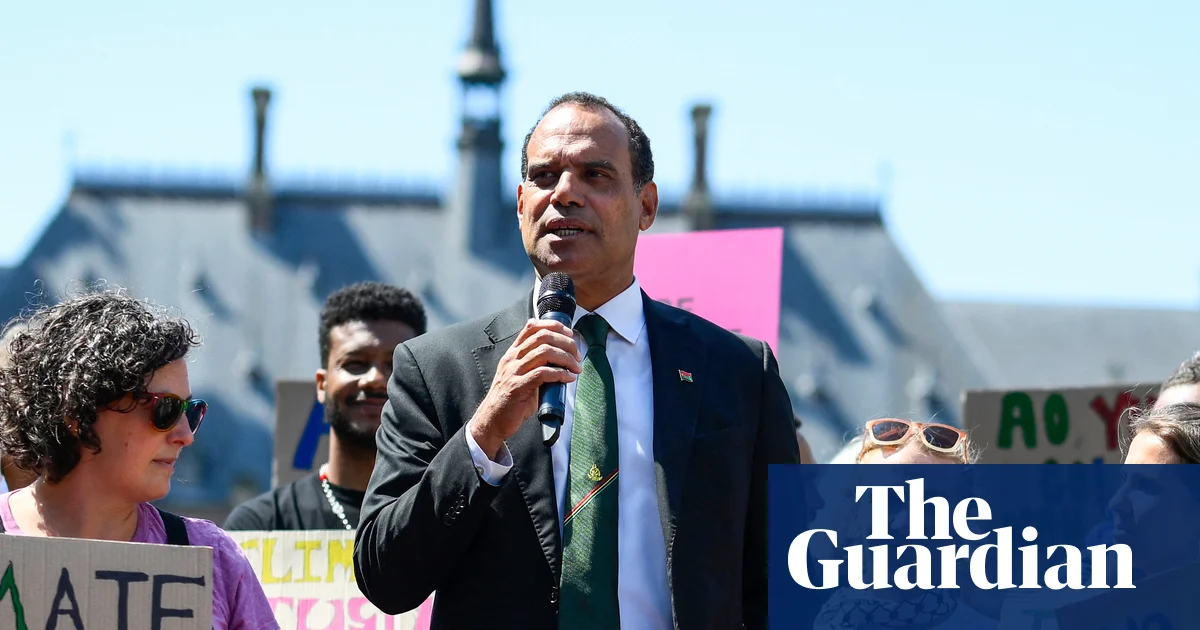
The Trump administration’s attempt to sink a UN resolution demanding countries act on the climate crisis has caused cuts to the proposal but hasn’t entirely killed it, according to the tiny Pacific island country spearheading the effort.
The US has demanded that Vanuatu, an archipelago in the south Pacific, drop its UN draft resolution that calls on the world to implement a landmark international court of justice (ICJ) ruling from last year that countries could face paying reparations if they fail to stem the climate crisis.
Vanuatu, one of several Pacific island countries that consider themselves existentially threatened by the climate crisis despite doing little to cause it, said it had to remove sections of its proposed resolution in the hope that a reduced version could be adopted at the UN in a vote later this month.
“Having the Trump administration actively intervening in the market to stop the phase-out of fossil fuels is very frustrating, it’s beyond what you’d expect a government to do,” Ralph Regenvanu, Vanuatu’s minister for climate change adaption, said.
“It’s going to have a huge harmful effect on the world and future generations.”
The resolution to fulfill the opinion issued by the ICJ is non-binding but “could pose a major threat to US industry”, the Trump administration said in guidance to American embassies and consulates last month.
“President Trump has delivered a very clear message: that the UN and many nations of the world have gone wildly off track, exaggerating climate change into the world’s greatest threat,” the US state department cable added.
This opposition, alongside those of other major fossil fuel producers such as Saudi Arabia and Russia, has resulted in the proposed UN resolution being watered down.
The resolution previously called for countries to submit a registry of the “loss and damage” they suffer from the impacts of an overheating world, such as storms, floods and droughts. This accounting of damages was strenuously opposed by the US, the world’s second-largest carbon emitter, which has long feared legal liability for its pollution, and has now been dropped.
However, a new version of the resolution’s draft shared for debate this week still outlines that UN member countries “comply fully with their obligations under international law as they relate to climate change” consistent with the ICJ ruling, and restrain the global temperature rise to 1.5C above preindustrial times via “a rapid, just and quantified phase-out of fossil fuel production and use”.
Regenvanu said: “The US asked us to withdraw the resolution, which is disappointing, and pushed back on the language.”
He added: “We are hoping the compromise on the loss and damage registry will mean some of that other language will stay in. It’s concerning but we don’t think it will derail the resolution completely, and I hope it will pass with more than just a simple majority.”
Vanuatu has been supported by a coalition of countries, including the Netherlands, Colombia, Barbados, Kenya, Jamaica and the Philippines in pushing for the non-binding resolution. But opposition to the resolution has been “more effective than from those in support”, said Regenvanu, who added that the EU has “not been as helpful as we expected”.
It is the US, though, that stands as the lead threat to the proposal and global climate cooperation more broadly. Trump has told other world leaders that clean energy is a “scam”, dismissed climate science as a “con job” and urged countries to remain wedded to the fossil fuels that are dangerously heating the planet.
His administration has torn up environmental rules in order to “drill, baby, drill” in the US while making extraordinary interventions internationally, such as withdrawing the US from the foundational UN climate treaty and taking control of Venezuela’s oil industry after seizing the country’s president, Nicolás Maduro.
Trump has sought to sabotage global initiatives aimed at cutting planet-heating pollution, such as a levy on shipping emissions, and excoriated the International Energy Agency for accounting for the climate crisis in its energy outlook scenarios.
Unlike the planned shipping carbon levy, Vanuatu’s UN resolution would not impose any specific fees or regulations on countries such as the US and will probably be ignored by the Trump administration should it pass.
But the resolution represents the “beginning of the world building up a body of law for when the politics are different and the world takes more serious action on climate”, said Noah Gordon, an expert in global climate politics at the Carnegie Endowment for International Peace. “Judges and lawyers will look back at this as the foundation of international climate law that has teeth.”
He added: “The Trump administration has tried to blow up climate diplomacy but other countries are still trying to move forward. We are seeing a big divide between countries that produce fossil fuels, and those who consume them.”
While the world’s attention is drawn to Iran after the US and Israel’s attack, on the heels of other armed conflicts in Ukraine and Gaza, the primary threat to many countries is the climate crisis, said Regenvanu, who noted that a tropical cyclone in 2015 wiped out 64% of Vanuatu’s GDP.
More recent storms, fueled by hotter ocean and air temperatures, have caused similar economic and humanitarian catastrophes in other countries. Such disasters are taking a growing toll in the US, too, where home insurance is becoming unavailable in some places due to a growing barrage of extreme weather events.
“This is the single greatest threat to our continued existence, security and livelihoods,” Regenvanu said.
“The world needs to be brave and move away from entrenched fossil fuel interests and find a path for future generations. But the state of multilateralism is pretty terrible at the moment, it’s at one of the lowest ebbs ever. This is reflected in climate negotiations, too.”
A US state department spokesperson said that the US asked Vanuatu to “withdraw this performative resolution that if adopted, could pose a major threat to US industry.
“The United States did not support seeking this advisory opinion from the ICJ and has strong concerns about its conclusions,” the spokesperson added.
“Furthermore, the ICJ’s advisory opinion does not provide a basis for the demands included in the draft resolution, which could have broader legal and economic impacts.”