The government of Ecuador on Wednesday declared Cuban ambassador to Quito Basilio Antonio Gutiérrez García and the embassy’s entire diplomatic mission personas non grata, giving them all 48 hours to leave the South American country.
At press time, the Ecuadorian government has not provided specific details on its decision to expel the communist regime’s diplomats from the country. In a brief statement, Ecuador’s Foreign Ministry said that the decision was made in accordance with Article 9 of the 1961 Vienna Convention on Diplomatic Relations, which allows states to declare diplomats of other countries as personas non grata any time and without having to explain its decision. Ambassador Gutiérrez García – and all other Cuban diplomatic, consular, and administrative staff stationed in Ecuador – were given 48 hours to depart from Ecuador.
The statement reads in part:
By virtue of this decision, adopted within the framework of the Vienna Convention on Diplomatic Relations and the sovereign powers of the Ecuadorian State, a period of 48 hours has been granted, in accordance with diplomatic practice, for the Ambassador and all officials of that Diplomatic Mission to leave the national territory.
The Government of Ecuador reaffirms its commitment to respect international law and defend the highest national interests.
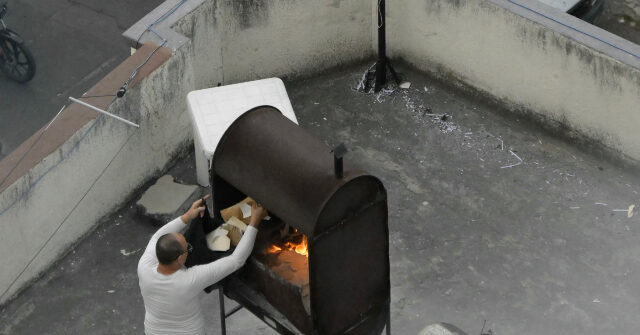
Moments after the Foreign Ministry issued the announcement, President Daniel Noboa published a video on social media that, according to local and international outlets, contains footage of Cuban embassy personnel burning documents atop the embassy’s roof. President Noboa described the video as “a paper barbecue.” The Associated Press noted that it witnessed the burning.
According to the left-wing propaganda network Telesur, the list of expelled Cuban diplomatic personnel alongside Ambassador Gutiérrez García includes Minister Counsellor Samuel Bibilonia Ballate, Consul Vladimir González Fernández, First Secretary Ivette Franco Senen, Press Attaché Sonia García, and every other secretary, civilian attaché, and member of the Cuban embassy.
Local outlets reported that, in addition to expelling the Cuban diplomats from Ecuador, President Noboa signed a decree on Wednesday ceasing José María Borja López’s functions as Ecuador’s ambassador to Havana, a position he had reportedly held since 2021.
The Cuban communist regime rejected Ecuador’s decision to expel its diplomats “in the strongest terms” in a statement issued by its Foreign Ministry. According to the Cuban regime, Ecuador’s Foreign Ministry informed Cuba of its decision through a diplomatic Note Verbale, describing it as an “unfriendly and unprecedented act that significantly damages the historic relations of friendship and cooperation between both countries and peoples.”
“The Ministry categorically reaffirms that the staff of the Cuban Embassy in Quito, as established by the 1961 Vienna Convention on Diplomatic Relations, has strictly complied with Ecuador’s laws and regulations without interfering in the internal affairs of that State,” the statement read in part.
The communist regime claimed that it “does not seem coincidental” that Ecuador decided to expel the Cuban diplomats from the country amid the “intensification” of the United States’ “aggression” against Cuba and claimed that the U.S. is allegedly pressuring other countries in the region to join its purported policy. The Cuban regime justified its accusations within the context of an upcoming “Shield of the Americas” Summit that President Donald Trump will host in Florida on March 7.
White House press secretary Karoline Leavitt explained this week that the Summit’s aim is to to promote “freedom, security, and prosperity in our region.” President Daniel Noboa is among the region’s U.S.-allied heads of state who were invited to the upcoming event, as were Argentina’s Javier Milei, El Salvador’s Nayib Bukele, Paraguay’s Santiago Peña, and others. Noboa confirmed his participation at the upcoming event this week.
“Cuba is convinced that the Ecuadorian people will defend the bonds of solidarity and brotherhood with Cuba,” Cuba’s Foreign Ministry wrote.
Christian K. Caruzo is a Venezuelan writer and documents life under socialism. You can follow him on Twitter here.