Concern among officials is rising as birds are showing up dead by the hundreds across multiple states in the last week.
Last month, more than 1,100 geese were found floating lifeless in waters across New Jersey, sparking worry among officials and residents alike.
A majority of the birds were Canada geese and brant geese and they were found dead in multiple locations along the Jersey coast.
Most recently this week, more dead geese were reported in Woodstown in Salem County in southern New Jersey.
Altogether, the New Jersey Fish & Wildlife (NJFW) service has recorded 4,370 dead or sick birds across 20 municipalities in eight counties.
While officials suspect bird flu is behind the deaths, some testing has come back negative for avian influenza, leading experts to posit the freezing temperatures or another, unconfirmed bird-related virus is to blame.
Woodstown Police Department posted on Facebook: ‘Woodstown Borough officials are aware of reports of dead geese at Woodstown Memorial Lake.
‘As a precaution, residents are asked not to approach any geese in or around the area due to recent reports of highly pathogenic avian influenza (HPAI) in south Jersey.
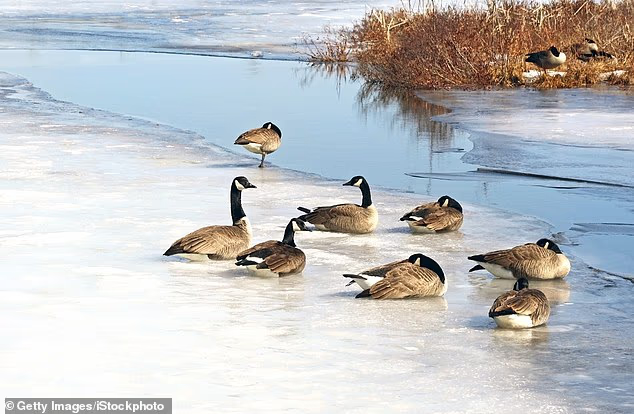
A majority of the birds were Canada geese and brant geese (stock image)

Altogether, the New Jersey Fish & Wildlife (NJFW) service has recorded 4,370 dead or sick birds across 20 municipalities in eight counties
‘While HPAI can infect humans, the U.S. Centers for Disease Control and Prevention has declared that the ongoing HPAI outbreak is primarily an animal health issue that poses low risk to the health of the general public.
‘While the risk is low, we advise members of the public to limit contact with dead wildlife and to keep children and pets away.’
Bird mortalities (incidents of 20 or more) have been reported in municipalities in Atlantic, Camden, Gloucester, Hunterdon, Middlesex, Monmouth, Ocean and Salem counties.
Residents living near Alcyon Lake in Gloucester County, where 50 to 75 geese were found dead in February, told ABC6 they noticed the birds, usually loud and energetic, were lethargic and looked unwell.
Marisa Brusco said she saw geese floating in the lake and Joie Shaw said he saw a sick goose in his backyard ‘just laying there with his head flopped over.’
Wildlife pathologist Patrick Connelly, who works with New Jersey’s Department of Environmental Protection, told NJ.com: ‘With migratory waterfowl coming into the state this time of year and large congregations of flocks, we have many susceptible hosts in close quarters and this disease can spread rapidly and kill these animals quickly.
‘I do suspect that the recent weather has had an effect here, with the primary effect being that it is causing birds to congregate in limited open water sources, so we have large numbers of waterfowl in close contact.’
New Jersey has faced several freezing winter storms, causing many open water sources to freeze over and become inaccessible to geese.
This forces more birds to crowd for limited water resources.
Officials have yet to confirm what all the birds have tested positive for and what their cause of death is, though avian flu is highly suspected.
Dr David Perlin, the chief scientific officer and executive vice president of Hackensack Meridian Health’s Center for Discovery and Innovation in New Jersey, said: ‘We don’t just ignore these things – we take them seriously,’ though Perlin added that it was unlikely the virus infecting and killing the birds will make the jump to humans.

Last month, more than 1,100 geese were found floating lifeless in waters across New Jersey
However, science writer David Quammen, who predicted the Covid-19 outbreak in his book Spillover seven years before the pandemic swept the globe, told Daily Mail last year that bird flu poses the biggest risk for the next pandemic.
The H5N1 strain of bird flu was first detected in the US in 2022 and has been confirmed among cattle, chickens, cats, raccoons, skunks, wild dogs, bears and dolphins.
According to the CDC, there have been 71 cases of H5N1 detected in humans since February 2024 and two people have died. There is no known human-to-human transmission and the current threat to public health is low.
Forty-one cases were in connection to exposure to dairy herds; 24 were in connection to poultry farms; three cases involved exposure to other animals; and three cases contracted the virus from an unknown source.
In the last 30 days, the USDA has reported bird flu outbreaks in 31 backyard flocks and 36 commercial flocks, affecting 11.5 million birds.
No outbreaks among cattle have been detected in the last 30 days, according to USDA data.
In February and March the USDA also reported detection of bird flu in wild birds in Colorado, Ohio, New York, California, Florida, New Hampshire, Alaska, New Mexico, Kentucky, Minnesota, Maryland, Indiana, Connecticut, Massachusetts, Missouri, Maine, Florida, Wyoming, Arizona, Iowa, West Virginia, Tennessee, Kansas, Oklahoma, North Carolina, Pennsylvania and Nebraska.