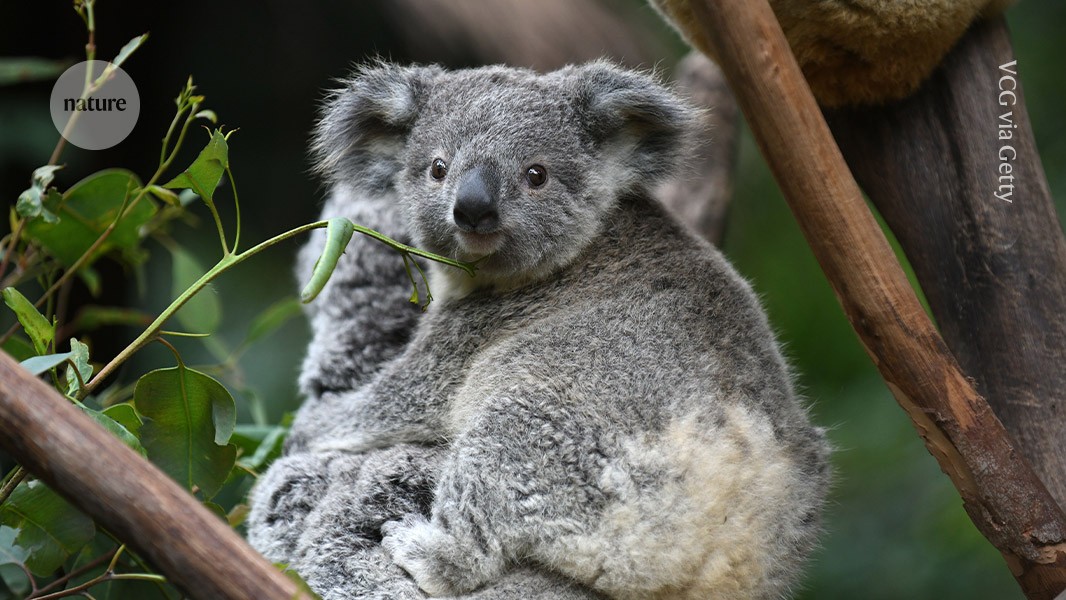
In some parts of Australia, koalas were hunted nearly to extinction by the early twentieth century.Credit: VCG via Getty
Once-threatened koala populations in parts of Australia are showing surprising signs of genomic recovery, according to a study that establishes a new way to assess the health of a population. It suggests that even species pushed to the brink of extinction can recover lost genetic diversity.
In the late nineteenth and early twentieth centuries, millions of koalas (Phascolarctos cinereus), marsupials native to Australia, were killed for their fur, pushing them close to extinction in the state of Victoria. Conservation strategies helped to restore their numbers, but the population was left with low genetic diversity. It is thought that such genetic bottlenecks reduce a species’ ability to evolve to protect itself from diseases or environmental change.
Once genetic diversity is reduced significantly, says study co-author Collin Ahrens, it’s rare to see it recover. “In conservation genetics, we think the population with a high genetic diversity is healthier,” says Ahrens, who is the principal scientist at Cesar Australia, an independent research company in Melbourne.
But in their study, published in Science today1, Ahrens and his colleagues find that koalas in Victoria are doing better than expected when taking into account their effective population size — the number of individuals that breed and contribute to the next generation’s gene pool. The team found that the effective population of koalas in Victoria has jumped substantially in the past few decades, despite previously collapsing by more than 90%.
“The study provides a road map for how to integrate genetic and evolutionary knowledge into conservation planning,” says Mathew Lott, a geneticist at the Australian Museum in Sydney. This should help managers to identify populations at genetic risk of extinction and take steps to reverse that, he says.
Bottleneck bounceback
By the 1920s, there were only between 500 and 1,000 koalas in Victoria. To protect the species from extinction, a few individuals had already been moved to island refuges. In the mid-twentieth century, their descendants were used to repopulate mainland Victoria, leading to a surge in the koala population: the state was home to nearly half a million individuals by 2020. But because the population had originated from such a small pool, it had low genetic diversity.
The research team reconstructed the history of koala population growth in Victoria and two other states using genomic data from 418 individuals across 27 populations. They found that the rapid population expansion in Victoria led to an increase in recombination — a process in which the DNA from two parents gets shuffled to form new sequences in their offspring. This leads offspring to have different combinations of genes from their parents, increasing genetic variation.
The team found an increase in rare genetic variants in the Victorian koala genomes. “If we include recombination in our analyses, then the Victorian populations are recovering in a way that we weren’t reporting before,” Ahrens says.
“A larger population means more individuals are reproducing, which in turn means more recombination events occur. Over time, natural selection spreads beneficial combinations and gets rid of harmful combinations,” he adds.