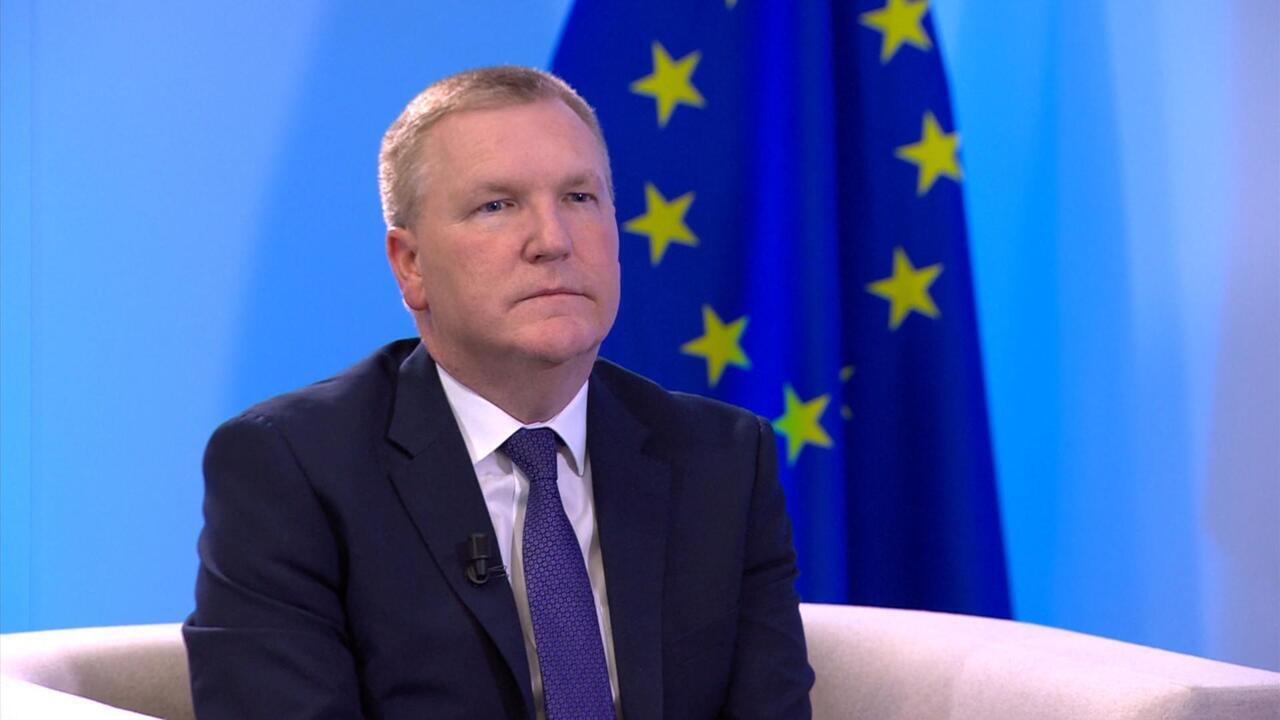
Talking Europe sits down at the EU Commission with a man whose work goes to the very heart of what the EU sees as its core values. Michael McGrath is the Commissioner responsible for democracy, justice, the rule of law and consumer protection. His work concerns not just breaches of the rule of law in EU member states, but also the whole online dimension of democracy, including disinformation and foreign interference. Indeed, he now leads a new European Centre for Democratic Resilience.
We start with the war in the Middle East and ask McGrath whether he believes, as France and Spain have said, that the US-Israeli attacks on Iran are outside international law?
“Well, ultimately, it is for the international courts to give a definitive determination on that legal question,” he answers. “But I think we have to remember here the absolute brutality of the Iranian regime and the brutality that they have perpetrated on their own people over many decades, including in recent weeks and in recent months.”
“There is an obligation on all parties now to this conflict to behave in a responsible way; to minimise damage and civilian casualties,” McGrath goes on. “It is appalling to see innocent lives being lost. And that must be avoided at all costs.”
On the Iranian political dimension, McGrath states that “the outcome that we want to see here as a European Union is a system of governance in Iran that meets the needs of the Iranian people, and that they can be better served and better supported by a new form of government. Ideally, we would like to see a democratic government, a form of government that meets their needs and treats them in a far better and more humane way than the current Iranian regime has been doing for a long time.”
On the obvious split between Spain and France on the one hand and Germany on the other when it comes to responding to the US and Israel, McGrath points out that the EU treaties make it clear that the Common Foreign and Security Policy “is determined on the basis of unanimity, at European Council level. So it’s not for the European Commission or the External Action Service to arrive at a policy position and represent the European Union. It is led by the member states, and we have to be given a mandate to represent and reflect that body of opinion. Of course, on any significant international issues, it is difficult to achieve unanimity. That is the reality that we face.”
‘Rule of law is not an optional extra’
Turning to rule-of-law issues in Hungary and Slovakia, McGrath reminds us that “the rule of law is not an optional extra within the European Union. It is a binding obligation of EU membership”. On Hungary, “a number of significant judgments are expected in the period ahead from the Court of Justice. And we have the Article 7 procedure that was triggered by the European Parliament back in 2018 – but the EU Council remains in ownership of that particular process”.
When it comes to Slovakia, McGrath says that the Commission has “received responses from the Slovak authorities in relation to our two letters of formal notice, which constitute the initiation of an infringement process. We are considering those replies that we have received. And of course, action and positive movement is what we actually need to see, in order for us to change our position. There is a way back (for the Slovak authorities) to address and repair these issues”.
With elections coming up in Hungary and in Denmark, we turn to the question online disinformation and election interference.
“I’m very pleased that the new European Centre for Democratic Resilience is now up and running and with the full support of the member states of the European Union,” McGrath avers. “And its central purpose really is to act as a hub, as a point of coordination, to join together all of the good work that is happening within the (EU) institutions and also at the level of the member states. We know that there has been foreign interference in elections in Europe. We also know that with the power of technology and the extraordinary power of artificial intelligence, the ability to spread disinformation does present real challenges for our democracies.”
Indeed, aren’t existing EU tools falling behind those very rapid advances in AI and deepfakes?
“We need guardrails and regulatory parameters, and in particular on AI”, McGrath replies. “And we need to keep this under review. If we need to do more, then we have to be willing to make such proposals. But we do have a very strong toolbox, including support for free and independent media, support for civil society and support for independent justice systems. All of these are essential foundations of a free, open and democratic society, and we need to continue to invest in them.”
Programme prepared by Oihana Almandoz, Aline Bottin, Isabelle Romero, Perrine Desplats and Paul Guianvarc’h