The Weekly Wrap: Trump’s Productivity Boom Meets the Iran War Oil Shock
Welcome back to Friday. This is the Breitbart Business Digest weekly wrap of business and economic news, where we strive to increase output despite no increases in our newsletter’s payroll.
This week, Jobs Friday returned with a jump scare entrance after taking several months off due to government shutdowns. The government said that your bosses are making you work harder and keeping a larger share of the upside for themselves—and this has been going on for years. Energy prices soared and stocks had a volatile week as investors monitored the situation in Iran, which President Trump started bombing seven days ago.
Stock market numbers are displayed on the floor of the New York Stock Exchange during morning trading on March 6, 2026, in New York City. Stocks continue to tumble with all three major indexes continuing to dip with the Dow Jones losing nearly 800 points at opening as oil prices raise due to concerns of the war with Iran and a weak jobs report release. (Michael M. Santiago/Getty Images)
The Jobs Report Bombs
The range of estimates for this week’s jobs report was unusually wide going into Friday. Econoday’s estimates ranged from a gain of 35,000 to a huge increase of 125,000. That typically suggests that there’s a lot of uncertainty about what’s happening in the labor market. As it turns out, even that range was not wide enough to capture what actually happened.
The Labor Department said that the economy shed 92,000 jobs in February, and it revised down the estimates for January and December by a total of 69,000. December went from an estimated gain of 48,000 to a loss of 17,000. While January still stands out as a strong month for hiring, with jobs rising 126,000, there’s no escaping the conclusion that this was an ugly report.
And it isn’t just one month of ugliness. Payrolls have contracted in three of the last six months, bringing the monthly average down to a loss of 1,000. The three-month average is slightly better, showing a gain of around 6,000, despite two months of declining payrolls. Over the past twelve months, jobs have declined five times, and the monthly average gain has been just 15,000.
Amazingly, however, the unemployment rate has barely changed. We were at 4.2 percent in February of last year, and now we’re at 4.4 percent. A big reason for that has been the Trump administration’s immigration policies. The civilian labor force has grown by just 42,000 over the past 12 months while employment has increased by 156,000. That slow pace of labor force growth is partly due to retirements from our aging workforce, but it is mostly due to a large number of deportations and self-deportations. The number of employed foreign-born workers has contracted by 519,000, and the foreign-born population has contracted by 741,000. Over the year, native employment has grown by 128,000.
In other words, the economy is not creating very many jobs, but that’s largely because there are few net new workers to create jobs for. We’re operating a full employment economy, so we should expect the number of jobs we add to be very low and perhaps even zero.
Productivity Is Surging
For years, whenever anyone on the right proposed dramatically scaling back immigration, a chorus of establishment economists would announce that this would be a drag on economic growth. The argument was that absent some kind of miraculous improvement in productivity, the only way for the economy to grow was to grow the population. And with fertility low and declining, the only way to do that was to import more workers.
As it turns out, we have managed to grow the economy rapidly by increasing productivity. No miracles necessary. Instead, the economy is adapting to a smaller workforce by improving the output of the workers we have. This week, the Labor Department said that productivity in the fourth quarter rose at a 2.8 percent annual rate and at a 5.4 percent annual rate in the third quarter. What’s more, the productivity growth over the current business cycle was revised up to 2.2 percent per year, well above the 1.5 percent in the previous cycle.
While it is tempting to say this is being driven by AI, it’s probably too early for that to be playing too big of a role. The bigger drivers are likely linked to Trump administration policy. As we’ve already discussed at length, we’re no longer supplying businesses with as many foreign workers, so they’re turning to innovation and investment to fuel growth. Similarly, Trump’s trade policies are likely pressuring companies to improve their bottom lines by becoming more efficient. Tax policy is incentivizing capital expenditures, driving technology investment. Energy policy is no longer acting as a speed bump for the economy. Deregulation—that is, setting fire to rules that raise compliance costs, deter investment, and limit competition—is freeing up the economy’s ability to produce goods and services.
Productivity growth is the key to healthy economic growth. It also explains many of the puzzles of our economy. How could companies pay hundreds of billions in import duties yet see impressive profit growth without passing the costs on to customers? Productivity improved. How is GDP growing so rapidly even though employment growth has slowed? Productivity improved. How can wages be rising rapidly without pushing up prices? Productivity improved.
So far, a lot of the improvement in productivity has accrued to the benefit of shareholders and business owners, which explains why stocks have been doing so well. Labor’s share of national income has actually fallen to an all-time low in records stretching back to 1947. In other words, the bosses are getting a lot more out of their workers, and the workers are only getting a bit more out of the bosses. That sounds like a raw deal, but it is really a promising development. It means there is room for a lot more upside for wages and a lot of capital to be invested to keep productivity growing.
Hopefully, the folks at the Federal Reserve and the Congressional Budget Office notice and get around to updating their estimates of the long-term growth potential of the U.S. economy. The assumption that we can only grow at around 1.8 percent looks increasingly out of touch with reality. Right now, the official projections of everything about our economy and our government budgets are nearly useless because they are doing the equivalent of planning a road trip, assuming a national speed limit of 55 miles per hour on roads where we can legally drive 70 miles per hour. We’re looking at you, Christopher Waller, Stephen Miran, and Michelle Bowman.
The Price of Oil Is Too Damn High
The price of oil rose above $92 a barrel on Friday after President Trump said that the end of the war will require the “unconditional surrender” of Iran. This is uncomfortably close to the three-year high mark of $95, a line that matters because history suggests that movements above the recent three-year high have contractionary effects on the economy and may feed into higher inflationary expectations that frighten the Fed into adopting a more restrictive stance for monetary policy.
Oil prices were much higher after Russia invaded Ukraine, jumping to $130 a barrel at one point. President Biden, however, was not really all that deeply bothered by high oil prices. When it became politically inconvenient, he used the strategic petroleum reserve to push gasoline prices back down. But his long-term economic vision was not hampered by pricey fossil fuels. If anything, rising oil was seen as speeding America along toward the inevitable transition to green energy.
President Trump’s economic agenda, however, really does require cheap and abundant energy. Oil prices near $100 a barrel will undermine economic growth. What’s more, sharply higher gas prices will act as a brake on the pace of growth and consumer spending in the near term. Remember all those “I did that!” Biden stickers people were putting on gas pumps across America a couple of years ago? Now imagine them with Trump’s countenance instead. You don’t want to be a Republican candidate for Congress in November with gas running above four dollars a gallon.
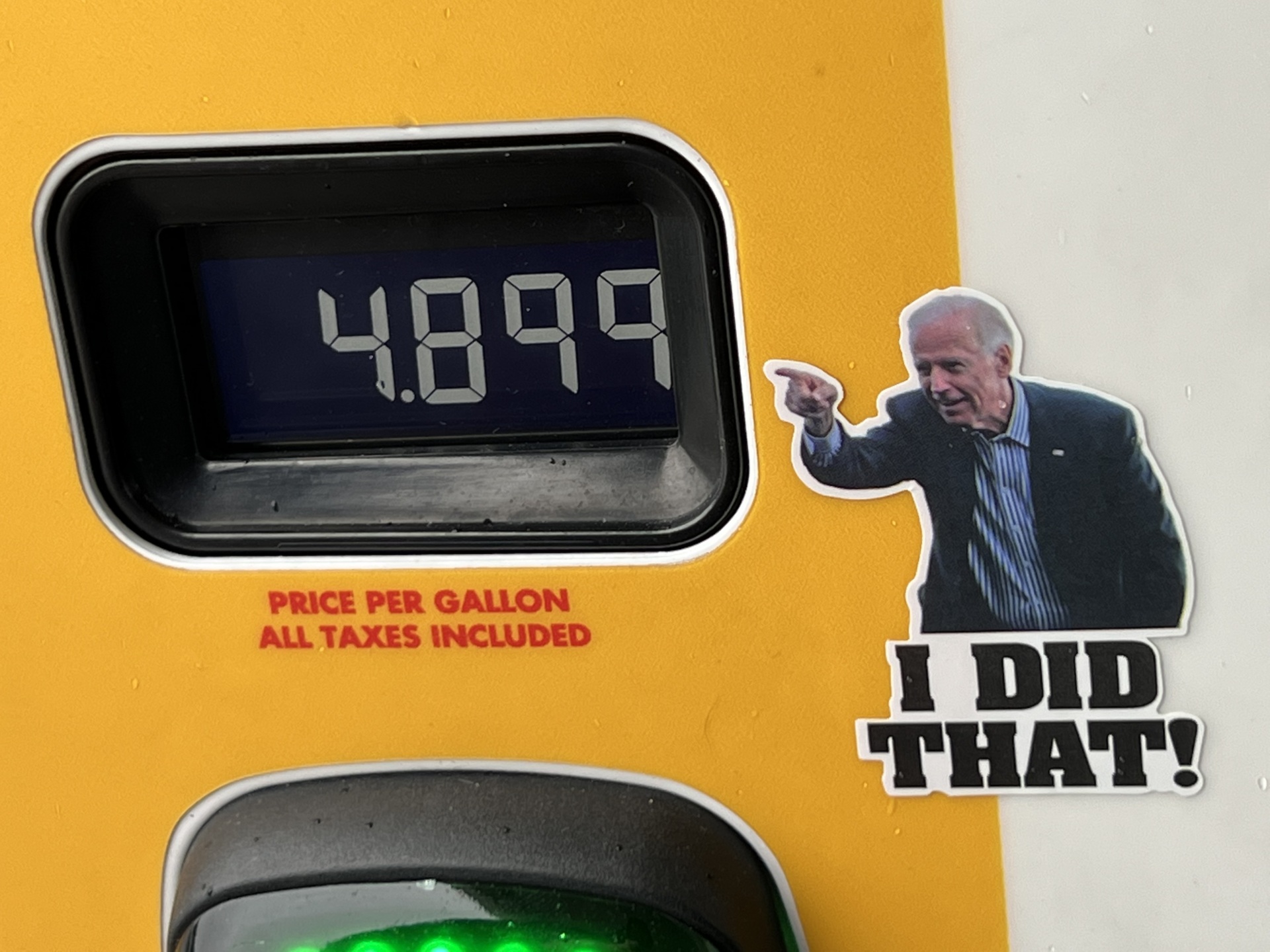
A satirical sticker critical of President Joe Biden, with text reading “I Did That,” is seen on a gasoline pump in Lafayette, California, on December 29, 2021. (Smith Collection/Gado/Getty Images)
Many Fed officials seem to be always looking for an excuse to keep monetary policy from cooperating with Trump’s growth program, and the increase in oil prices is providing them with exactly what they need. Even though traditional monetary policy would say you should look through a temporary supply crunch, Fed officials will say that high gasoline prices risk pushing inflation higher by de-anchoring inflation expectations. This is one of the amazing things about the “expectations channel.” It allows monetary policy makers to turn a deflationary development—like high energy prices or the imposition of higher tariffs—into an inflationary risk. No wonder the theory of inflation expectations is so popular in the Eccles building.
Perhaps some of the more rational voices on the Federal Open Market Committee will notice that while U.S. households had a lot of excess savings the last time oil prices spiked—which meant higher gasoline prices could be accommodated into household budgets without dampening spending elsewhere—that’s not the case this time. As a result, rising oil prices should be treated as a drag on the economy rather than a danger to price stability. Michelle Bowman, Christopher Waller, and Stephen Miran—please read your incoming messages!
Investors might want to consider that, despite President Trump’s “unconditional surrender” language, the war might wind up ending with something closer to a conditional surrender. Trump knows the value of starting with high expectations and stringent demands that can be relaxed later. Remember the Liberation Day tariffs? When you’ve launched a war to destroy a country’s military capacity, it’s probably a good idea to let the enemy’s leadership and troops believe you are a bit reckless and willing to go much further than they expected. That doesn’t rule out negotiations later.
Bubble, Bubble, Toil and Trouble: Happy Birthday, Alan Greenspan!
Alan Greenspan was born 100 years ago today in New York City’s Washington Heights. After failing to build a musical career around his saxophone and being found medically unfit for military service, he turned instead to economics and the philosophy of Ayn Rand. He abandoned the pursuit of a PhD in economics to work in research at Brown Brothers Harriman, then later left to form his own economics consulting firm. He served as a domestic policy adviser to Richard Nixon’s presidential campaign and later as chairman of the Council of Economic Advisers in Gerald Ford’s White House.
Ronald Reagan appointed him chairman of the Federal Reserve, a job that eventually earned him the title of “the Maestro” from an adoring financial press. His tenure at the central bank stretched across four presidencies, two financial bubbles, two recessions, the rescues of Mexico and Long-Term Capital Management, two foreign currency crises, the rise of China into an economic and military superpower, and 66 changes to the fed funds rate—not counting the murkier moves from his early years, when the Fed did not even announce clearly what it was doing.
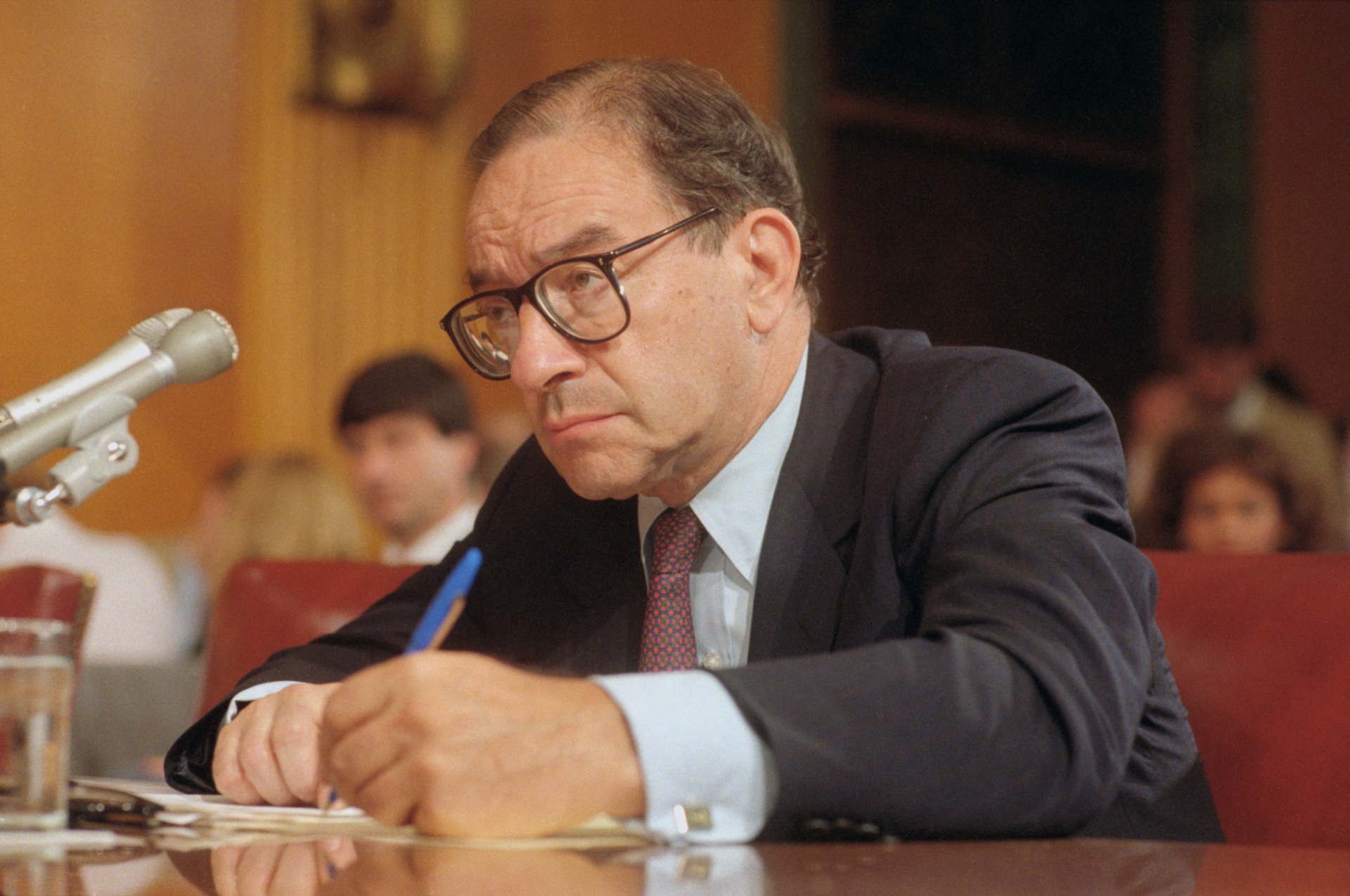
Alan Greenspan, nominated to replace Paul Volcker as chairman of the Federal Reserve Board, testifies before the U.S. Senate Banking Committee in July 1987 in Washington, DC. (Bettmann/Getty Images)
Monetary policy in the Maestro era often seemed less a matter of adjusting reserves and interest rates than of conducting the mood music of the American economy. If financial markets looked feverish, Greenspan would sometimes play a few bars from the irrational exuberance songbook. More often, however, his favorite movement was accommodation, which helps explain why he was so beloved on Wall Street and in Washington.
Greenspan was the last of the opaquely oracular Fed chairmen, famously remarking, “If I seem unduly clear to you, you must have misunderstood what I said.” He had the kind of visage people associated with deep and hard-won wisdom, so that even when his mumbled circumlocutions were utterly inscrutable, the assumption was not that he had failed to communicate but that the rest of us had failed to understand. This strategy of bafflement was either so successful that no one dared imitate it or such a spectacular failure that it was immediately abandoned.
If that sounds a bit mean-spirited, we’ll remind you that this is not a eulogy, and you cannot speak ill of the dead when someone is still alive—even if they are 100. And so let us salute the Maestro on his birthday: a man who spent a lifetime adding liquidity to markets while subtracting clarity from language.