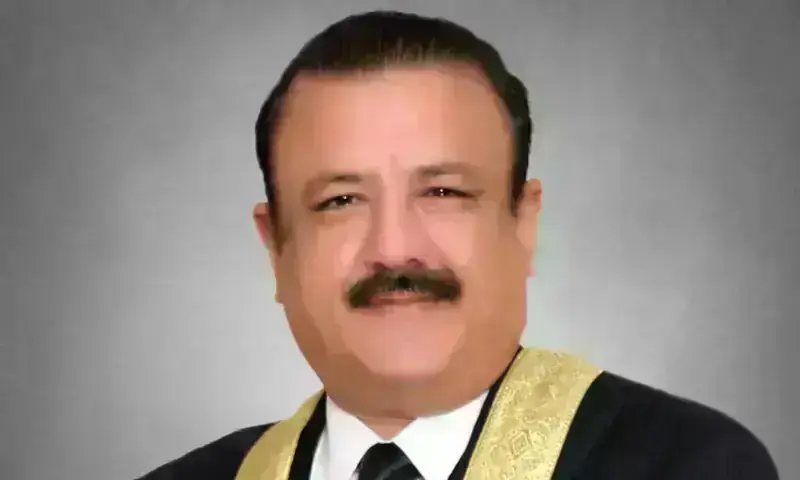
ISLAMABAD: Former Islamabad High Court (IHC) judge Tariq Mehmood Jahangiri moved the Federal Constitutional Court on Monday against his removal from the IHC.
He was removed as an IHC judge in December last year by President Asif Ali Zardari in compliance with an IHC order, which declared that his elevation to the court was “without lawful authority”.
A division bench comprising IHC Chief Justice Sardar Muhammad Sarfraz Dogar and Justice Muhammad Azam Khan had announced the verdict on a plea challenging the validity of Jahangiri’s law degree and, by extension, his appointment as a high court judge.
The plea was filed by a lawyer, Mian Dawood, who has been named as one of the respondents in Jahangiri’s petition filed today. Apart from Dawood, the federation of Pakistan, president of Pakistan, Judicial Commission of Pakistan, parliamentary committee (defunct) for the appointment of judges to superior courts, Higher Education Commission and University of Karachi have also been nominated as respondents in Jahangiri’s petition.
The petition, seen by Dawn, contended that an “orchestrated campaign” against Jahangiri had culminated in the removal of a constitutionally appointed high court judge through a writ of quo warranto passed by his own court.
But, it continued, the development was not a “personal trragedy” for Jahangiri.
“He is satisfied with the public service he has rendered and his adherence to the dictates of his conscience and his constitutional oath,” the plea said, adding that the development, however, was “a mortal blow to the independence of judiciary as enshrined in the very preamble and Articles 2-A, 37 and 175 of the Constitution”.
If not remedied, it “shall surely serve as a grim lesson for serving and future judges”, the plea stated.
The plea further stated that the IHC order the led to Jahangiri’s removal “proceeds on certain assumptions as opposed to appreciating the record that was before the court determine whether” he met the constitutional qualifications to become a judge.
“The impugned order incorrectly assumes that the petitioner was ‘not holding a valid LLB degree, which is a prerequisite for enrolemnt as an advocate’“, plea said.
It further quoted the IHC order as stating that when Jahangiri “could not be considered as an advocate, then consequently he was not eligible for elevation as a judge of a high court in terms of the requirements of Article 175-A of the Constitution“.
But, the plea contended, the requirements for the appointment of a high court judge were described in Article 193 of the Constitution and not Article 175-A.
And the said requirements did not list LLB degree as one of the requirements, it added.
Moreover, from the date of the issuance of the IHC order till the passing of Jahangiri’s plea in the FCC, there had been no declaration by any competent authority or court of law that declared his degree invalid, the petition further stated.
It said the University of Karachi, which awarded Jahangiri his law degree, had taken the position before the IHC that the degree was declared invalid for the first time in 2024.
“Consequently, the assumption in the impugned order that the petitioner did not possess a valid degree at the tome of his elevation is completely contrary to the record that was placed before the court. At no stage, any party before the court asserted that the Jahangiri’s degree was invalid in the year 2020 when he was considered for elevation.”
The plea further contended that IHC orde relied on KU’s declaration that the degree was invalid. But the declaration, the plea argued, had no legal effect as it had been suspended by the Sindh High Court.
And not just that, the order “also proceeds to give the declaration a retrospective effect”.
The petition further argued that the IHC division bench did not have the “jurisdiction to make any declarations regarding the validity of Jahangiri’s degree. Consequently it proceeded to make assumptions regarding the validity of his degree”.
Moreover, the bench also made assumptions regarding Jahangiri’s licence as an advocate, the plea said.
“It asserts that Jahangiri ‘could not have been considered as an advocate’.”
But, it was a matter of record that the relevant bar council was present before the IHC and repeatedly asserted that the petitioner was their licencee and no complaint had ever been received regarding the his licence.
“The representatives of the bar council urged the court to summon the record of the bar council … The bench, instead of relying on the record of the bar council, deemed it appropriate to assume that Jahangiri could not have been considered as an advocate.”
The plea argued that the order, “being solely based on assumptions and conjectures is unconstitutional, devoid of any constitutional basis and coherence, and beyond the quo warranto jurisdiction of the high court”.
More to follow