Listen to this article
Estimated 6 minutes
The audio version of this article is generated by AI-based technology. Mispronunciations can occur. We are working with our partners to continually review and improve the results.
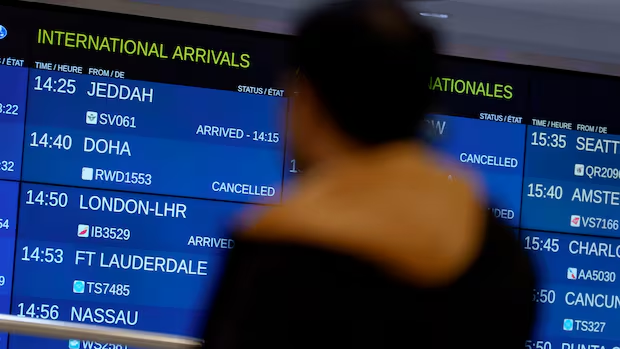
Many Canadians travelling abroad have run into challenges getting home in recent months, after unforeseen events in Latin America and the Middle East disrupted flights on short notice.
Airlines have scrambled to respond to circumstances beyond their control, leading to delays and flight cancellations.
“The current geopolitical situation in several parts of the world indeed gives rise to a lot of disruptions that are ‘outside the carrier’s control,’ as they are either situations of war or political instability,” Vincent Correia, a professor of air law at McGill University, said via email.
Yet some customers have reported cases in which they say their carriers have fallen short of what Canada’s Air Passenger Protection Regulations (APPR) require in those circumstances.
Anyone preparing to travel may wish to familiarize themselves with the APPR, which sets out what airlines must do if a flight is cancelled or delayed because of uncontrollable events — a scenario that has played out repeatedly this year.
Still, some observers question how much consumers can truly rely on airlines to meet the regulatory requirements when disruptions occur.
“Clutching your pearls is one thing, but coming home is another,” said Max Johnson, a Winnipeg-based tourism consultant.
Repeated upheavals

In early February, Cuba reported a fuel shortage that meant incoming airplanes would not be able to refuel there. Canada’s major airlines abruptly wound down service to the island nation and arranged a corresponding wave of repatriation flights.
Canada’s airline regulator, the Canadian Transportation Agency (CTA), told CBC News on Thursday it was not aware of “systemic issues” stemming from the Cuba flight disruptions that would require an investigation.

Later that month, the killing of a cartel leader in Mexico on Feb. 22, sparked an outbreak of violence in multiple parts of the country, including the Pacific Coast tourist destination of Puerto Vallarta. Canadian airlines temporarily cancelled service there but resumed flights on Feb. 24.
Some Canadians reported difficulties getting back on track in a timely manner, and the CTA has since said it is investigating disruptions involving Puerto Vallarta.

More recently, the attacks U.S. and Israel launched against Iran have led to counter-attacks and created dangerous conditions in the skies over multiple countries in the region.
Foreign Affairs Minister Anita Anand said on Friday that more than 108,000 Canadians had registered with Global Affairs Canada (GAC) in the Middle East, and about 3,500 of them were seeking help leaving the region.
Airlines and the APPR
The APPR sets out the expectations for airlines when situations happen that are outside of their control, such as extreme weather, emergencies, or security, labour and airport issues.
Extreme weather may seem less dramatic than some of the headline-making geopolitical crises, but it can still be highly disruptive. Johnson said two of his trips were disrupted within a few weeks of each other this winter because of major snow events.

Ene Underwood, CEO of Habitat for Humanity Toronto Greater Toronto Area, was stranded in Dubai during a layover as war broke out across the Middle East. Global Affairs Canada has secured seats on one U.S. flight out of Beirut but has warned it has limited ability to assist in an active war zone.
When uncontrollable events unfold, Canadian airlines are required to rebook passengers, free of charge, on a replacement flight — on the original airline or another that holds a commercial agreement with that original airline — within 48 hours of the departure time on the original ticket.
If the airline cannot make that happen within 48 hours, passengers can choose to be refunded or have the airline do the following:
- Large carriers must rebook passengers, free of charge, on the next available flight on any airline, that is travelling “on any reasonable air route from the airport at which the passenger is located” — or at another airport within a reasonable distance — to get them to their destination. (Air Canada, WestJet, Air Transat, Sunwing Airlines, Porter Airlines and Flair Airlines are considered large airlines under the APPR.)
- Small carriers must rebook passengers, free of charge, on the next available flight on the original airline or another airline with a commercial agreement, that is travelling “on any reasonable air route from the airport at which the passenger is located” to get passengers to their destination.
McGill University’s Correia said current events in the Middle East may lead many passengers in that region to opt “for a rebooking on the next available, confirmed flight” rather than a refund.
He added that the APPR does not provide air travellers with additional compensation beyond the refund-or-rebooking choice when circumstances occur outside the carrier’s control.
“If a passenger opts for a refund and ends up paying a higher fare with another airline, he or she cannot claim the price difference with the first airline,” he said. “Passengers who choose a refund in those situations genuinely walk away with no further recourse.”
Complaints from consumers
If a passenger believes an airline has not met its obligations, the first step is to contact the airline in writing.
After that, a person must wait 30 days for the airline to respond.
If a response does not arrive within that time, or if the resulting response is not satisfactory, the passenger can file a formal complaint with the CTA.
The CTA has a large backlog of complaints, but Correia said “it is still the best avenue if the airline does not provide satisfaction to the customer’s complaint.”
Correia said consumers can file complaints with the CTA at no cost. That contrasts with going to small claims court, which he said is “more costly and burdensome for the claimant.”
Broader travel advice
CBC News asked GAC what advice it had for Canadians travelling abroad this month.
The department advised travellers to keep GAC’s “3 Rs” of international travel in mind:
GAC also advises outbound travellers to arrange adequate travel insurance, if available, that covers trip cancellations.
Johnson agreed travel insurance is essential. He said travellers should recognize that instability — some political in nature, some relating to climate change — is increasingly shaping travel.
“If one is going to travel … you have to be aware of the fact that we are in a different era,” he said.