Listen to this article
Estimated 5 minutes
The audio version of this article is generated by AI-based technology. Mispronunciations can occur. We are working with our partners to continually review and improve the results.
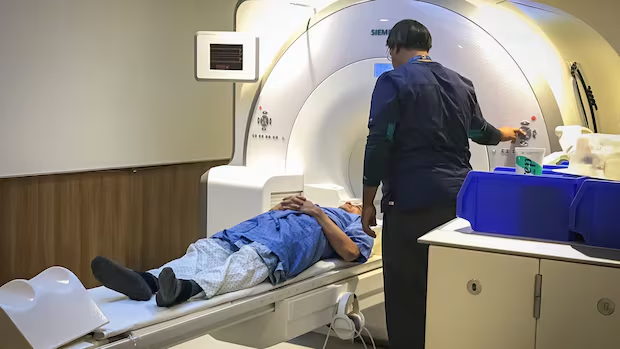
A mobile MRI unit intended to serve patients in two northern Manitoba communities has been parked in Thompson and is struggling to retain staff, according to two associations representing technologists in the province.
The provincial government launched the mobile MRI unit in Thompson last June, with plans for it to rotate between that northern city and The Pas — about 300 kilometres to the southwest — later in 2025.
Dayna McTaggart, the provincial manager for the Canadian Association of Medical Radiation Technologists Manitoba, works as a medical radiological technologist in The Pas.
McTaggart said the mobile unit hasn’t yet visited her town of nearly 6,000, with patients left relying on the MRI facilities in Thompson or Dauphin, also about 300 kilometres from The Pas.
She said some patients are choosing to travel to Brandon — 450 kilometres away — for MRI scans, which are often used for diagnosis, to detect diseases including cancers, and to monitor treatment.
“Until the machine is actually deployed to The Pas, members of our community and surrounding area are not going to see a significant difference,” she said.

“We have not received any indication as to a concrete date. And from what I can see around the health facility, there has been no start on ensuring that the space is ready for the equipment when it arrives,” she said.
A spokesperson for Health Minister Uzoma Asagwara said the government is still working to expand mobile MRI services to The Pas.
It has taken longer than expected because the project to connect the mobile unit only received one bid, which was over the approved budget, the spokesperson said. That has forced the province to enter a second request for proposals process.
60% vacancy rate: union leader
Manitoba Association of Health Care Professionals president Jason Linklater said the unit has also struggled to recruit and retain staff in the nearly nine months since it was introduced.
The union president said the facility has a 60 per cent vacancy rate, with just two staff members — one working full time and the other part time. Several staff members have resigned since June, he said.
“As the staffing situation gets worse, your ability to retain people also gets worse,” he said.

Asagwara’s spokesperson confirmed the facility has one full-time time MRI technologist and one part-time technologist. Another full-time technologist has been hired, the spokesperson said, who is expected to start after training is completed later this spring.
Linklater said union members who work north of the 53rd parallel are supposed to receive higher pay through a 15 per cent differential.
Staff who work at the mobile MRI but live in southern Manitoba aren’t getting that pay bump, according to Linklater. Not receiving the incentive has led some former staffers to resign, he said.
“There’s a northern differential in place for precisely this reason. But they won’t extend it to the MRI techs from the south to fill those positions in [the] mobile MRI,” Linklater said.
“They need to use the incentive that’s there. That probably will be enough to keep at least some of the people that they currently have there, and hopefully be enough to attract another position to the northern MRI,” he said.
Shared Health, which operates the mobile MRI unit, says work to ensure the facility has stable staffing levels is ongoing. The provincial health agency is exploring several options, including “wage enhancements,” it said in a statement.
Technologist McTaggart said working at a mobile service could also create a level of uncertainty for staff, who may not know how long they’ll be stationed away from home.
Wait times lower at mobile MRI unit
Despite being parked in Thompson, McTaggart suggests the mobile unit has still increased access to MRI services in the north.
According to provincial wait time data, the median wait time for an MRI scan at health-care facilities across the province was 26 weeks in 2025. Last year, the median wait time at the mobile unit was four weeks — the lowest of any facility in the province.
“I think that if you live in the north and you’re willing to go to Thompson for an MRI, you’re likely accessing those scans quicker than anyone else in the province,” McTaggart said.
The mobile unit has completed more than 1,500 MRI scans since June, the province said.