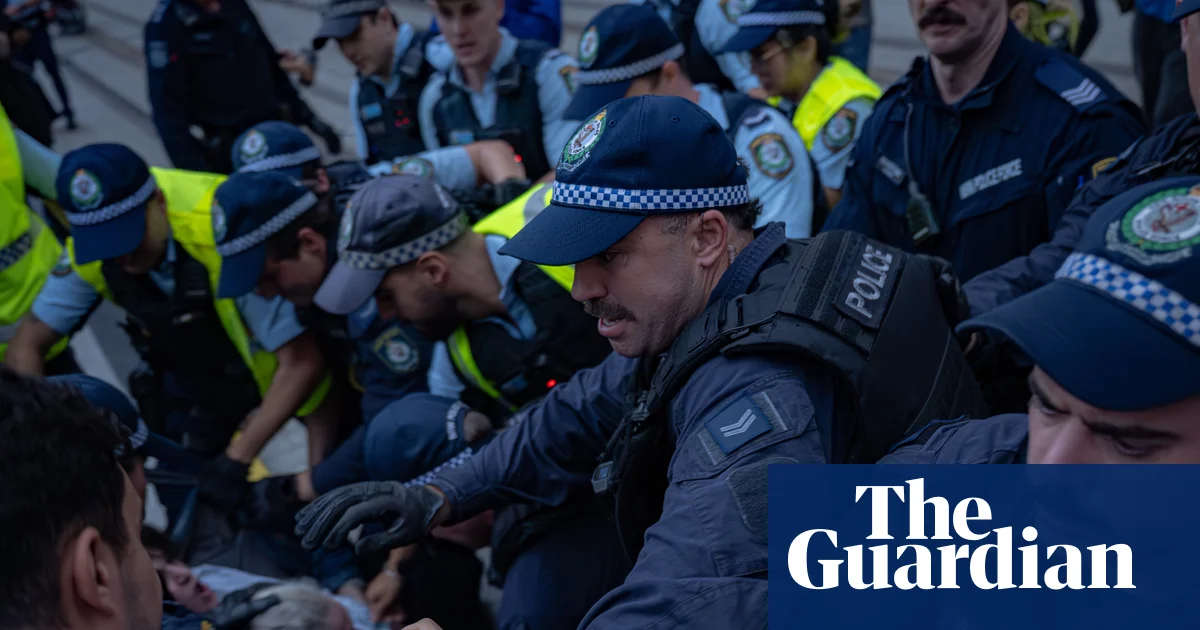
The New South Wales premier, Chris Minns, was warned before passing controversial laws restricting protests that heavy-handed policing might alienate communities and could even “increase the risk of radicalisation”, documents reveal.
The Labor leader was also advised further hate speech reforms conceived in the aftermath of the Bondi beach terror attack risked making the problem worse.
Advice on tackling incitement of violence and hatred using existing legislation was provided by the NSW cabinet office national security executive director, Alexandra Caples, a week after the antisemitic mass shooting on 14 December that killed 15 people during a Hanukah festival.
In outlining options, her briefing note pointed to the appropriateness of reforms. Caples urged Minns to give careful consideration to proportionality, judicial oversight and community engagement.
This was “to avoid unintended consequences, constitutional risks and other issues”, according to the memorandum attached to her correspondence.
NSW laws cracking down on gun ownership and public protests were passed on Christmas Eve.
As a result, the state’s police commissioner was empowered to curb public assemblies in designated areas without judicial oversight in cases of a declared terrorist attack. The laws were heavily criticised by civil rights groups.
Caples stressed that previous consorting and anti-terror laws had been disproportionately applied.
Those impacted included Indigenous communities, ethnic minorities and young people, raising concerns about profiling and discrimination.
“Heavy-handed enforcement may alienate communities, making individuals less likely to co-operate with authorities or report genuine threats,” she said.
“Worst case, perceived injustice or targeting can fuel resentment and increase the risk of radicalisation. Expanded police powers and/or aggressive enforcement can damage trust between police and communities, undermining broader efforts to counter extremism through partnership and prevention.”
Emergency legislation granted police additional powers after the warning was received.
Minns’ office said it would be inaccurate to say Caples’ advice – which included options to tackle hate speech and warnings about police overreach – was ignored, because it didn’t directly relate to the 24 December laws.
“We stand by our laws to keep the community safe,” a NSW government spokesperson said. They said community safety was the priority.
During February’s Australian visit by the Israeli president, Isaac Herzog, the NSW police commissioner, Mal Lanyon, used extra powers to ban street protests in certain areas of central Sydney.
Violent clashes between police and protesters followed. Officers also removed a group of Muslim men during prayers, sparking outrage from the Islamic community.
The Minns government has steadfastly defended police, maintaining protesters were briefed on what was permitted at the rally and blaming the violence on participants trying to breach enforcement lines.
The Australian Lawyers Alliance spokesperson Greg Barns said Caples’ advice was demonstrably ignored.
“And given the subject matter, dangerously so,” he said.
“Noting that anti-terror laws have been disproportionately applied to groups such as ethnic minorities, the Minns government runs a very high risk that by ignoring advice about heavy-handed enforcement of these laws, it’s fuelling social division.”
There was a tendency for politicians to ignore professional advice and sacrifice democratic rights in situations in which they believe they should be seen to be taking action, Barns added.
“One of the consequences of these laws and this mindset on the part of the government is what we saw during the Herzog visit.”
Extremism expert Michael Zekulin said government overreach exacerbated social grievances, which led to radicalisation and violence.
Rhetoric and action, such as the use of police force against praying Muslims, could confirm people’s perceptions that their community was being singled, the Australian National University academic said.
That made them more susceptible to extremist messaging and radicalisation.
“What you’re probably doing is creating an environment where more people may investigate ideas they were dismissing earlier, as you’re adding a kernel of truth to what they believe,” Zekulin said.
Lanyon has defended the use of force by his officers but privately apologised to members of the Muslim community.
The premier has admitted there had been a relationship breakdown between his government and the community, leading to the cancellation of an annual dinner with its leaders.
The Australian Federation of Islamic Councils president, Rateb Jneid, criticised the premier’s sustained defence of the police use of force and what he said was a failure to listen to community concerns about anti-hate laws.
Minns continues to push for a ban on the phrase “globalise the intifada”.
It means “uprising” or “shaking off” in Arabic and pro-Palestine protesters have employed it as a rallying cry for resistance against Israeli oppression.
But Jewish groups say it incites violence and anti-semitism due to its use during political violence against Israel.
Caples also advised in her email that “legislation doesn’t change behaviour” and argued rapid reforms risked driving concerning activity underground, where it was harder to track.
“Broader powers may criminalise speech or association that is controversial or unpopular, which risks suppressing legitimate dissent, debate or minority viewpoints,” she wrote.