Listen to this article
Estimated 4 minutes
The audio version of this article is generated by AI-based technology. Mispronunciations can occur. We are working with our partners to continually review and improve the results.
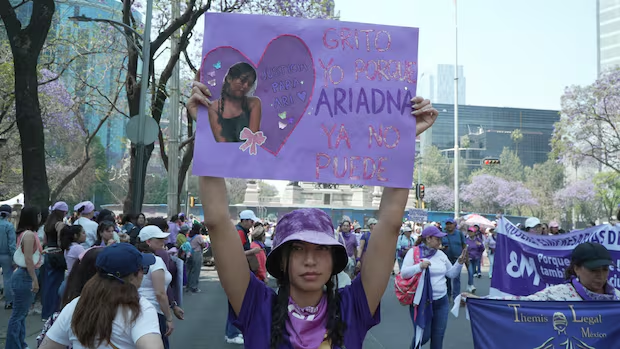
Tens of thousands of women marched through Mexico City and across the country Sunday to mark International Women’s Day in what has become the biggest political protest event in a country where human rights advocates say gender-based violence often goes ignored or unpunished.
One of Mexico City’s main avenues turned into a sea of purple and green — colours representing justice and reproductive rights — as thousands of women marched demanding an end to gender-based discrimination by the country’s institutions.
In Mexico, about seven out of every 10 women have experienced physical, sexual, emotional or economic violence, according to several studies.
Natalia Soto marched on Sunday for her best friend Ariadna Fernanda López, who is believed to have been killed in Mexico City, after her body was found in 2022 along a highway by a cyclist in the southern neighbouring state of Morelos.
“We come every year and this year, we shout for her,” said Soto.
Two people were arrested in connection with the case, which remains in jurisdictional limbo.
The state attorney general in Morelos claims that Fernanda López died after suffocating on her own vomit. However, Mexico City’s attorney general’s office says she died from blunt force trauma.

An average of 10 women are killed per day in Mexico, according to the Washington Office on Latin America (WOLA) and other advocacy organizations. But only one in 10 cases involving femicide result in a conviction.
In the weeks leading up to Sunday’s march, two women who both attended Autonomous University of the State of Morelos were reported missing and later found dead. Around the same time, another woman had been reported missing in the State of Mexico after taking a motorcycle taxi to a party, and was also later found dead.
Yesenia Zamudio said she was marching for “those who have been torn from us.”
Zamudio’s daughter María de Jesús Jaime Zamudio, a student of the National Polytechnic Institute, was murdered in 2016. A fellow student and a professor were named as the suspects. The student has been convicted in her death and the professor is wanted in connection with the case.
“We have to go out and march, to shout, to demand justice and an end to femicides. And if we have to break things, we will break them. And if we have to burn things, we will burn things, but we cannot remain silent,” said Zamudio.

Women draw strength from each other
On Saturday evening, a group of women gathered in Mexico City’s Tepito neighbourhood, one of the most troubled areas of the city, to hold a poster-making workshop.
More than 25 people attended the event, which was started four years ago and is held in six other states on the eve of the International Women’s Day march.
Selene Bárcenas, one of the workshop leaders, said a medical condition keeps her from attending the protest marches. This is how she contributes to the movement, she said.
Andrea Buendía, one of the workshop participants, said she draws strength from the women who march around her.
“When you’re at the march and you look around at all the messages that each person carries, I think it makes it more powerful,” she said.
“When I go to march, I do it mainly for my niece. I always think that I don’t want anything to happen to my niece at all.”

Mexico elected its first woman president, Claudia Sheinbaum, in 2024, and she declared 2025 the year of the Indigenous woman. Sheinbaum’s government has also unveiled programs to provide pensions to women between the ages of 60 and 65, open 200 childcare centres and help women become homeowners.
Amneris Chaparrol, director of the Centre for Gender Studies and Research at National Autonomous University of Mexico (UNAM), said while the programs seem positive on the surface, not much has changed on the ground for women.
“It also sometimes scares me a little that these struggles are being co-opted and reduced to just a checklist,” said Chaparrol.
“I believe there are changes that are needed that are more profound.”