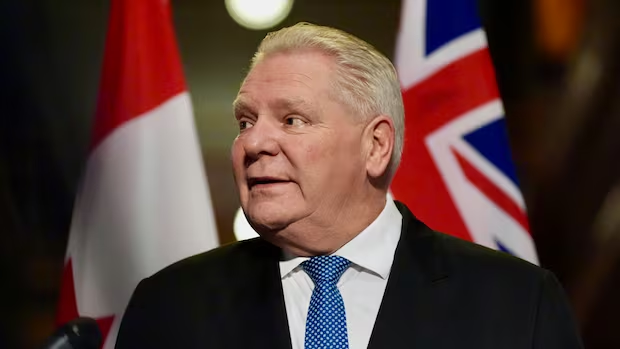
Premier Doug Ford is defending his government’s health-care record ahead of his eighth budget, even as the province’s hospitals say they face a billion-dollar structural funding deficit.
Ontario’s premier has repeatedly pushed back in recent weeks against criticism that his government is not providing the province’s hospital system with enough funding to address problems like hallway health care. That comes as the association that represents Ontario’s hospitals is warning that funding uncertainty is causing critical financial strain.
Ford, who promised to end hallway health care in hospitals when he was elected in 2018, says the province’s population has grown since then, compounding the problem. He has stressed that his government has rolled out tens of billions in new spending on health care in that time.
“What we’ve done is nothing less than a miracle to our health-care system,” Ford said at a recent hospital announcement in Niagara Falls.
The Ontario government’s 2025 budget paints a grim picture of the province’s economic future in the face of U.S. tariffs. As CBC’s Mike Crawley explains, the province is battling falling revenues and a deficit that’s expected to more than double in size.
Ontario budget expected to be tabled in coming weeks
Ontario has not announced when it will table its 2026 budget, but it could come as soon as the end of the month, after the legislature returns for its spring sitting on March 23.
Spending on health care is always the single largest expense in the spending plan — sitting at $91.5 billion last year — and Ontario Finance Minister Peter Bethlenfalvy said recently that he is concerned its rate of growth is “unsustainable.”
Ford has stressed his government has hiked health spending by $27 billion over seven years, touted another $50 billion spent on hospital expansions and highlighted new initiatives to recruit and retain doctors, nurses and other health-care workers.
“Do you know what we need to do more? We need to start promoting it more,” Ford said, hinting his government may advertise their health-care achievements, a year after Ontario spent a government-record $112 million on ads.
“We need to start advertising it and telling the people what we’re doing for health care. And that’s going to be coming shortly.”
‘Rapidly developing into a crisis’
The head of the Ontario Hospital Association said Ford’s government increased the number of acute care beds in hospitals, which has helped address hospital crowding and hallway health care.
But Anthony Dale said provincial edicts ordering hospitals to balance their budgets over the next three years without stable multi-year funding commitments jeopardize that progress.
“Our view is that now that we’re just getting things solid under our feet, now is not the time for this kind of uncertainty,” he said. “Right now this is rapidly developing into a crisis that is affecting the underlying financial health of Ontario’s hospitals.”

Hospitals face ‘deepening structural deficit,’ OHA says
Dale said costs in the sector are rising at a rate of six per cent annually, in part because of Ontario’s growing, aging and more medically-complex population. Recent funding increases from the government of four per cent a year have created a “deepening structural deficit” of $1 billion.
Dale said hospitals have dipped into their financial reserves, normally used for capital investments or to protect hospital finances, to fund everyday operations. And $500 million in cost savings found by hospitals illustrates that there is nowhere left to cut that doesn’t impact patient care, he said.
That will lead to difficult conversations with the public about what they can expect when it comes to hospital services, Dale said, and it may mean moving some services hospitals provide to other settings.
“These are all the kinds of tools that we’re using and working on to prepare for the future,” he said. “It’s just that this financial uncertainty is really impeding our ability to focus on that very, very significant objective.”
Ontario’s independent fiscal watchdog said in a report last fall that, based on Ontario’s 2025 budget estimates, it is projecting health-care spending growth of 0.7 per cent this coming year. The Financial Accountability Office estimates that to be at a “significantly slower pace” than the 6.6 per cent average annual growth in the sector over the previous three years.

Funding to recruit and retain medical professionals needed, Ontario’s doctors say
The president of the Ontario Medical Association said she is watching closely as the government prepares its budget. Her hope is that the province invests more in solutions to hallway health care, but also additional funding to help retain the province’s health-care workers.
“Hospitals can’t open more acute care beds without nurses, physicians and all the allied health professionals to staff them,” OMA president Dr. Zainab Abdurrahman said.
“We have to look at focusing on retention and recruitment strategies that align with real-time demand and population growth.”
Abdurrahman also expressed disappointment that the province intends to “retire” its tracking of hallway health care. The government quietly signaled the change earlier this year, which was first reported by The Trillium.
“We have to be transparent when you’re trying to build trust in a strained health-care system,” she said.
A spokesperson for Health Minister Sylvia Jones confirmed the tracking will end in favour of other data gathering for 21 new categories, including length of stay in an emergency room.
‘A downward spiral’
A vice-president with the Canadian Emergency Physician Association said that organization is also watching Ontario’s budget process closely. More targeted spending in the budget to address hallway health care is needed and putting an end to tracking the problem won’t make it go away, Dr. Michael Herman said.
“I think you can have the numbers, but you can also have the experience of just being down there and seeing the chaos,” he said.
Herman said the association would like to see Ontario spend more on hospitals, but also long-term care beds and better home-care supports as part of the solution.
“I think there’s a very big concern that there just won’t be that ability to robustly invest in measures that will help eliminate [hallway health care] and I think it’s just a downward spiral,” he said.
Cameron Mackay, CEO of Home Care Ontario which represents home-care service providers across the province, says those agencies are ready to help address the pressure on hospitals. But in order to do that, they need the government to ensure personal support workers are paid competitive wages, he said.
“Home care is the antidote to overcrowding in hospitals and long term care settings,” he said. “But we need to make sure that we have the staff in place to deliver that care.”