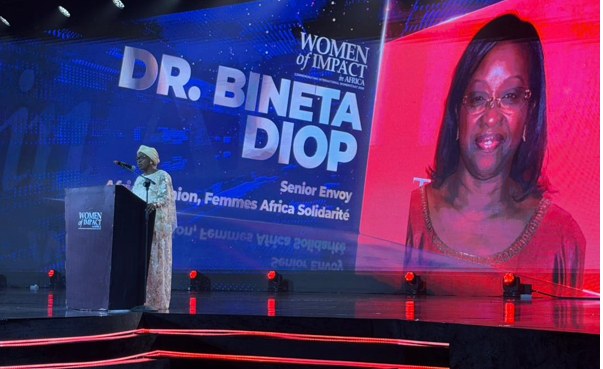
There are moments in history when an award means more than an individual achievement. When the honour being given carries the weight of thousands of voices, the grief of communities shattered by conflict, and the quiet, persistent courage of women who refused to be erased.
This was one of those moments.
On International Women’s Day 2026, in the heart of Lagos, Nigeria, before an audience gathered by Arise News, Bineta Diop received the African Women Impact Award 2026. As her name was called, it was not just a woman walking to receive a trophy. It was three decades of sacrifice, struggle, and transformation being recognized.
Thirty Years. One Movement. One Woman.
The year 2026 carries a depth of meaning that no ceremony could fully contain. It marks 30 years of Femmes Africa Solidarité (FAS), the organization Bineta Diop championed the African Union Convention on Ending Violence Against Women and Girls (AU-CEVAWG), adopted in 2025 – the first continental legal instrument wholly dedicated to ending all forms of violence against women and girls, including in the digital sphere and in conflict zones.
These are not just legal texts. They are lifelines. They are the result of decades of listening, lobbying, negotiating, and refusing to accept that women’s safety could remain optional.
From 2014 to 2025, Bineta Diop served as Special Envoy on Women, Peace and Security at the African Union Commission, a historic appointment that placed her at the very heart of Africa’s most complex peace challenges.
She travelled to Somalia when it was engulfed in instability. She stood in Sudan, in Darfur, where communities had been torn apart by atrocity. She worked with women in the Great Lakes region who were rebuilding lives brick by brick after devastation. In every conflict zone she entered, her message was the same, and it cut through the noise of politics and posturing:
“Women are not merely victims of conflict. They are architects of peace.”
founded with a single, defiant conviction: that African women belong not at the margins of peace and governance, but at its very center.
When she started FAS in 1996, few believed that women’s voices would ever be formally integrated into Africa’s peace architecture. The odds were stacked against her, and she built anyway. She built with the women displaced by war in Liberia and Sierra Leone. She built with the survivors of sexual violence in the Democratic Republic of Congo and Rwanda. She built with the women in Darfur who had lost everything and still dared to demand justice.
She built because she understood something fundamental: you cannot build lasting peace on a foundation that excludes half the population.
From Villages to the Highest Tables of Power
What makes Bineta Diop’s journey extraordinary is not just its ambition, but its breadth. Few leaders have moved as seamlessly, and as purposefully, between the grassroots and the global.
She has sat with women in displacement camps who had no shoes, no shelter, no certainty about tomorrow. And she has stood before Heads of State, United Nations bodies, and African Union summits to demand that those women’s realities be written into law, into policy, into the architecture of peace itself.
Her advocacy helped advance the implementation of the Maputo Protocol, Africa’s most comprehensive framework for women’s rights, a document that guarantees equality, dignity, protection from violence, and autonomy over reproductive health. She championed the African Union Convention on Ending Violence Against Women and Girls (AU-CEVAWG), adopted in 2025 – the first continental legal instrument wholly dedicated to ending all forms of violence against women and girls, including in the digital sphere and in conflict zones.
These are not just legal texts. They are lifelines. They are the result of decades of listening, lobbying, negotiating, and refusing to accept that women’s safety could remain optional.
From 2014 to 2025, Bineta Diop served as Special Envoy on Women, Peace and Security at the African Union Commission, a historic appointment that placed her at the very heart of Africa’s most complex peace challenges.
She travelled to Somalia when it was engulfed in instability. She stood in Sudan, in Darfur, where communities had been torn apart by atrocity. She worked with women in the Great Lakes region who were rebuilding lives brick by brick after devastation. In every conflict zone she entered, her message was the same, and it cut through the noise of politics and posturing:
“Women are not merely victims of conflict. They are architects of peace.”
One of the most powerful, and often overlooked, dimensions of Bineta Diop’s leadership is her unwavering belief in partnership.
Her vision was never about women succeeding at the expense of men, or in opposition to them. She built a model of leadership in which men are allies, not adversaries, where transformation is collective, and where the full potential of societies is unlocked only when all voices are at the table.
Through capacity-building programmes in Dakar and collaboration with the Harvard Kennedy School’s Center for International Development, she nurtured generations of young African leaders, men and women alike, equipped to lead with empathy, equity, and purpose.
Her philosophy has always been clear: Lasting change happens when we build together.
This Award Belongs to Every African Woman
When Bineta Diop spoke after receiving the African Women Impact Award 2026, she did what she has always done. She turned the spotlight away from herself and toward the women who made the work possible.
She dedicated the honour to the peacebuilders in villages, who mediated community conflicts long before any government took notice. To the negotiators in boardrooms, who fought for a seat at tables that were never designed for them. To the mothers in displacement camps, whose resilience defies comprehension. To the young girls daring to dream beyond limitation, who deserve a world built in their image.
“This award belongs to the women who fought for the Maputo Protocol to become reality,” she said.
“To the women who rebuilt communities after war. To the women who continue to demand justice, dignity, and representation.”
In her words, as in her life, the personal and the political were inseparable.
A Living Archive for Future Generations
On this milestone day, Bineta Diop also unveiled her new official website, a digital tribute to thirty years of advocacy, diplomacy, and impact. More than a personal platform, it is a living archive of Africa’s women’s movement: a resource for policymakers, researchers, young leaders, and anyone who believes that the story of Africa cannot be told without the women who shaped it.
It is her way of ensuring that the movement does not end with her, that every lesson learned, every battle fought, every breakthrough achieved, is preserved and passed forward.
*Communication Specialist
agency@afrin3xus.com – Tel: +229 (01) 97517070