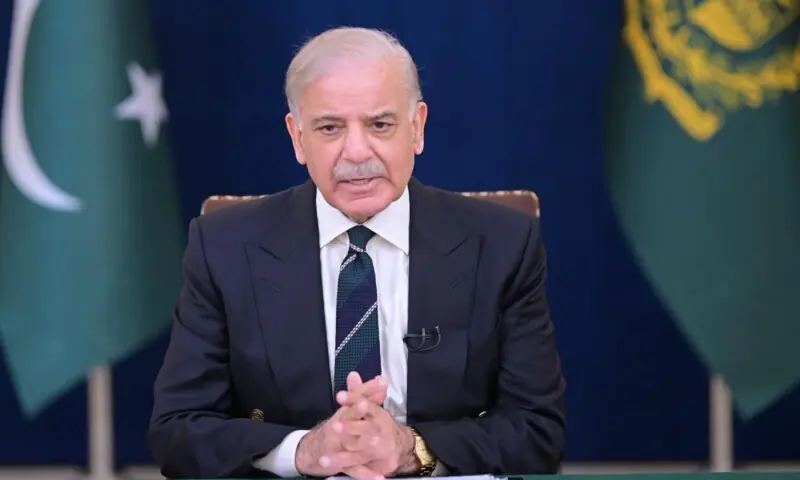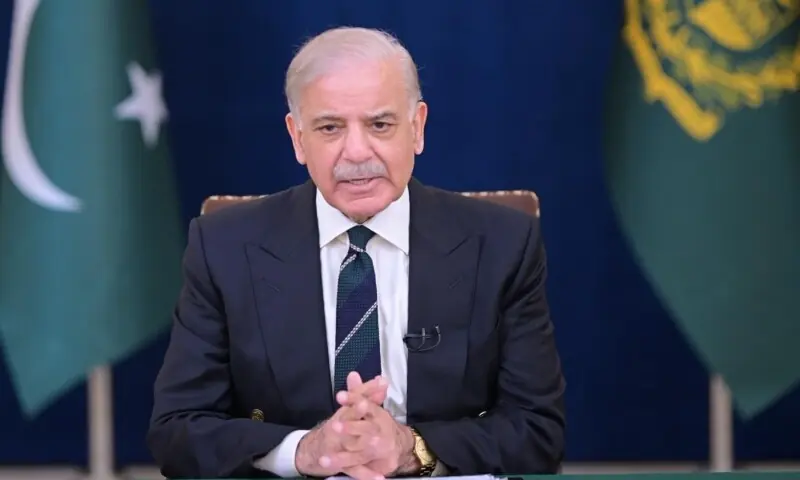
Prime Minister Shehbaz Sharif on Monday announced a host of austerity measures to conserve fuel in view of the global fuel crisis triggered by the US-Israel war on Iran.
Austerity measures
- 50pc cut in fuel allowance for official vehicles, with the exemption of ambulances and public buses, for the next two months
- The use of 60pc vehicles being employed by government departments will be stopped for the next two months
- The federal cabinet will forgo salaries for the next two months
- Parliamentarians’ salaries to see a 25pc cut
- Two days’ salary of BS-20 government officials, who earn more than Rs300,000, will be deducted
- Expenses of government departments to be reduced by 20pc
- 50pc staff to work from home in both public and private sector and workplaces will open four days a week, but agriculture, industrial and banking sectors, as well as those providing essential services, are exempted
- All higher educational institutions to begin online classes; a two-week break for all schools starting from the end of this week
- Prohibition on the purchase of vehicles, furniture, air conditioners, and other items for government departments
- Ministers, advisers and government officials are barred from undertaking foreign trips unless they are “essential for the country’s interests”
- Teleconferencing and online meetings to be preferred for saving fuel
- Prohibition on official dinners and Iftar parties
- Seminars and conferences will be hosted on government premises instead of hotels
In his address to the nation, the premier said that a meeting was convened earlier in the day where austerity measures were discussed with the federal and provincial governments.
Providing details, he said that for the next two months, the fuel allowance of official vehicles would be cut by 50 per cent. However, ambulances and public buses are not included in this, he said.
He said that for the next two months, 60pc of the vehicles used by government departments would be stopped. He further said that for the next two months, the federal cabinet would forgo its salary.
He further said that the salary of parliamentarians would be cut by 25pc. Moreover, two days’ salary of BS-20 government officials, who earn more than Rs300,000, would be used for the people.
The premier said that the expenses of government departments would also be reduced by 20pc. He said that there will be a ban on purchasing vehicles, furniture, air conditioners and other items for government departments.
Further, a ban has been imposed on foreign trips by ministers, advisers and government officials “apart from those that are essential for the country’s interests”, he said.
He went on to say that teleconferencing and online meetings would be preferred so that fuel could be conserved.
He added that official dinners and Iftar parties had also been banned. He said that to reduce government expenses, seminars and conferences would be hosted on government premises instead of hotels.
PM Shehbaz said that to conserve fuel and energy, decisions had also been taken for the public and private sectors. He said that apart from essential services, 50pc of staff would work from home.
He said that offices would only open four days a week. “However, this will not apply to banks,” he said.
He said that all schools would also have two holidays, and all higher educational institutions would begin online classes. He also announced a two-week break for all schools beginning at the end of this week.
He said that directives had been issued in this regard to all provincial governments.
The premier also warned profiteers and hoarders of oil, saying that they should not try to gain unlawful profit from this situation.
“Otherwise, the law will come into effect and action will be taken,” he said.
Concluding his address, PM Shehbaz said that the world was facing a host of “new challenges”. He said that at this delicate turn, the country needed to show unity now more than ever.
Pakistan making efforts to solve crisis through diplomacy
At the outset of his address, the premier said the entire region had been gripped by war. He said that Pakistan was making efforts to solve the situation through diplomacy.
He said Pakistan was also facing terrorism on its Western borders. He said that the country’s armed forces were dealing with the situation under the leadership of Chief of Defence Forces Asim Munir.
He also condemned the US-Israeli attacks on Iran that resulted in the assassination of Supreme Leader Ayotollah Ali Khamenei. At the same time, he also condemned Iran’s retaliatory attacks on friendly countries — namely Saudi Arabia, Qatar, United Arab Emirates, Turkiye, Oman, Kuwait, Bahrain, and Azerbaijan.
“These attacks have posed a great threat to the whole region,” he said. He said that he had spoken to the leaders of these countries and conveyed that Pakistan stood shoulder to shoulder with them.
“We consider the stability and security of these countries as the stability and security of our country,” he said.
PM Shehbaz said that due to the situation, the global price of oil had jumped to more than $100 per barrel. “If things keep progressing in this manner, then the prices will get out of hand,” he said.
He said that Pakistan depended on oil and gas coming from the Gulf. “Keeping this reality in mind, the government took difficult decisions for the country’s economy,” he said.
He said that it needed to be acknowledged that the global price of oil was not in Pakistan’s hands.
“When conflict arises or war erupts in the region, the effects are felt on energy prices,” he said. At the same time, he assured the nation that the government was making efforts to ensure the economy remained strong.
He said that the decision to raise the price of petroleum products was a “difficult” one, where his head was at war with his heart. He said that it was advised that prices be raised more than what the government had notified.
“We tried to take the middle road so that the burden on you is less,” he said. Highlighting the economic pressures faced by the country, he said that Pakistan was close to default some time back. However, the government, setting aside political differences, gave preference to the people.
“And you supported us and demonstrated patience,” he said. He said that inflation had fallen, the rupee was stable and electricity prices had also fallen. He assured the nation that the government would try its best to burden the people as little as possible.
He said that in the coming days, oil prices would again increase. “But I will try that the burden does not fall on you. For this, efforts are ongoing day and night,” he said.
The development comes after the government came under fire from its allies, the opposition, and citizens alike for hiking petrol and diesel prices by up to Rs 55.
The United States and Israel’s war on Iran has severely disrupted Middle East energy exports, collapsing oil production in Iraq and choking off the Strait of Hormuz that handles a fifth of the world’s supply.
On Sunday, PM Shehbaz chaired a meeting to review the austerity plan, according to a press release from the Prime Minister’s Office (PMO).
“The burden of austerity should be borne judiciously by all segments of society, while the elite and privileged class should set an example of adopting adjustments and austerity measures,” the PMO quoted the premier as saying.
Participants were told that the country had adequate reserves of petrol and diesel. They were further informed that the government had already taken precautionary measures to deal with any situation.