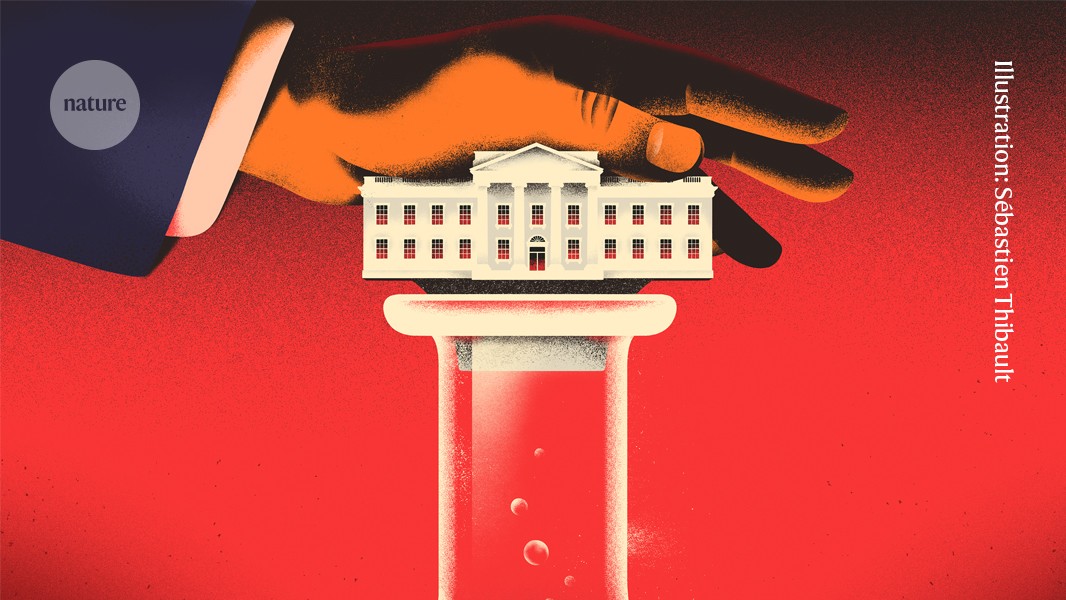
Thanks to legislation passed by the US Congress on 3 February, government spending on research and development unrelated to national defence is expected to decrease by 3–7% in the current fiscal year. This is much less than the 33% cut sought by President Donald Trump last year.
Trump one year on: How six US researchers plan to protect science amid chaos and cuts
The news has brought relief to many US scientists. We welcome this development. But US science is a long way from being in good shape. Those of us with ties to the US National Institutes of Health (NIH) and other agencies are witnessing a fundamental shift in how federal science agencies are being governed. (One of us, M.H.H., runs an NIH research group but writes in a personal capacity, not for the agency; the other, N.B.A, studies NIH policymaking.)
Since the late 1940s, the legislative branch of the federal government has set priorities for scientific research and an expert-driven civil service has implemented them in consultation with external scientists. Now, this decentralized model is being replaced by one in which the president, through political appointees, is exerting unprecedented control over what research gets funded and who conducts it, with little say from Congress.
This top-down approach risks harming the US science base. Several analyses show that civil servants who are hired on merit are more effective than political appointees are at ensuring that government agencies operate effectively (see, for example, go.nature.com/473sw7t). A 2023 systematic review of more than 1,000 articles on meritocracy and government performance shows, for instance, that merit-based systems do better than politicized ones on all sorts of measures — from corruption and efficiency to civil-servant motivation and public trust1.
Here, we call for the expert-led decentralized governance that has operated at the NIH for the past eight decades — and at other US science agencies — to be re-established and strengthened in law. Congress must go beyond protecting budgets and reassert its role in directing research priorities at the NIH and other federal science agencies. It should also codify the decision-making power of the scientific community into law. Other nations, too, might consider similar steps to strengthen the independence of their scientific research systems.
A decentralized model
Among the dozen or so agencies that fund the basic research that has made the United States a scientific superpower, the NIH is a clear success story. NIH grants for early-stage research funding contributed to the development of 99% of new drugs approved by the US Food and Drug Administration between 2010 and 20162. And in 2024, every US$1 spent by the NIH has generated $2.56 of new economic activity3 — a return on investment of more than 250% that well outstrips the average of 5% for federal agencies4.
Much of this success has stemmed from a governance model that was established in the aftermath of the Second World War and prizes academic freedom and scientific independence. The legislative branch of the US federal government sets broad-brush priorities in law — mandating at different times a focus on areas such as cancer, Alzheimer’s disease and precision medicine, for example. Decisions about which specific projects will be funded are then made by NIH employees — many of whom have been trained as researchers — in consultation with advisory groups of external scientists, such as NIH councils and peer-review panels.

US president Richard Nixon signed the National Cancer Act in 1971.Credit: AP Photo/Alamy
Various presidents have urged certain priorities but have then worked with Congress to implement them. Richard Nixon, for instance, made tackling cancer a national priority in 1971, and Barack Obama made studying the human brain a national research effort in 2013. After their proclamations, both presidents — Nixon a Republican, Obama a Democrat — negotiated with Congress to pass them into law.
Under this decentralized system, the scientific community had enormous influence over the NIH. No single actor or organization exerted an outsized influence on what science gets done. Historically, only two presidential appointees have worked for the agency — the NIH director and the director of the National Cancer Institute. Memberships of advisory and review panels rotate, so that individuals generally serve no more than three years.
Consolidation of power
The long-standing governance model of the NIH — in which extensive consultation with the scientific community steers funding decisions — is based on a philosophy of pluralistic decision-making5. This holds that scientists should have a central role in helping civil servants to determine the best way to spend the funds Congress allocates to agencies. But this model is now being replaced with a top-down one that centres the political priorities of the White House. Instead of allowing Congress to set priorities for health research in law, the Trump administration has asserted an unprecedented ability to reset priorities without congressional approval —overriding many decisions previously taken by scientists at the agency.
How Trump 2.0 is reshaping science
Since early 2025, the Trump administration has terminated and frozen thousands of grants for projects that address topics it opposes. Thousands of staff have been lost through involuntary terminations, early retirement or buy-out offers, and 16 of 27 directors of NIH institutes have left since January. Standard procedures for hiring institute directors have been bypassed and employment rules for civil servants have been rewritten. This means that individuals can be more easily removed for poor performance, including “intentionally subverting Presidential directives”.
The NIH’s process of peer review is also being altered. In November 2025, the agency announced a change in grant-review policy. Whereas ranking of grants using their peer-review scores was once the dominant way to determine which projects would be funded, NIH staff are now being advised to consider peer-review assessments as “just one input in setting award budgets” among other criteria, such as assessments of whether the proposals meet the agency’s presidentially approved priorities (see go.nature.com/4s4hesf).
Meanwhile, many scientists who were previously appointed to NIH advisory panels have had those positions terminated. Indeed, councils (which are responsible for NIH’s second level of grant review) for more than half of NIH’s institutes are now on track to lose all of their voting members this year.

President Barack Obama announced the US national brain-research initiative in 2013.Credit: Jewel Samad/AFP via Getty
The NIH isn’t without issues. Its critics have long complained about the growth of bureaucratic rules that make many aspects of grant, programme and internal administration difficult6. Others have argued that the agency has not done enough to support early-career independent investigators — or that a flat budget combined with a vast increase in the number of grant applicants has put pressure on established investigators and led to a shortage of career options for doctoral students7.
The recent shifts have only made these problems worse. For example, at the NIH’s National Cancer Institute, a switch to funding more multiyear awards, in which the NIH funds all years of a project upfront, has reduced applicants’ chances of obtaining funding for any one project by more than half.