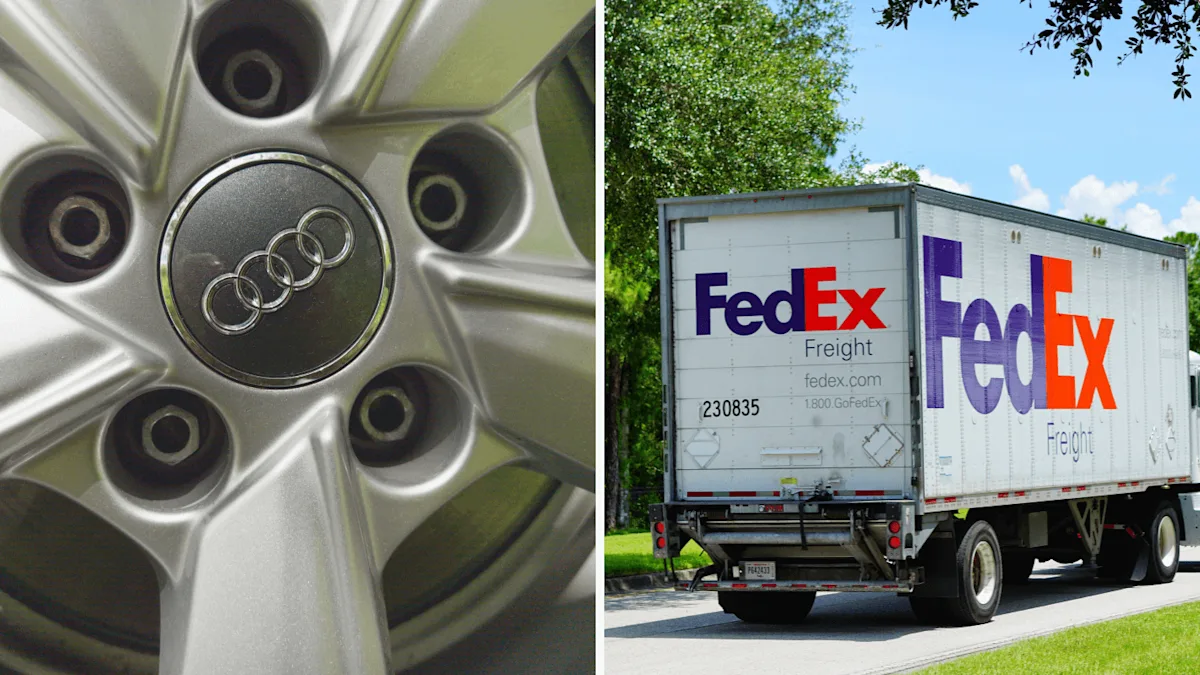
Paul Polak just wanted to do something nice for his granddaughter. Instead, the Loveland, Colorado, resident got tangled in America’s increasingly chaotic tariff system — and a bill that left him wondering whether it’s even worth buying anything from overseas anymore.
Polak’s granddaughter was about to inherit her dad’s 22-year-old Audi station wagon, and one of the hubcaps was missing. So he went online, found a replacement from a seller in the United Kingdom and placed an order. The hubcap cost $67.
Then came the letter from FedEx.
When the hubcap arrived in the U.S., Customs and Border Protection assessed a string of import duties. FedEx, which had covered the tariffs upfront as the shipment’s importer of record, sent Polak a bill seeking reimbursement — plus a $4.50 disbursement fee for handling the customs paperwork. All told, Polak owed $41.88 in tariffs and $4.50 in fees on a $67 purchase — an effective tax rate of roughly 69%, as first reported by 9NEWS investigative reporter Steve Staeger (1).
The duty invoice broke the charges into four separate tariff lines: a 2.5% standard duty, a 10% reciprocal tariff tied to the UK, a 25% tariff for a passenger vehicle part and another 25% tariff for a medium- or heavy-duty vehicle part.
Keith Maskus, a retired economics professor and former chief economist for the U.S. State Department, reviewed the invoice and told Staeger that the tariffs appeared to have been improperly stacked — each one levied against the full value of the hubcap rather than applied correctly.
Under current trade rules, auto parts imported from the UK are subject to a 25% Section 232 tariff under the Trade Expansion Act — the national-security provision President Trump used to impose broad duties on vehicles and vehicle parts starting in spring 2025 (2).
While the US-UK Economic Prosperity Deal, announced in May 2025 and implemented in late June, reduced that rate to 10% for qualifying UK-origin parts, that lower rate only applies to parts destined for UK-origin vehicles — not a German-made Audi.