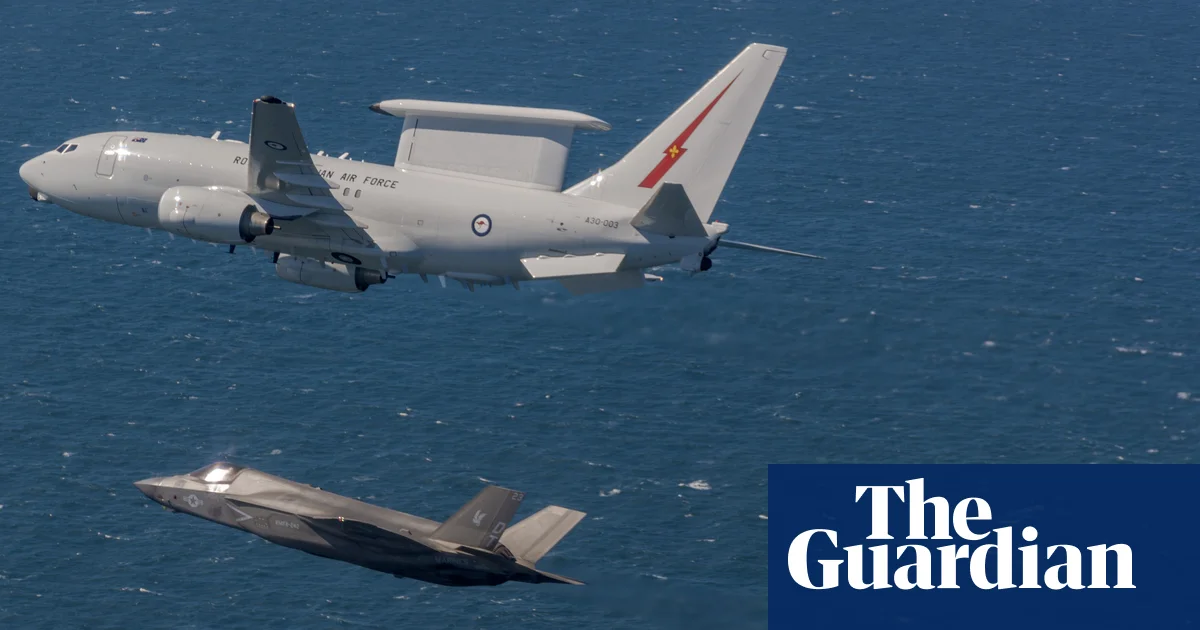
Australia will send a specialist surveillance aircraft and stocks of air-to-air missiles to the United Arab Emirates, in what Anthony Albanese said is an effort to help protect Australians in the region under threat from Iranian attack.
As the Iran war grows, the prime minister announced the assistance on Tuesday morning after talks with the UAE’s president, Mohamed bin Zayed Al Nahyan, and US president Donald Trump overnight. Iran has attacked a dozen countries since the start of US and Israeli bombings and the death of the country’s supreme leader, Ayatollah Ali Khamenei.
Albanese insisted Australia was not part of offensive action against Iran and would not be deploying troops more broadly to the Middle East. Instead, Australia was helping defend against “unprovoked attacks” by the Iranian regime.
Approximately 85 defence force members will be deployed as part of the assistance package, with crews expected to leave Australia by midweek and be operating on the ground by the weekend.
Albanese said an E-7 Wedgetail aircraft would help provide long-range reconnaissance capability to help secure the airspace above the Gulf on an initial four-week deployment.
The aircraft uses long-range surveillance radar, secondary radar and voice and data communications systems to provide an airborne early warning and control platform.
Sign up: AU Breaking News email
Stocks of advanced medium-range air-to-air missiles will also be sent to the UAE.
“My government has been clear that we’re not taking offensive action against Iran, and we’ve been clear that we are not deploying Australian troops on the ground in Iran,” Albanese said.
“We continue to work on contingencies to keep Australians safe and to help travellers leave the Middle East.”
Albanese said Australia was taking defensive action to support regional partners and keep Australian expats safe. About 115,000 Australian citizens and permanent residents are in the Middle East, including about 24,000 in the UAE.
“Australia has supported action aimed at preventing Iran from getting a nuclear weapon and preventing Iran from continuing to threaten international peace and security,” he said.
“Deployed ADF assets will operate according to the right of collective self-defence.”
The defence minister, Richard Marles, said the E-7 Wedgetail aircraft was one of the leading reconnaissance and command aircraft in the world. The same aircraft has been stationed in Poland in recent months, assisting with Ukraine’s war against Russia.
As the conflict continues to play havoc with international air travel, the foreign affaris minister, Penny Wong, confirmed the majority of transiting Australians had left the region.
Around 2,700 people had returned to Australia on commercial flights so far, she said, and land transport was being provided to some people stranded in Kuwait and Bahrain, via Saudi Arabia.
Wong said the security situation was likely to get worse before it gets better, and urged Australians wishing to come home to act quickly, if it was safe to do so.
“We do understand these are difficult decisions for Australians and their families.
“We encourage those who do wish to leave do so now, do so while commercial flights are still available, however limited,” Wong said.
The Department of Foreign Affairs and Trade’s crisis portal remains open for Australians in Bahrain, Iran, Israel, Kuwait, Lebanon, Qatar and the UAE.
Advice from the department’s Smartraveller website continues to advise Australians not to travel to Bahrain, Iran, Iraq, Israel, Kuwait, Lebanon, Palestine, Qatar, Syria, the UAE and Yemen.
Australians should reconsider the need to travel to Jordan, Oman and Saudi Arabia and exercise a high degree of caution on the ground.