As measles ravages the US, a new case study has shed light on a terrifying side effect that can lurk and kill years after infection.
According to the latest CDC figures, updated on March 6, there have been nearly 1,300 cases of measles nationwide so far in 2026, on pace to rival last year’s historic outbreak.
At the heart of this year’s crisis is South Carolina, where 662 residents are confirmed to have developed measles since the start of the year.
Measles, which is highly infectious, is characterized by cough, fever, a distinctive, blotchy rash that starts in the face before spreading down the body and tiny white spots inside the mouth called Koplik spots.
While many cases resolve on their own, in rare instances, patients may suffer brain swelling, immune system damage and additional infections.
In a medical journal, doctors at Children’s Hospital of Orange County in California last month detailed the case of a seven-year-old boy who had suffered from seizures and cognitive deterioration for three months. In the hospital, his reflexes were overly sensitive and spasming, and he was unable to speak.
Doctors learned the boy had contracted measles at seven months old while living in Afghanistan, where the disease is endemic.
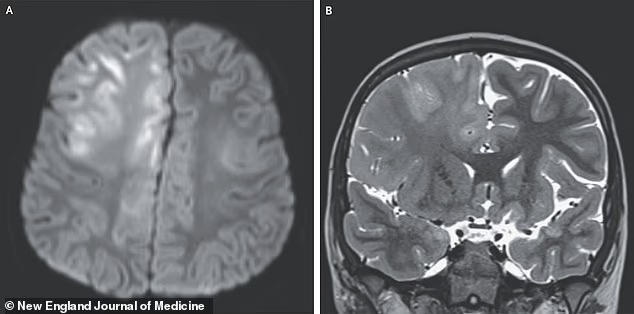
An MRI scan of the child’s brain showed swelling and slowed movement of water molecules in the frontal lobe and corpus callosum, a sign of cell injury or death. The doctors diagnosed the boy with subacute sclerosing panencephalitis (SSPE) caused by his measles infection.
The above images show the child’s brain nearly seven years after he was infected with measles. He died a year later of subacute sclerosing panencephalitis (SSPE)
SSPE progresses over months or years after measles and has a mortality rate of 95 percent. The boy in the case study died a year after his symptoms began, doctors wrote in the New England Journal of Medicine.
As the disease progresses, patients gradually become vegetative. Survival time of SSPE ranges from about 45 days to 12 years, and most patients survive nearly four years after symptoms start.
There are usually only four to five cases every year in the US, recent studies have estimated.
The latest CDC figures show 1,281 measles cases so far in 2026. The highest totals have been reported in South Carolina (662), Utah (184) and Florida (109).
Measles spreads through direct contact with infectious droplets or through the air. Patients with a measles infection are contagious from four days before the rash through four days after the rash appears. Enclosed areas like airports and planes are extremely risky locations for disease transmission.
It first invades the respiratory system, then spreads to the lymph nodes and throughout the body. As a result, the virus can affect the lungs, brain and central nervous system.
While measles sometimes causes milder symptoms, including diarrhea, sore throat and achiness, it leads to pneumonia in roughly six percent of otherwise healthy children, and more often in malnourished children.

Measles causes a distinctive rash as pictured in the above stock image. In severe cases, it can also lead to pneumonia and brain swelling (stock image)
Though the brain swelling that measles can trigger is rare, occurring in about one in 1,000 cases, it is deadly in roughly 15 to 20 percent of those who develop it, while about 20 percent are left with permanent neurological damage such as brain damage, deafness or intellectual disability.
Measles also severely damages a child’s immune system, making them susceptible to other potentially devastating bacterial and viral infections they were previously protected against.
The disease can best be prevented with a two-dose measles, mumps and rubella (MMR) vaccine, which is given to children once between 12 and 15 months and again at between four and six years.
The shot is 97 percent effective, and the CDC estimates unvaccinated individuals have a 90 percent chance of becoming ill.
‘The primary way to prevent measles infection and its neurologic sequelae is vaccination,’ doctors wrote in the case study.
Nationwide, 92.5 percent of kindergarteners are fully vaccinated against measles and 3.6 percent have an exemption.
Before MMR vaccines became available in the 1960s, measles caused epidemics with up to 2.6 million global deaths every year. By 2023, that number had fallen to roughly 107,000 deaths.