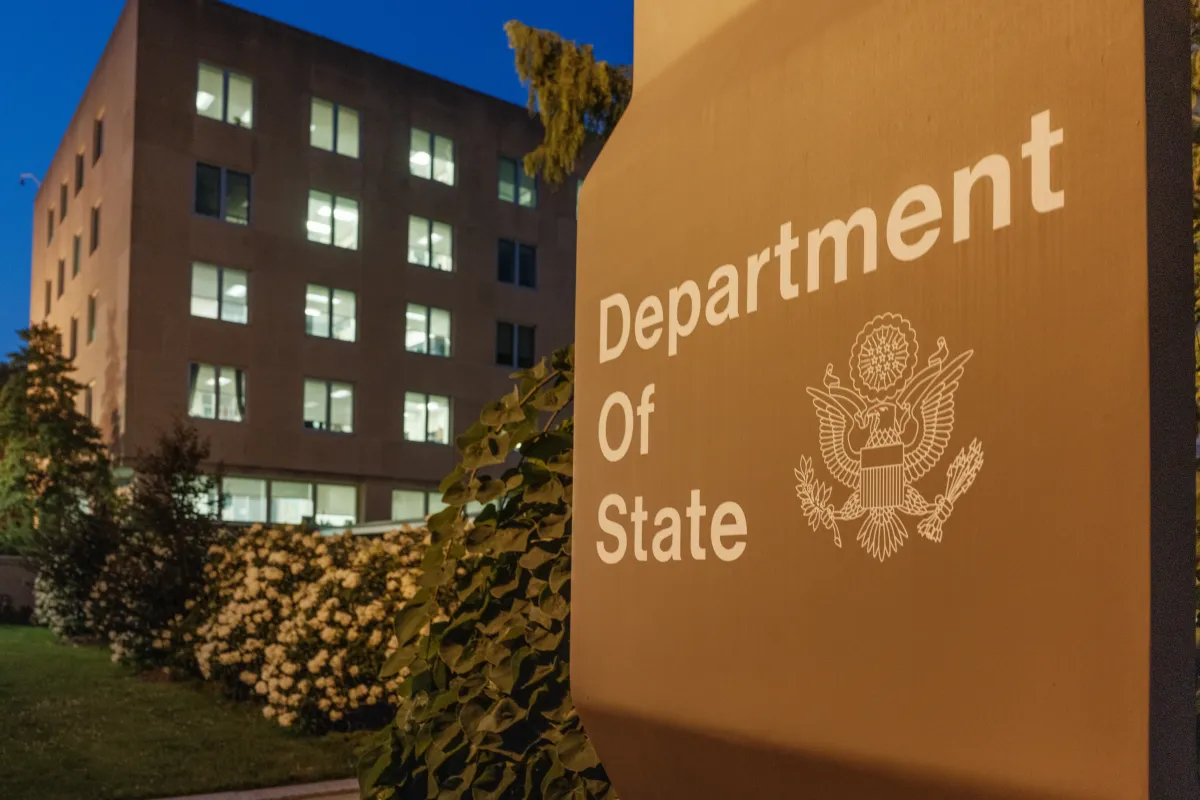
Thousands of U.S. visa appointments have been canceled across multiple countries after American embassies and consulates in parts of the Middle East and South Asia suspended routine visa processing amid the ongoing conflict involving Iran, Israel and the United States.
Three experts who spoke with Newsweek warned that halting visa services at multiple U.S. embassies and consulates could trigger massive backlogs, leaving tens of thousands of applicants waiting indefinitely for new appointments.

In March 2025, U.S. consulates issued 6,318 nonimmigrant visas in Pakistan, 1,848 in Jordan, 1,611 in Lebanon, 865 in Iraq, 862 in Kuwait, 5,942 in Saudi Arabia, 243 in Qatar, 1,022 in the United Arab Emirates and 286 in Bahrain.
U.S. embassies and consulates in several countries—including Pakistan, Jordan, Lebanon, Iraq, Kuwait and Saudi Arabia—have temporarily suspended visa services.
Immigration attorney Gnanamookan Senthurjothi told Newsweek that the number of affected applicants could be substantial if the closures continue.
“Across all six countries combined, somewhere between 40,000 and 60,000 applicants are directly affected for every week these closures remain in place,” Senthurjothi said. “If the suspensions in Karachi, Lahore, Baghdad, Beirut, Kuwait City and Amman extend beyond a few weeks, the cumulative backlog could easily surpass 150,000 to 200,000 pending cases, with no clear rescheduling timeline published for most of these posts.”
These figures are rough estimates, and there is no official data from the U.S. government on how many applicants have been affected.
Business immigration attorney James Hollis told Newsweek that U.S. consulates normally process about 30,000 to 40,000 visas per month, based on the latest data from August 2025.
Several major visa-processing locations are not operating. In Pakistan’s Karachi and Lahore, consular services remain suspended with no announced reopening date. In Islamabad, the U.S. Embassy is providing services only to American citizens.
“The region does not have a lot of huge processing posts outside of Islamabad, which is quite a significant embassy in terms of nonimmigrant and immigrant visa processing,” Hollis said.
Visa services have been halted in Baghdad, Kuwait City and Beirut, as well as in Amman, Jordan. Routine consular operations have also been suspended at U.S. missions in Doha, Qatar; Manama, Bahrain; and Saudi Arabia’s Riyadh and Jeddah.
Most of these closures followed orders for nonemergency diplomatic personnel to depart several locations because of security concerns.
The only country in the region currently operating without significant disruption to visa services is Turkey.
In September, the U.S. State Department revised its policy on third-country visa processing, requiring most applicants to apply in their country of nationality or legal residence, which limits alternatives for those affected by the current consular closures.
“There was clearly no thought for the State Department or its personnel prior to the attacks,” Hollis said. “They needlessly put a lot of U.S. government employees and their families in harm’s way.”
Düden Freeman, a former consular officer at the U.S. Department of State, said the widespread suspension of visa services across the Middle East stems largely from security concerns and staffing reductions linked to the Iran war.
Freeman said multiple U.S. embassies and consulates in the region had closed or halted most visa operations after nonessential diplomatic personnel were ordered to depart several posts.
“Conditions are fluid and vary by country, so the only definitive source for any specific post is that embassy or consulate’s own website and security or consular alerts,” Freeman told Newsweek.
Under current U.S. policy, most nonimmigrant visa applicants must attend interviews in their country of nationality or legal residence, which limits alternatives for applicants affected by the closures. The previous practice of seeking faster visa appointments in third countries has largely ended, though there are limited exceptions where applicants from countries without functioning U.S. visa posts are assigned to another location.
Freeman said the suspensions at 12 major visa-processing posts—including Amman, Doha, Baghdad, Erbil, Beirut, Kuwait City, Riyadh, Dhahran, Jeddah, Abu Dhabi and Dubai—would normally account for about 23,500 visas per month based on March 2025 issuance levels.
She added that based on March 2025 visa issuance data, more than 1,000 diplomatic and international organization visas were issued across the affected posts, potentially complicating official travel and diplomatic engagement.
Almost 19,000 B-1 and B-2 visitor visas were issued, meaning the pause could disrupt corporate meetings, conferences and commercial visits, particularly for Gulf-based firms in Riyadh, Dubai and Abu Dhabi.
Employment-based visas—including about 250 H-1B, L-1 and O-1 visas—could delay engineers, executives and specialists starting work in the U.S. Family immigration is also affected, with 89 fiance visas issued that month potentially delaying weddings and reunification, and about 550 F-1, J-1 and M-1 student visas could prevent some applicants from starting or returning to U.S. universities, with financial consequences for institutions relying on international enrollment.
“A one-month full halt could mean about 19,000 business trips lost, 250 key hires delayed, 550 students sidelined and 89 family reunions postponed,” Freeman said, noting the effects could multiply if closures last several weeks or months.
Immigration attorney Nandini Nair, a partner at A.Y. Strauss, said even short pauses in U.S. consulates in the Middle East could create significant delays because many applicants were already near the end of the visa process.
“Even a brief suspension can result in appointment backlogs that take weeks or months to resolve once services resume,” Nair told Newsweek. “If services resume quickly, the impact may be manageable. If the pause extends, however, we could see significant backlogs and travel uncertainty for applicants across the region.”
A spokesperson for the State Department told Newsweek the safety of American citizens remained the department’s highest priority. Since February 28, more than 36,000 U.S. nationals have returned home from the Middle East, and more than 23,000 Americans abroad have received direct assistance, security guidance and travel support. The department said affected visa applicants were being notified directly and urged the public to check embassy websites for updates.
Adam Klein, a former senior official at the Department of Homeland Security, told Newsweek that immigration agencies have some tools available to mitigate disruptions.
The U.S. Citizenship and Immigration Services can provide case-by-case flexibilities during emergencies, including rescheduling appointments, expedited processing requests or extensions for certain applicants already in the United States.
“The key question is whether the agency will exercise its discretion to provide meaningful flexibilities in the current circumstances,” Klein said. “USCIS has mechanisms to address emergencies through case-by-case measures.”
He continued: “The real issue is whether these tools will be used to stabilize individuals whose immigration processes may be disrupted by events outside their control—or whether those disruptions will instead expose individuals to enforcement actions during this period of heightened enforcement.”
In a polarized era, the center is dismissed as bland. At Newsweek, ours is different: The Courageous Center—it’s not “both sides,” it’s sharp, challenging and alive with ideas. We follow facts, not factions. If that sounds like the kind of journalism you want to see thrive, we need you.
When you become a Newsweek Member, you support a mission to keep the center strong and vibrant. Members enjoy: Ad-free browsing, exclusive content and editor conversations. Help keep the center courageous. Join today.