This article is part of Upstream, The Daily Wire’s new home for culture and lifestyle. Real human insight and human stories — from our featured writers to you.
***
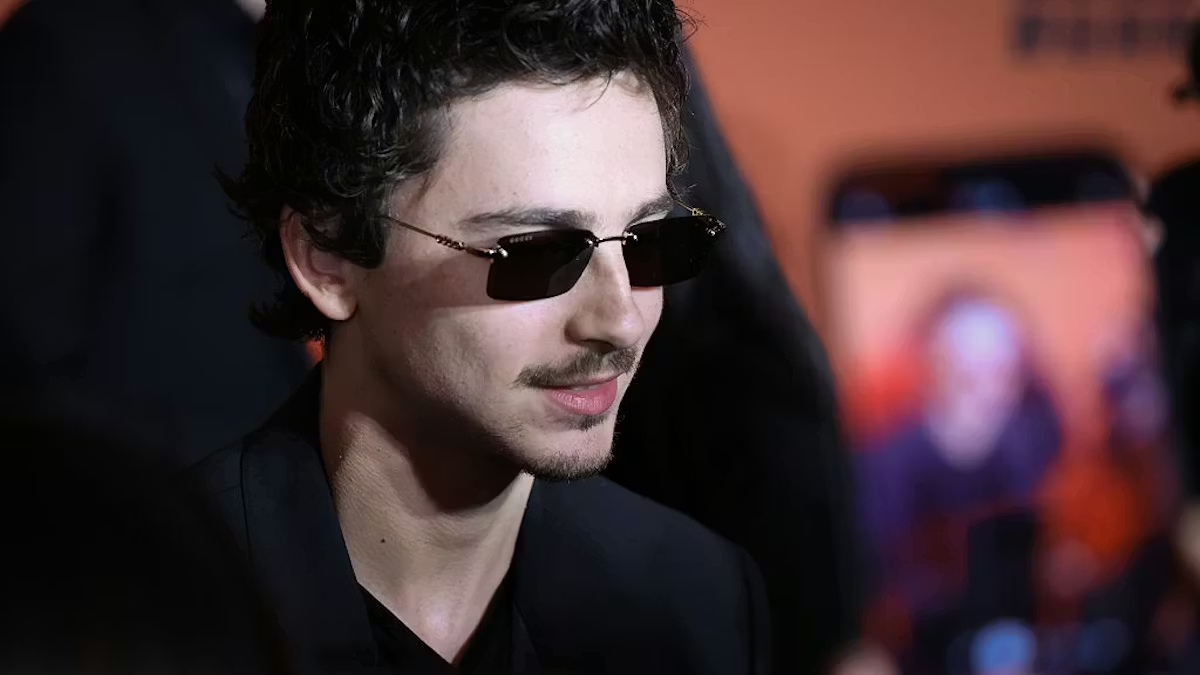
Rising movie star Timothée Chalamet sparked an online firestorm thanks to a recent CNN/Variety town hall with Matthew McConaughey. “We gotta keep movie theaters alive,” he said, before adding, “I don’t want to be working in ballet or opera,” dismissing the performing arts as things being “kept alive” despite the fact that “no one cares about this anymore.”
Tone aside, Chalamet’s remarks raise an important question: How relevant are the performing arts today? Certainly, the best boxes at the Metropolitan Opera are no longer coveted with the same pitiless tenacity by our leading culturati as in HBO’s “The Gilded Age,” and new contemporary operas now premiere before niche audiences — or, in my case, those roped into them by inflexible season subscriptions — before being discussed in the skimmed pages of the New Yorker. But this is both expected and normal. As culture ebbs and flows, so too do its dominant art forms. Jazz trios and rock-and-roll bands, each of which enjoyed its own period of hegemony in the 20th century, are hardly at the bleeding edge of culture today. That does not make them any less important.
Movies and cinema, like ballet and opera, are ultimately mediums for storytelling. That Chalamet — whose grandmother, mother, and sister all danced with New York City Ballet — should so casually dismiss their relevance is a symptom of youth and the tendency to mistake provocation for insight. Some of the greatest and most enduring stories in Western culture can be traced through the librettos and scenarios of opera and ballet.
Long before we were inundated with sprawling franchises like Marvel’s MCU, Chalamet’s own “Dune,” “The Lord of the Rings,” or even “Star Wars,” Richard Wagner had already pioneered the blueprint for the interconnected multi-part epic in his “Ring Cycle (Der Ring des Nibelungen).” He helped codify the modern fantasy trope of the magical artifact (the one ring) and its corrupting power, along with the mythic hero’s journey destined to save the world.
Tchaikovsky’s “Swan Lake,” meanwhile, with its dark and brooding dramatic tensions, anticipates the now-familiar psychological thriller, complete with the fractured self and the haunting interplay between innocence and corruption. And what modern romantic comedy or social satire can truly stand up to Mozart’s farcical triumph “The Marriage of Figaro”? In it, a clever valet must outwit his own master, a plotting count intent on seducing the valet’s fiancée. It is a brilliant societal romp whose DNA, replete with class-defying wit, romantic intrigue, and strategic social maneuvering, is still visible in later Hollywood classics such as Billy Wilder’s “The Apartment.”
The Gothic romance, too, can trace some of its roots through ballet. In “Giselle” (1841), with its eerie second act and the “Dance of the Willis,” the vengeful spirits of betrayed women force faithless men to dance until they die. The contours of both classic and current horror are also palpable, from the supernatural to the erotic, the punitive, and the dead returning to settle old scores.
And few works can claim a more far-reaching cultural influence than Igor Stravinsky’s “The Rite of Spring” (1913). The Russian composer’s revolutionary use of jagged, primitive rhythms — stabbing, percussive chords that feel like a heartbeat or pulsate like a predatory hunt — laid the groundwork for modern suspense music. Its echoes can be heard in countless film scores, including the work of John Williams, from “Jaws” (1975) to “Star Wars” (1977).
And if you are still unconvinced of opera and ballet’s enduring relevance, you need only open your favorite streaming service and search for “Dance of the Sugar Plum Fairy” from “The Nutcracker” (or better yet, try getting last-minute “Nutcracker” tickets around Christmastime), Rossini’s overture to “The Barber of Seville,” “Libiamo, ne’ lieti calici” from Verdi’s “La Traviata,” the Habanera from Bizet’s “Carmen,” “La donna è mobile” from “Rigoletto,” or Puccini’s “Nessun dorma.” Even for those who do not recognize the operas or ballets from which they come, or know anything of their plots, these pieces remain ubiquitous cultural fixtures. They have appeared in countless films, cartoons, commercials, and public spectacles. They are etched into our collective memory whether we realize it or not.
It is also a misconception that today’s concert halls and opera houses are populated exclusively by wheelchair-bound octogenarians. Anecdotally, as someone who attends these performances regularly, that caricature is plainly false. In the past two years, I have seen sold-out performances of Tchaikovsky’s “Eugene Onegin,” Puccini’s “Madama Butterfly,” and Mahler’s Ninth Symphony, to name just a few, all met with rousing standing ovations and audiences that included not only elderly patrons, but plenty of younger faces as well. A recent study from the Royal Philharmonic Orchestra reached a similar conclusion about the listening habits of young adults. Suffice it to say, classical music still has an audience, and a living one at that.
Chalamet is right to worry that movie theaters should remain vital parts of our shared culture. But culture is not a static snapshot of whatever happens to be fashionable at a given moment. It is a long, evolving exposition that bridges past and present and melds tradition and innovation. It would indeed be a sign of stagnation if the only works we had left to discuss were revivals of 19th- and 20th-century masterpieces; culture must continue to produce new forms, new stories, and new art. But if we sever our connection to the past, we also sever ourselves from the traditions that taught us how to tell stories in the first place. And that loss would not only impoverish opera and ballet. It would impoverish cinema too.
***
Harry Khachatrian (@Harry1T6) is a film critic for the Washington Examiner’s Beltway Confidential blog. He is a software engineer, holds a master’s degree from the University of Toronto, and writes about wine at BetweenBottles.com.
The views expressed in this piece are those of the author and do not necessarily represent those of The Daily Wire.