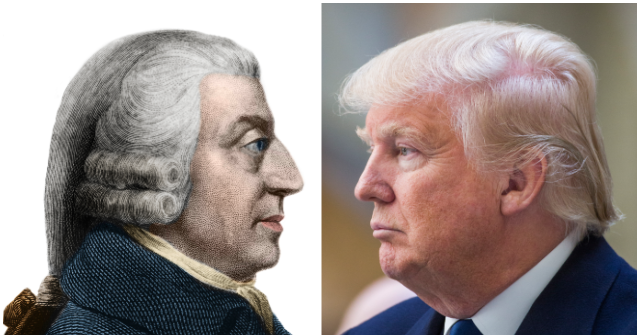
Donald Trump and Adam Smith vs. the Washington Consensus
This year marks the 250th anniversary of Adam Smith’s The Wealth of Nations, which is fitting because official Washington has spent much of the modern era quoting Smith without reading him very carefully.
In Washington and much of economic academia, the settled view is that if government is going to meddle in industry, it should do so in the tasteful way: subsidies, tax credits, grants, “investment,” “partnership,” “targeted support.” Tariffs are considered vulgar. Tariffs are blunt. Tariffs have side effects. This was the theory behind the Biden administration’s favorite toys, from the CHIPS Act to the Inflation Reduction Act. Industrial policy was fine so long as it arrived in the form of federal checks and conferences in mountain resorts.
President Donald Trump has rejected this consensus from rotten fish head to fin.
He sees the Biden subsidies as wasteful and corrupt, rewarding political conformity, cementing cozy oligopolies, and laundering favoritism through the language of national renewal. Tariffs, in Trump’s view, are a far better industrial policy. They raise revenue, preserve competitive pressure, and can be used to pry open foreign markets while giving domestic producers reason to invest, improve, and expand.
Many economists prefer the Washington model. Trump, however, has an ally of some consequence: Adam Smith.
The Forgotten Smith
Smith’s central insight was not that imports are good and tariffs are bad. His central insight was that a nation’s wealth lies in its productive powers. He begins The Wealth of Nations with the famous claim that the annual labor of every nation is the fund that supplies it with the necessaries and conveniences of life. Later, he adds that consumption is the sole end and purpose of all production.
These are not contradictory thoughts. They are the same thought. Production is not the point of economic life. But without production, there is nothing to consume except borrowed time and other people’s output.
This point has been steadily blurred by modern Smithians, who tend to remember only the parts of Smith that flatter the habits of late-stage consumer societies. They like the imports. They like the cheapness. They like the air of sophistication that comes from telling a country not to worry about what it makes so long as the container ships keep arriving. What they forget is that Smith did not treat wealth as passive access to goods financed by debt. He treated wealth as the annual produce of labor.
Trade mattered because it widened markets, deepened the division of labor, and increased production. It was valuable because it enlarged the scope for making things, not because it absolved nations of the need to do so.
Smith Against Subsidies
This brings us to the part of Smith’s classic tome that modern economists are least eager to quote.
In The Wealth of Nations, Smith is deeply hostile to bounties, which is his word for subsidies. He says they force trade into channels less advantageous than those in which it would otherwise run. They prop up trades that cannot stand on their own returns. They misdirect capital. They encourage the wrong activity for the wrong reason.
This can be a bit inaccessible to modern readers because Smith spends a good deal of time discussing the dangers of bounties by dissecting subsidy the British government offered for herring. To us, the herring bounty may sound quaint. It was not. Herring was a major commercial staple in northern Europe, and the British state treated the fishery as strategically important for food, exports, shipping, and seafaring strength. The subsidy was meant to build up the industry by paying vessel owners according to the tonnage of their boats. Smith’s objection was not that the industry was trivial. It was that the instrument was rotten.
His treatment of the herring bounty is especially merciless. Smith does not regard it as enlightened support for a strategic domestic industry. He regards it as a racket. The bounty was paid by tonnage rather than success, which meant vessels could be fitted out for the purpose of collecting the subsidy rather than catching fish. It rewarded the wrong form of fishing, copied a Dutch model that made little sense for Scotland, and consumed large public resources for laughable results.
This is not a side note. It is Smith making a general point about industrial policy through subsidies. Bounties do not merely cost money. They debase production by severing reward from performance. They tempt producers to chase politics rather than customers. Ultimately, they warp the economy in a way that depletes a nation’s wealth rather than increases it.
That happens to be the defining assumption of the modern Washington model. Subsidies are presumed to be the elegant instrument. They do not look like protectionism. They can be routed through tax preferences, loan guarantees, and administrative discretion. They can be described as incentives rather than handouts. They flatter the managerial class because they require managers.
Smith saw through them.
Smith’s Defense of Herring Import Duties
Now for the part that should be causing a little discomfort in the polite salons.
In a January 3, 1780, letter to William Eden, written four years after The Wealth of Nations, Smith proposes ways to raise revenue without imposing fresh burdens on the public. One of them is to repeal import prohibitions and substitute them with “moderate and reasonable duties.” His reason is plain enough: “A prohibition can answer no purpose but that of monopoly.”
But he goes further.
Smith says prohibition commonly prevents the “improvement and extension” of the very industry it purports to help. He then turns to Dutch cured herrings. His solution is not to exclude them. His solution is to tax them. The Dutch goods would still enter the market, but at a higher price. British curers, Smith says, would “immediately endeavour to get this high price” by improving their own product through “superior care and cleanliness.” The result would be a faster improvement in quality, a wider extension of the manufacture, and eventually the ability to rival the Dutch in foreign markets.
Read that again slowly.
Smith is not merely saying a duty is less harmful than a prohibition. He is saying that a duty can produce desirable results. It raises revenue. It avoids monopoly. And it improves domestic production by creating the incentive for native producers to earn the better price through better goods.
And note that the duty Smith proposes as “moderate and reasonable” would cause jaws to drop on Wall Street and in Washington. Smith proposes a 50 percent duty on Dutch herring.
That is not the modern consensus. It is not even in the neighborhood of the modern consensus.
Donald Trump’s Smithian Capitalism
This is where the instrument question becomes unavoidable.
The Biden-Washington model says we should support industry with subsidies. Trump’s instinct is the opposite. He does not want industry built on subsidy. He wants import duties. He wants revenue at the border instead of demands on the Treasury. He wants foreign producers pressured by price. He wants domestic producers to improve under competition rather than settle into the comfortable semi-monopoly that always lurks behind public subsidy.
That is a much more Smithian mix than respectable opinion is prepared to admit.
Smith opposed prohibitions because they created monopoly. He attacked bounties because they misdirected production and rewarded the wrong behavior. He defended duties because they could raise revenue while preserving competition and encouraging industrial improvement.
On the 250th anniversary of The Wealth of Nations, it is worth noting that Adam Smith defended the policy mix now advanced by President Trump.