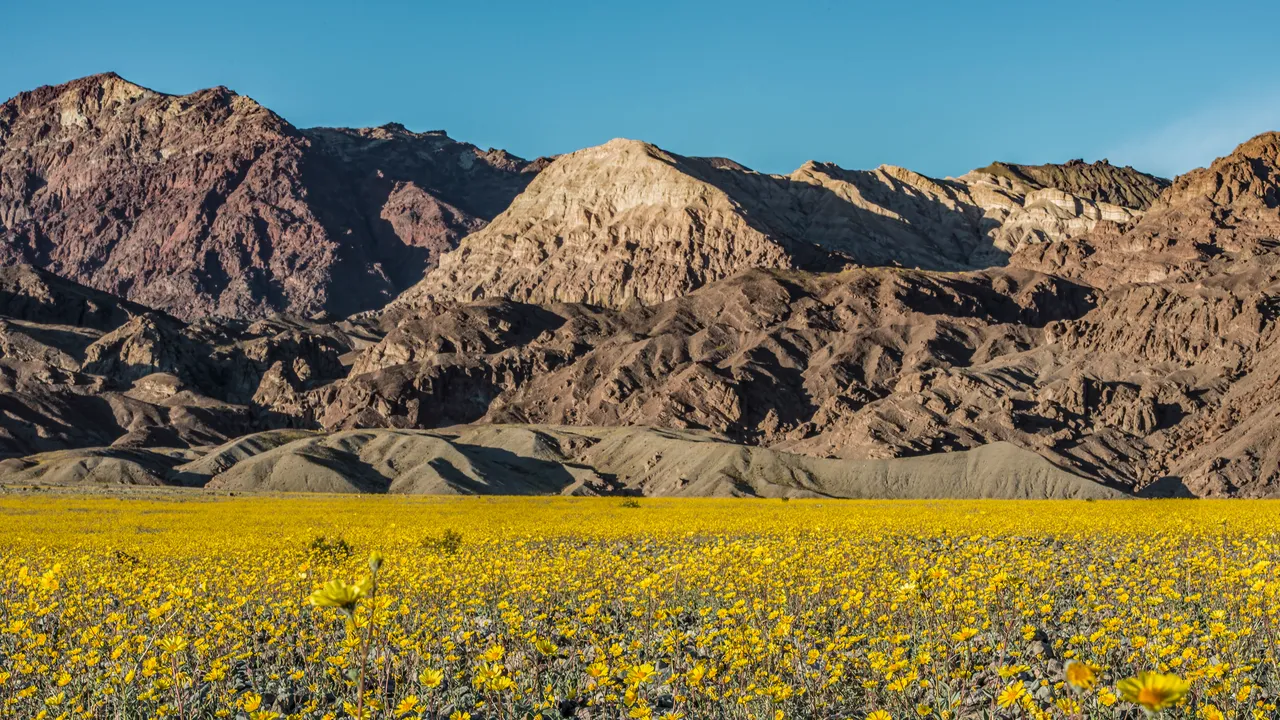
Death Valley, California—the hottest and driest place in North America—is rarely a place you associate with flowers. Its vast salt flats, jagged canyons, and sweeping sand dunes seem merely designed to test human endurance. Yet this spring, after an unusually rainy 2025, the desert is showing a side of itself few expect: colorful, vibrant, and breathtakingly alive
Swathes of Death Valley are now carpeted with golden desert gold, violet sand verbena, brown-eyed primrose, and bursts of grape soda lupine. The US National Park Service (NPS) calls it “the best blooming event the site has seen since 2016.” (And indeed, this fine magazine covered the event a decade ago.) Low-elevation blooms are already in full display through mid- to late March, while higher elevations will follow in April, stretching the desert’s seasonal awakening into early summer.
The trigger? Record rainfall. This past autumn, 2.41 inches of rain fell across the valley, soaking dormant seeds and washing away their protective coatings. quiet’s steady showers gave those seeds the moisture needed to root, sprout, and bloom before the desert heat returned. Most of Death Valley’s wildflowers are annuals, or ephemerals, meaning they live fast and die young. They survive the desert’s extreme conditions by lying dormant as seeds for years, then bursting into life when conditions allow.
According to NPS, you can walk through Badwater Basin, where the desert gold forms a golden carpet against the stark white salt flats. Sand verbena spreads in patches of deep violet, while clusters of brown-eyed primrose dot sandy washes. Grape soda lupine adds flashes of pink and magenta along ridgelines near Zabriskie Point. Even the park entrance sign is surrounded by a bed of color, a stark contrast to the barren expanses that usually greet visitors. The blooms also attract a flurry of desert pollinators. Bees, butterflies, moths, and hummingbirds are drawn to the abundance, taking advantage of a resource that is otherwise scarce. For a brief window, the desert is abuzz with activity, a living counterpoint to its usual quiet.
NPS advises visitors to respect the fragile landscape: As tempting as it may be, do not pick flowers; park fully off road shoulders; and watch for deep sand or uneven edges. Some flowers can irritate the skin, so observing them without touching is safest. Spring is a high-traffic season, so expect limited parking and crowds at popular viewpoints.