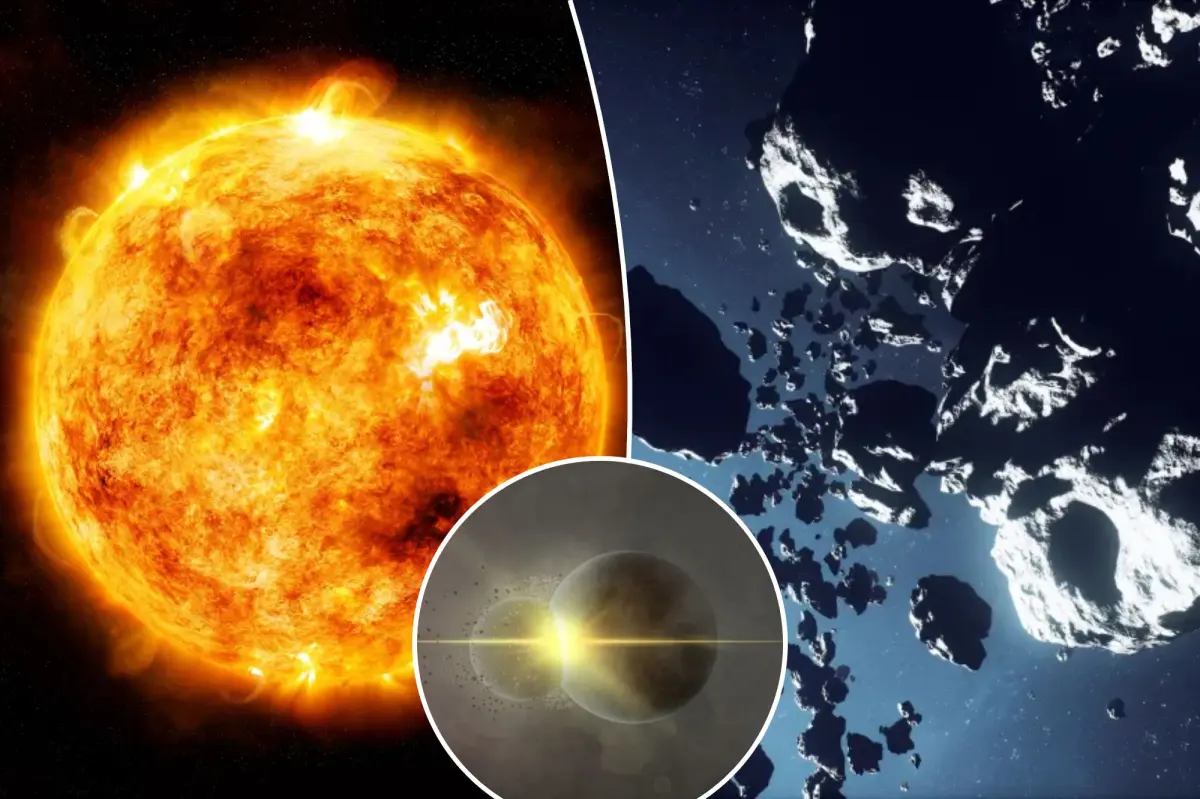
When worlds collide…suns act squirrely.
Astronomers have witnessed a rare and violent cosmic crash between two planets, and they say the fallout could teach us about the formation of our world.
The astral accident took place near the constellation Pupis, some 11,000 light-years from Earth. For the uninitiated, a light-year is nearly 6 trillion miles.
Reviewing telescope observations, astronomer Andy Tzanidakis, a doctoral candidate in astronomy at the University of Washington, noticed that Gaia20ehk, a “main sequence” star similar to our sun, was acting out of sorts.
According to Tzanidakis, while main-sequence stars typically shine with rock-steady brightness, Gaia20ehk began flickering chaotically.
“The star’s light output was nice and flat, but starting in 2016, it had these three dips in brightness. And then, right around 2021, it went completely bonkers,” he said. “I can’t emphasize enough that stars like our sun don’t do that. So when we saw this one, we were like ‘Hello, what’s going on here?’”
Tzanidakis and other researchers eventually deduced that the ‘bonkers’ dimming effect was not caused by the star itself but from massive amounts of hot dust and rock debris drifting in front of it, blocking the light traveling toward Earth.
They believe the heavy debris was formed by a brutal collision between two heavenly bodies; their analysis was published on March 11 in The Astrophysical Journal Letters.
Unlike other stars that display dramatic changes in brightness, Gaia20ehk’s luminosity briefly dipped and then became erratic. The team struggled to comprehend this pattern until they shifted their observations from visible to infrared light.
“The infrared light curve was the complete opposite of the visible light,” Tzanidakis said. “As the visible light began to flicker and dim, the infrared light spiked. Which could mean that the material blocking the star is hot — so hot that it’s glowing in the infrared.”
The team maintains that a planetary collision is quite capable of cooking up that level of heat and would also explain the initial dip in brightness.
“That could be caused by the two planets spiraling closer and closer to each other,” Tzanidakis said. “At first, they had a series of grazing impacts, which wouldn’t produce a lot of infrared energy. Then, they had their big catastrophic collision, and the infrared really ramped up.”
Tzanidakis believes that this space spectacle can offer insights into how our world was born.
“There are only a few other planetary collisions of any kind on record, and none that bear so many similarities to the impact that created the Earth and moon. If we can observe more moments like this elsewhere in the galaxy, it will teach us lots about the formation of our world,” he said.
Primary among the similarities between this latest collision and our solar system is that the debris cloud surrounding Gaia20ehk appears to orbit the star at about 1 astronomical unit, roughly the distance between Earth and the Sun.
Tzanidakis shared that at that location, the scattered material could cool and combine to form new planetary bodies similar to those in our Earth-moon system, though the timeline for this cool-down-and-combine routine could take a few years…or a few million.
Still, studying these collisions can provide insights into how planetary systems form and evolve and help determine what worlds beyond our own might be fit for habitation.
“How rare is the event that created the Earth and the moon? That question is fundamental to astrobiology,” said senior author James Davenport, a UW assistant research professor of astronomy.
“It seems like the moon is one of the magical ingredients that make the Earth a good place for life. It can help shield Earth from some asteroids, produce ocean tides and weather that allow chemistry and biology to mix globally, and even play a role in driving tectonic plate activity.”
The team notes that at present, we don’t know how common these qualities are, but if we witness more collisions, we’ll have a clearer understanding of how plausible the habitation of other planets might be.
Previous research has suggested that Theia, a Mars-sized celestial object from the outer solar system, collided with Earth, enabling life on the planet.