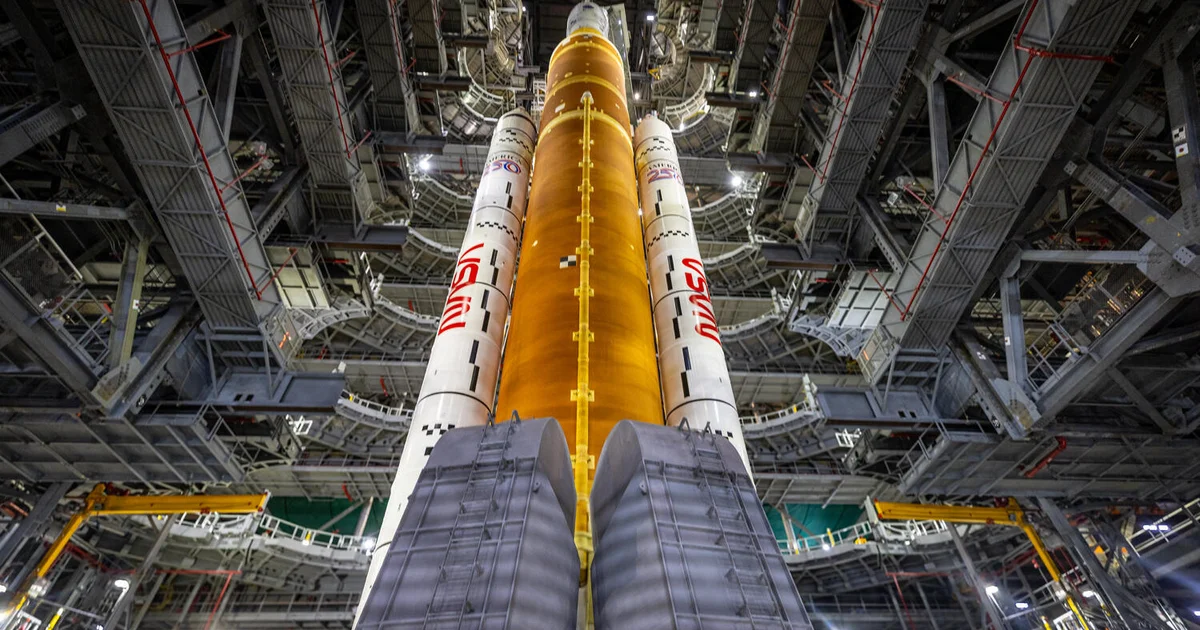
NASA plans to haul its Artemis II moon rocket back out to its seaside launch pad next week to ready the huge booster for blastoff as early as April 1 on a delayed-but-historic flight to send four astronauts on a nine-day trip around the moon, the agency announced Thursday.
At the conclusion of a two-day flight readiness review, “all the teams polled ‘go’ to launch and fly Artemis II around the moon, pending completion of some of the work before we roll out to the launch pad,” said Lori Glaze, associate administrator of Exploration Systems Development at NASA Headquarters.
“Just a reminder to everybody, we talk about it every time we talk about this flight, it’s a test flight, and it is not without risk. But our team and our hardware are ready,” Glaze said.
NASA/Frank Michaux 
Based on the ever-changing positions of the moon and Earth, along with a complex mix of mission objectives, NASA must launch Artemis II by April 6, or the flight will slip another month or so. For an April 1 launch, liftoff is expected at 6:24 p.m. EDT, followed by splashdown in the Pacific Ocean nine days later.
NASA workers had hoped to launch the Space Launch System rocket, the Orion crew capsule and its four passengers — Artemis II commander Reid Wiseman, Victor Glover, Christina Koch and Canadian astronaut Jeremy Hansen — in early February.
But the long-awaited flight was delayed by hydrogen fuel leaks and, more recently, by problems with the rocket’s upper stage propellant pressurization system.
The hydrogen leaks were fixed at the launch pad by replacing suspect seals in the umbilical system that attaches fuel lines to the base of the rocket. But engineers could not access the upper stage at the launch pad, and the entire rocket had to be hauled back to NASA’s Vehicle Assembly Building for repairs.
Once inside the cavernous facility, upper-stage access platforms were extended and engineers quickly found a displaced seal in a helium quick-disconnect fitting. Pressurized helium is used to push propellants through the propulsion system and to help drain and dry propellant lines.
Replacing the displaced seal fixed the pressurization system problem, and crews went ahead with needed work to replace batteries in the rocket’s self destruct system, strap-on boosters and both SLS stages. They also charged batteries in the Orion capsule’s launch abort system.
That work is virtually complete, and NASA managers said the rocket should be ready for the start of its 12-hour roll to pad 39B next Thursday evening.
“I was very proud of the team and the work that they did to quickly understand the root cause and get us back in a posture to roll back out,” said Shawn Quinn, manager of Artemis ground systems. “So far, the VAB processing has gone very well.”
Summing up the flight readiness review, Glaze said mission risk was a topic of discussion, but she and John Honeycutt, chair of NASA’s Artemis mission management team, declined to provide any actual numbers during a Thursday news conference.
In a report released last week, NASA’s Office of Inspector General said the agency’s “risk threshold” for an Artemis moon mission, based on the presumed use of a SpaceX lander, was expected to be in the realm of 1-in-40 during lunar operations, while the overall mission risk was put at 1-in-30 from launch to splashdown. The report said the risk of death faced by Apollo crews was 1-in-10.
Artemis II is not a lunar landing mission, which would imply lower risk overall, but it will still be only the first piloted flight of an SLS rocket and Orion capsule after a single unpiloted test flight in 2022.
Citing the short flight history and the long gap between launches, Glaze and Honeycutt both said coming up with a realistic overall risk assessment for the Artemis II mission is difficult.
“I think sometimes we get tricked into believing that those numbers are somehow really telling us something critically important,” Glaze said. “I think they’re valuable. I think we can do things in a relative sense to measure what is more risky or less risky.
“But I agree with John that in this sense, it’s not the first flight, but we’re also not in a regular (launch) cadence. So we definitely have significantly more risk than a flight system that’s flying all the time. But I’m with him, I wouldn’t actually put a number on it.”
NASA’s Artemis program, established during the first Trump administration, is aimed at returning astronauts to the surface of the moon. The original target was 2024, but budget shortfalls, the COVID pandemic and a variety of other issues triggered repeated delays, eventually pushing the first moon landing to 2028.
That’s still the case even though NASA revised the near-term launch sequence two weeks ago. As before, the agency plans to launch the Artemis II crew on the first piloted test flight of an SLS rocket and Orion capsule as early as April 1.
That flight will now be followed by an additional mission next year — Artemis III — in which astronauts aboard an Orion capsule in low-Earth orbit will rendezvous and dock with one or both moon landers being built by SpaceX and Blue Origin. That will allow NASA to test the spacecraft and procedures in space before attempting an actual landing.
If those flights go well, the agency hopes to launch at least one and possibly two lunar landing flights in 2028 using whichever landers are available. After that, NASA plans to launch one moon landing flight per year to develop the procedures and infrastructure needed for eventual flights to Mars.
But Mars is a purely aspirational goal goal at present. In the near term, Artemis II is the center of NASA’s attention.
Like Artemis I, the Artemis II Orion crew ship will not go into orbit around the moon. Instead, it will follow a “free return” flight path that will carry the crew around the far side of the moon, using lunar gravity to bend its trajectory back toward Earth for a splashdown in the Pacific Ocean nine days after launch.
As such, they plan to spend the first full day of their mission checking out the Orion’s flight control, communications, navigation and life support systems in low and high Earth orbit before finally setting off for the moon.
Assuming an on-time launch April 1, the crew will fly within about 4,100 miles of the moon’s surface at closest approach and in so doing travel farther from Earth than any other humans — around 252,800 miles.