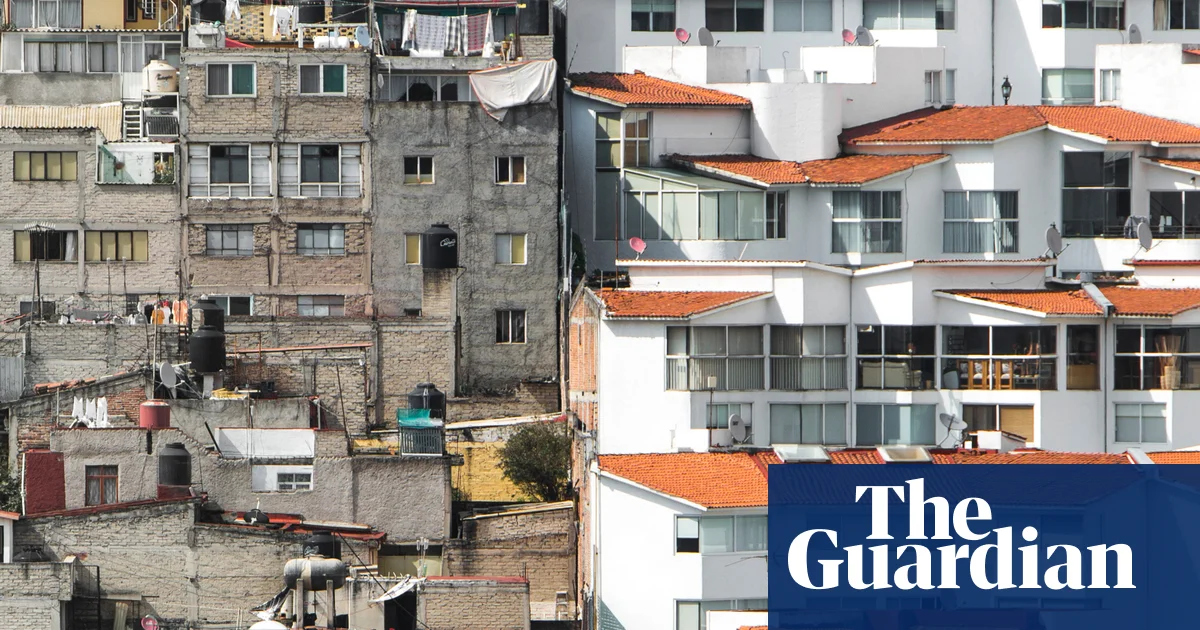
Scrunched between luxury apartment buildings and a lush gated community, the neighborhood of Santa Lucía Reacomodo in Mexico City is a working-class pocket of real estate. Electrical wires tangle above cinder-block houses, stray cats slink down narrow streets, debris piles up on the pavement.
María del Socorro Corona, 79, arrived here decades ago, back when it was just a cactus-covered hillside. The two-bedroom turquoise house she built with her now-deceased husband is crammed with bags of clothes and knick-knacks she sells at a weekly market.
“I have to make money,” she said, “or I won’t eat.”
While most people built their homes here in the 80s and 90s, the area really started to change about 20 years ago, Corona said, when the government constructed a bridge connecting Mexico City to the high-end business district of Santa Fe nearby. Foreigners came wanting to buy up their land, but none of the neighbors wanted to sell.
“So now the rich are over there,” she said, pointing at one of the looming luxury apartment buildings: row upon row of glass balconies with carefully manicured hedges. “And the poor are over here.”
The stark contrast in this little enclave of the capital is a microcosm of a problem that has plagued Mexico for decades: rampant income inequality, with a small slice of the population living in opulence while millions of families languish in poverty.
“Mexico is unbelievably unequal – it’s almost inconceivable,” said Viri Ríos, a public policy expert and director of Mexico Decoded. “Inequality in our country has been around for centuries: we’ve just grown accustomed to living this way.”
A recent report by Oxfam Mexico shed light on the problem: the richest 1% of the population owns 40% of the country’s wealth, according to the report, while nearly 19 million people struggle to put food on the table.
And in line with international trends, the rich here are only getting richer. Mexico’s 22 billionaires have seen their fortunes double in the last five years, reaching an unprecedented collective wealth of $219bn, according to Oxfam. Between 1996 and 2025, the wealth of Carlos Slim – the richest man in Latin America – increased more than eightfold, while the wealth of all other billionaires more than quadrupled.
“Over the past 30 years, extreme wealth concentration has become entrenched in Mexico,” the report reads. “Ultra-rich Mexicans have never been so numerous or so wealthy as they are today.”
There is some good news. While the super-wealthy have grown wealthier, the poor have got somewhat less poor. Thanks largely to substantial increases in the minimum wage, during the six-year term of former president Andrés Manuel López Obrador, the number of people living in poverty dropped by 13.4 million, a decrease of almost 26%.
The number of people living in extreme poverty also dropped from nearly 9 million to just 7 million. According to the World Inequality Database, which tracks inequality worldwide, as of 2024 Mexican inequality was at its lowest point since 2006.
“What we’re witnessing are historic reductions in Mexico’s inequality,” said Ríos. “There are many policies, especially labor policies, that are changing income distribution in the country in ways we haven’t seen in decades.”
Still, while the gap between rich and poor might be narrowing, it remains a chasm, with the wealthy living in exclusive gated communities, and poor or working-class Mexicans relegated to sprawling cinder-block slums.
“Rich Mexicans have been very effective at isolating themselves from the rest of the country,” said Ríos. “Not only because of the neighborhoods they live in, but because of the way they live, because they don’t use public services like health or education.”
Santa Lucía Reacomodo is a case in point. While the the neighborhood can be reached by anyone, both the gated community of Bugamvillas on one end and the apartment buildings on the other side are accessible only to residents and their guests, with strict security measures in place.
When this reporter attempted to enter Bugamvillas, uniformed security guards turned him away. Outside the complex that includes the luxury towers visible from Santa Lucía, a police pickup truck idled near a manicured pond and the security guard wouldn’t even provide the name of the gated area.
Security in Santa Lucía is a different story.
Sebastián Cejalugo, 36, has lived in the neighborhood his whole life. As a kid he used to play out on the streets until 10pm. Now a garbage collector, he says the neighborhood is filled with “lots of thieves and lots of drugs”.
“After 8 or 9pm you’re done for,” he said.
Francisco González, 59, also says the neighborhood has changed and not for the better: “It used to smell like forest,” he said. “Now it smells of cats, dogs and marijuana.”
González is also annoyed at the bridge just a few hundred meters from his house: the rush of traffic is a constant hum, punctured regularly by police or ambulance sirens.
“And another thing is the people who have lots of money own sports cars,” he said. “You can hear them roaring early in the mornings.”
But as far as the wealthy developments that have surrounded Santa Lucía, residents say they have benefited the community by providing jobs: Cejalugo once worked as a carpenter repairing doors and windows in the Bugamvillas gated community.
“The houses are luxurious,” he said. “Even their kitchens are pretty.”
Still, Cejalugo prefers living in Santa Lucía.
“The houses in Bugamvillas are cool because of the luxuries,” he said. “But here we have parties, Christmas celebrations, feasts celebrating the Virgin. Over there, there’s none of that.”
Cejalugo’s family home is one house down from a 10-foot wall that divides the neighborhood from Bugamvillas. His aunt Pilar said the wall has been there for as long as Santa Lucía has existed.
“That’s the wall that divided us,” she said.
“The rich from the poor,” responded her nephew.