This is a game for people who like pain, more pain, and pretty sunsets.
TL;DR
Pros:
- An interesting blend of concepts and gameplay mechanics
- Difficulty that scales well to personal preference
- Divinely scenic landscapes with a great photo mode to take advantage of them
- Swelling, solemn music interspersed for extra majesty
- Well-paced storytelling with promising insights into the main character and universe
Cons:
- Slow, sometimes quite tedious gameplay
- Some issues with stability, visual clipping and overheating
Score: 5/7 — Not for the faint of heart, but well worth a try
Reviewed on PC; available on PC (Windows) and PlayStation 5.
Price: $10.49 (Steam); $29.99 (PlayStation Store). Deluxe add-on: $5.89 (Steam); full Deluxe Edition for $36.99 (PlayStation Store).
I love hard games. I really, really love hard games. So when I nearly crashed out and gave up on Cairn a few hours in, I don’t want you all to think it’s because I’m a wimp who can’t handle a challenge.
I’m glad I didn’t bail, though. This new indie release by The Game Bakers — known for Furi and Haven — is as unforgiving as it looks, and doesn’t beat around the bush about it. But it’s highly rewarding, as well as visually stunning, once you finally hit your stride. After all, it’s a game about climbing a mountain. How could it be anything but beautiful and tough?
A great blend of mechanical concepts
It’s a simple premise at its core: here’s a mountain that’s killed most everyone who tried to climb it.
Go on, then.
Cairn introduces a subtly techno-futuristic world and your protagonist Aava (excellently voiced by Sophia Eleni), a steely professional mountain climber. As the game progresses, you learn more about her, getting a glimpse into a strong personality with a rich inner life.
Along with her helpful companion droid Climbot, Aava is setting out to climb the unconquered Kami: the highest summit of the world in-game, so dangerous that few people ever come back. This is hammered home by the fact that you discover your first corpse about 90 minutes in.
The game is a mountain climbing simulator that heavily features survival game elements, as you’re fighting to find food and shelter while facing the dangers of the mountain. These include: losing your footing in pouring rain, getting lost in the sprawling landscape, and apparently… bears.
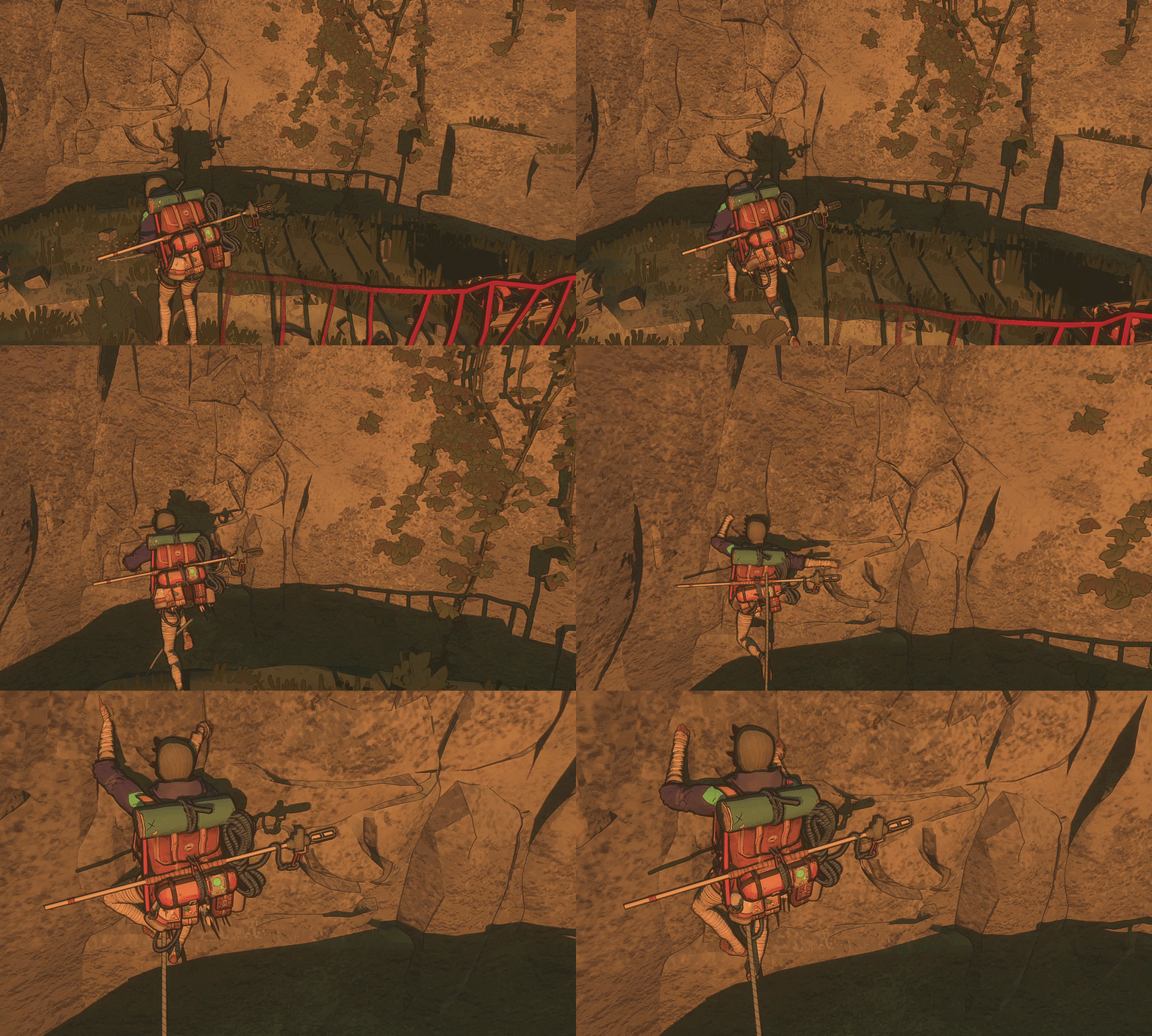
The real point of fascination with Cairn is its core gameplay mechanic: the climbing simulation. You climb this titanic mountain cliff by tedious cliff, selecting and moving each one of Aava’s limbs in turn to find precarious purchase on rock faces — over and over and over, until you reach stable ground or die trying.
To be completely honest, it took me hours to get into this aspect (maybe simulators just ain’t for me). It’s very, very slow, especially when you’re bad at it like I am. Thankfully, after a little practice, it gets familiar enough that I even started enjoying how puppeting Aava around can feel like QWOP on steroids.
You also have a certain amount of stamina, as well as hunger, thirst and cold to keep in check with limited resources. You can rest and recoup at shelter points along the climb, but if you take too many bad falls or run out of food you’re dead, and restart from your last save point.
I’m no stranger to difficult mountain climbing games, but this is certainly not Celeste. Survival games and simulation games are both among my least-played genres, so this was a fun new challenge for me. At least, it got more fun when I finally decided to abandon shame and tailor the difficulty to suit me better.
Difficulty that scales to your needs
At its core, I think you have to struggle a little to be playing Cairn the way it’s intended. But you don’t have to suffer more than what’s enjoyable for you.
I bailed on my first save file a couple of hours in, once I realised I had saved over some bad choices and wasn’t even having fun. For my next playthrough — for journalistic research, of course — I switched from ‘Alpinist’ to ‘Explorer’ mode, which promises to go a bit easier with its survival mechanics and even allows you to rewind bad climbing choices.
(Note that there’s also an extra-hard Free Solo mode. I will not touch this with a 10-foot pole.)
You can also individually enable other accessibility settings, even removing the survival mechanics altogether. I haven’t done this, but there’s no shame in it if you’d rather have a less stressful experience.
For me, the difference made by Explorer mode was immediate: I finally felt like I was making progress at a decent enough clip to at least review the game meaningfully. For those of you who don’t have jobs or anything better to do, feel free to take as long as you like being Real Gamers.
The rocky aspects
Cairn nearly lost me over how long it seems to take to get anywhere. Sure, the painstaking hand-over-hand climbing is part of the idea, but sometimes it takes tolerance just to cover stable ground.
On my first playthrough, I actually bailed on exploring most of the brilliant, sprawling map (bad idea for a game with foraging mechanics, by the way) because just walking around felt like a needless test of patience.
You can also run, but it eats at your stamina. Interesting choice! I don’t like it.
I know this game specialises in realistic mechanics. But if it can let me put full bowls of steaming hot food straight into my backpack for later, I think it could stand to let me walk slightly faster without sacrificing a vital resource. We’ve already taken a bat to realism.
My other minor nitpicks relate to stability. There are visual issues — noticeably with clipping, brief freezing and wobbly limb placement — though usually not bad enough to interfere with gameplay. There are also a few issues with interfacing, like losing mouse input on occasion and struggling with photo mode settings. None of it is a dealbreaker, but it is noticeable.
Finally, do note that Cairn recommends a controller. While mouse and keyboard works okay, I also recommend a controller for PC players, if only because this game runs hot as a furnace and my fingertips were burning off on my non-specialised laptop.
Okay, that’s about it. Now onto some really great stuff.
A godly view
You might be asking: okay, this looks like a lot of suffering and big polygonal rock walls. What’s it all for?
I answer you: look at these freakin’ views.
Kami (‘god’) is an aptly named mountain, and the landscapes you see are equally divine. Day and night cycles are fairly quick, and watching the stars come out for the first time is a breathtaking experience. The game knows how pretty its skyline is, and throws in a great photo mode with lots of settings to help capture it.
If this is what you get at the very start, I will play as long as it takes to see what the higher peaks have in store. Even at its most tedious, Cairn rewards you with a new and beautiful view at every turn, with its blend of 2D and 3D art lending a gorgeous hand-painted look to a lot of the scenery.
Subtle musical serenades
There isn’t a whole lot of music (at least so far) during the climb, but what you do get is subtle, solemn and powerful, perfectly suited to the mountain’s majesty. While the main gameplay mostly avoids a backing track, maybe for added immersion, it knows when to use musical cues to let you know you’re getting somewhere, and to remind you to stop and take in the game for a moment.
I’m impressed by how sparingly and effectively Cairn uses music: a sweet and powerful music swell after a harsh climb is a breath of fresh air. I do wish the music would keep playing while I fiddle around with photo mode, though, as it often accompanies the most delightfully scenic shots.
While not always musical, sound design is still woven firmly into the game’s mechanics, as is visual design. Aava makes her exhaustion and precarious footing known with both visual and vocal cues, trembling and whimpering as she gets tired or under stress. Reading her body language and voice is crucial to avoiding a rocky death.
Verdict: Not for the faint of heart
I really appreciate what Cairn does with its immersive, gritty gameplay and its survival mechanics. That said, if it wasn’t for the scalable difficulty options, I’d have had an extremely hard time getting into it. If you do play this, decide early on what kind of challenge you’re looking for, so that you don’t sink too much energy into a save file you’ll start to hate later.
All told, I like this game a lot more than I expected to. It’s certainly not for everyone, genre-wise or challenge-wise, but it’s well worth a try if you enjoy being pushed to your limits.