
With Iran choking off one of the world’s most crucial shipping lanes, heads of government and industry now face a tough question: what can be done to stop them?
What is happening?
The Strait of Hormuz, which separates the Gulf States from Iran, is a waterway of huge economic significance, with a fifth of the world’s oil and gas trade passing through.
It’s also a big part of the global supply of various oil and gas-derived products, including fertiliser, plastics, and composite materials, according to Sky’s economic editor, Ed Conway.
So, facing sustained joint attacks from the US and Israel, Iran is retaliating by making global markets feel the pain, attacking shipping traffic in to narrow channel, which is just 24 miles wide at its narrowest point.
Iran war latest: New supreme leader ‘likely disfigured’
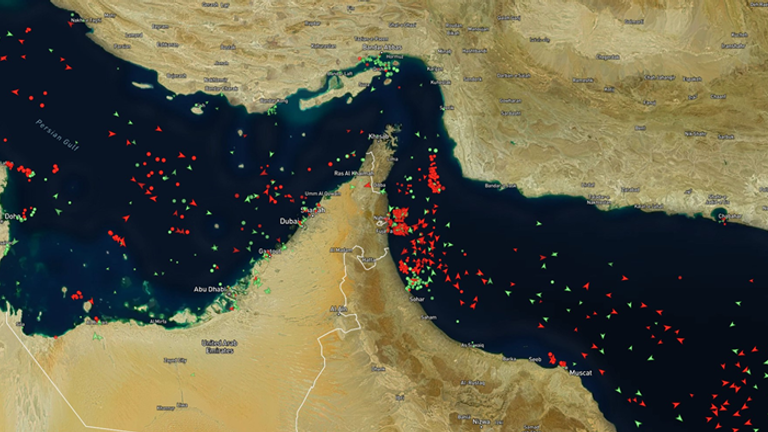
A satellite map of shipping in the Strait of Hormuz. Pic: AIS
Among the weapons in Iran’s arsenal are sea and air drones, anti-ship mines and missiles, submarines, and GPS jamming to undermine navigation systems.
What can America do?
Donald Trump has suggested US warships will escort commercial shipping through the strait “if necessary”.
During his weekly Q&A session Sky’s military expert Michael Clarke cast doubt on the idea.
“There are never enough warships to escort enough tankers through a difficult sea passage,” he said.

FILE PHOTO: Smoke billows from an oil tanker that was hit off Oman’s Musandam peninsula in the Straits of Hormuz. Pic: Reuters
He was also sceptical of the suggestion that oil tankers could be equipped with the means to defend themselves against drones.
“You need all the stuff that goes with it, so you need all of the radars and the target acquisition, as it’s called, the Istar – intelligence surveillance target acquisition and reconnaissance.”
Mr Trump has further suggested that the US would provide insurance and guarantees for shipping “at a very reasonable price”.
But Professor Clarke said the $20bn (£15bn) the American government has allocated to insurance “doesn’t touch the sides” given the possible costs.
Air defence destroyers
One possible method he suggested was “a gun line of air defence destroyers all the way along the Gulf facing the Iranian coast”.
“Then you’re almost certainly going to have to use air power to attack anything on the Iranian side of the coast, anything that moves,” he added.
But he warned that the Iranians might even welcome such an outcome.
He said: “It’s very intensive. I’m pretty sure the Iranians would quite welcome that, because it brings the Americans into fighting low down and dirty on [their] territory.
“And the chance of getting lucky, and the chance of being able to disrupt it would still be high.”
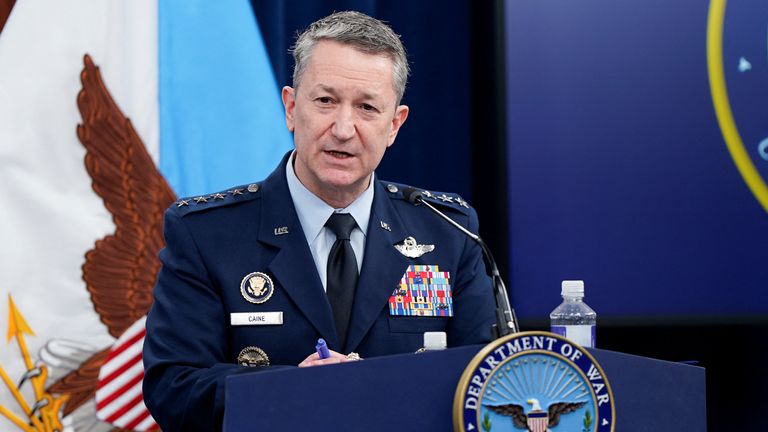
Chairman of the Joint Chiefs of Staff General Dan Caine holds a briefing. Pic: Reuters
General Dan Caine, the highest-ranking military officer of the US armed forces, told a press conference on Friday that they were focused on degrading Iran’s capability to disrupt shipping, without giving specifics.
“This means going after Iran’s minelaying capability and destroying their ability to attack commercial vessels,” he said.
Read more:
Why the Strait of Hormuz is so important in the war with Iran
UK weighs options to defend shipping in Strait of Hormuz
He added: “We’ve made it a priority to target Iran’s minelaying enterprise, their minelayers, the naval bases and depots, in addition to the missiles that could influence the Straits.”
He also said the Iranian navy had been rendered combat ineffective, but acknowledged that Iran still possessed attack capabilities at sea.
“Work on this effort continues,” he added.

The Thailand-flagged cargo ship Mayuree Naree.
Pic: Royal Thai Navy/Reuters
Jamming
Others have suggested that jamming GPS navigation systems may be as good a defence as it is an attack.
Dr Ramsey Faragher, director of the Royal Institute of Navigation, told Sky News that multiple countries may be using the technology in the Gulf.
“It’s probably a combination of Iran possibly turning up and turning on more of its own interference sources,” he said.
“But also I suspect neighbouring countries have now turned on some of their own in order to try to defend against the drone strikes.”
Disrupting navigation signals is one of the “cheapest and effective first lines of defence” against drone attacks, he added.
Can these efforts ultimately protect shipping in the Strait of Hormuz? With maritime traffic in the waterway almost at a standstill, it’s yet to be proven.

