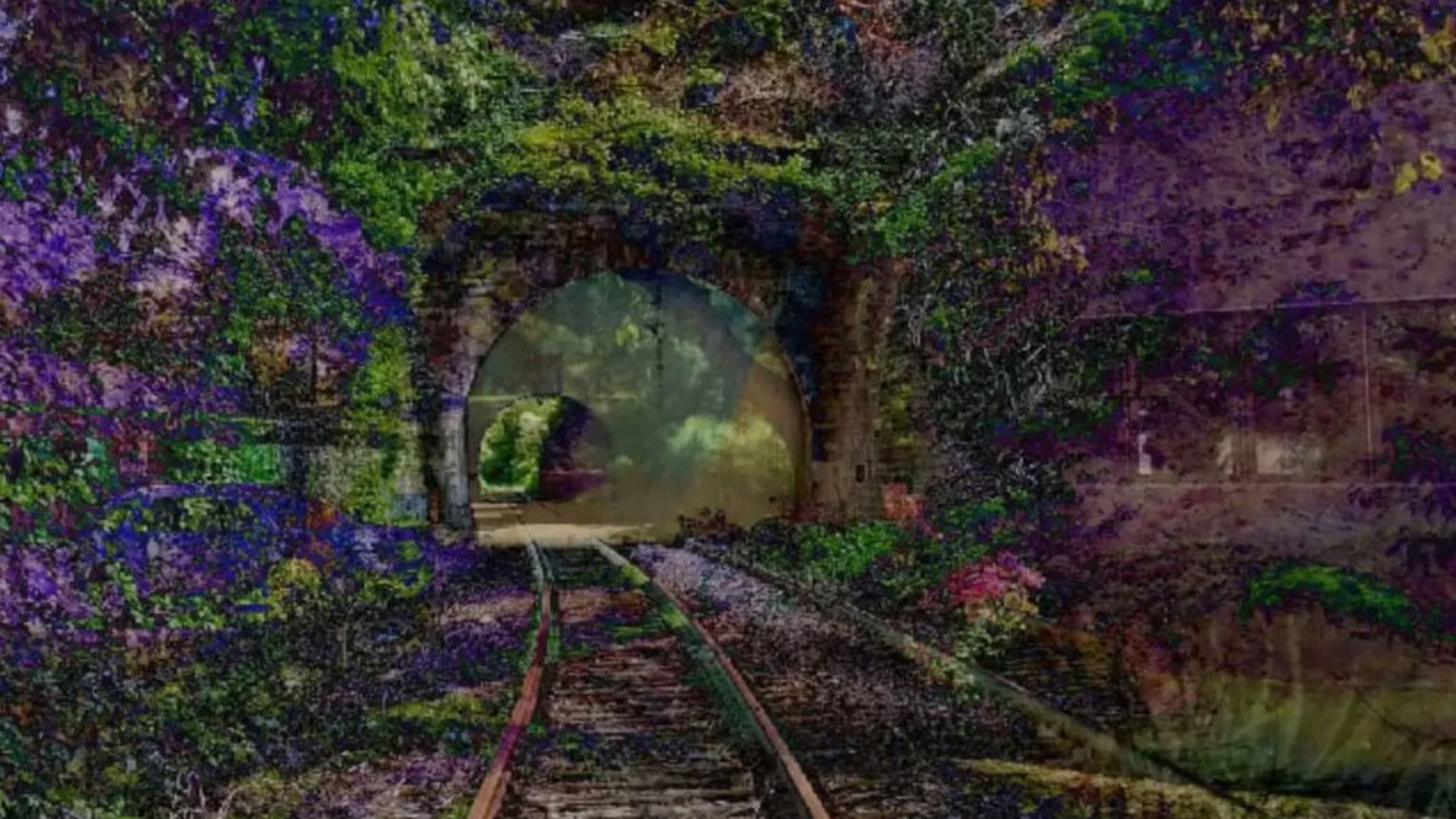
Computer scientist Stephen Thaler was well ahead of the curve when it came to generative AI. He created his own generative AI system, DABUS (Device for the Autonomous Bootstrapping of Unified Sentience), many years before the current boom, and used to create the piece of artwork you see above, entitled A Recent Entrance To Paradise.
I don’t feel scared that Thaler might sue us for using his art in this post because I know he doesn’t have a copyright in it, and I know that because courts have been telling him he can’t get a copyright in it since 2012. The most recent blow came on March 2, when the Supreme Court of the United States declined to hear Thaler’s appeal, affirming the lower court’s ruling that his artwork is ineligible for copyright because it lacks “human authorship.”
This pattern of decisions has implications for the future of AI in filmmaking, which has been a hot-button topic in Hollywood for the last few years.
Why can’t AI art be copyrighted?
State of the (generative) art
The U.S. Copyright Office issued a report in January of 2025 that basically sums up the current state of copyright in the age of generative AI. “Where A.I. merely assists an author in the creative process, its use does not change the copyrightability of the output. At the other extreme, if content is entirely generated by A.I., it cannot be protected by copyright,” it reads. “Between these boundaries, various forms and combinations of human contributions can be involved in producing A.I. outputs.” However, “prompts alone do not provide sufficient human control to make users of an A.I. system the authors of the output.”
Thaler’s artwork was created by a prompt alone, and the logic is that because the generative AI system does so much of the rest of the work itself, the resulting output isn’t eligible for copyright protection.
There’s been a lot of talk lately about Hollywood replacing actors, writers, and directors with generative AI, about Hollywood using AI to create movies and TV shows. But the content Hollywood studios produce is only valuable because it can be copyrighted and sold. If a studio has no copyright in its work, there would be nothing to compel people to pay to see it. Obviously Hollywood wants money, so they have an incentive to keep doing things the old-fashioned way.
But that doesn’t mean they can’t incorporate AI into their workflows
There are a lot of lines yet to be drawn
That said, there’s a lot of ambiguity in exactly how much AI you can use in an AI-generated film before it can considered a work of “human authorship.” If you search on social media, you’ll see a ton of posts saying things like “Hollywood is over” accompanied by an AI-generated video. Many of the latest such videos were created with Seedance 2.0, an advanced video generation model developed by tech company ByteDance. Some of these videos, like the one at the top of this article, were likely created with one prompt and can’t be copyrighted under current law. But others, like the one immediately above, might be different. That one was almost definitely generated by many prompts that were then strung together and massaged by human editors. Is that film eligible for copyright protection?
Works are considered by courts on a case-by-case basis, so the truth is that, right now, we don’t know. There are probably a lot of cases coming down the pike that will give us a clearer idea of what is and isn’t copyrightable.
At the moment, Hollywood is absolutely using AI as part of its production pipeline, but the base is still human-generated. For instance, below, watch a clip from the new season of Ted on Peacock where actor Seth MacFarlane plays President Bill Clinton. AI was used to make MacFarlane’s face look eerily like Clinton’s, but the full scene was still filmed with real people in front of and behind the camera, and it’s still clearly MacFarlane performing; you can hear him doing a Bill Clinton impression, rather than AI generating Clinton’s voice. This would absolutely be copyrightable.
Hollywood using AI to help, not replace, artists
For now…
Right now, the line you mostly hear from studios is that while generative AI will be a “tool” for artists, it won’t replace them. That’s the tack that Paramount CEO David Ellison said in a February earnings call. And Paramount just just outbid Netflix to buy Warner Bros., one of the biggest and most reputable studios on Earth, so what people like him say is important if we want to know where things are headed.
Netflix, too, is preparing for the future. On March 5, the studio bought InterPositive, a new AI filmmaking company created by Ben Affleck. Affleck’s idea is for filmmakers to use AI mainly in the post-production process. “You have to create your movie essentially first, before you can really build your model around your movie using AI, and once you do that, you have your model, you control it,” he said. Then you could use the AI model to remove wires from stunts, or change the color of someone’s costume, or whatever.
Affleck thinks that will speed up production without sacrificing the human artists involved. “You know, you might be able to get two seasons of House of the Dragon in a year instead of one,” he said on CNBC. When it comes to House of the Dragon, I’d settle for just one season per year, since we currently get one every other year; the third season is finally coming later this year, along with a lot of other fantasy shows.
Google is trying to teach its AI about morality
DeepMind warns chatbots mimic ethical language but may lack true moral understanding, proposing a roadmap to assess “moral competence.”
Even the government doesn’t want AI art to be copyrightable
Obviously generative AI is being used for tons of things nowadays, from coding to writing to planning your week. Given how quickly the technology has developed, it’s hard to predict where it will be in a few years, but for the moment the question of whether you can copyright a piece of art generated from a single prompt seems settled. Even the Trump administration, which has been very bullish on AI technology, encouraged the Supreme Court not to hear Thaler’s appeal, signaling they’re not interested in expanding copyright protection in that way.
But again, there’s a difference between art produced from a single prompt and the more complicated hybrid pieces of art we’ll probably see a lot more of in the future. There remain a lot more unanswered questions than answered ones.

- Release Date
-
2024 – 2024-00-00
- Network
-
Peacock
- Directors
-
Seth MacFarlane
- Writers
-
Dana Gould, Jon Pollack, Brad Walsh, Julius Sharpe, Paul Corrigan, Seth MacFarlane
- Franchise(s)
-
Ted