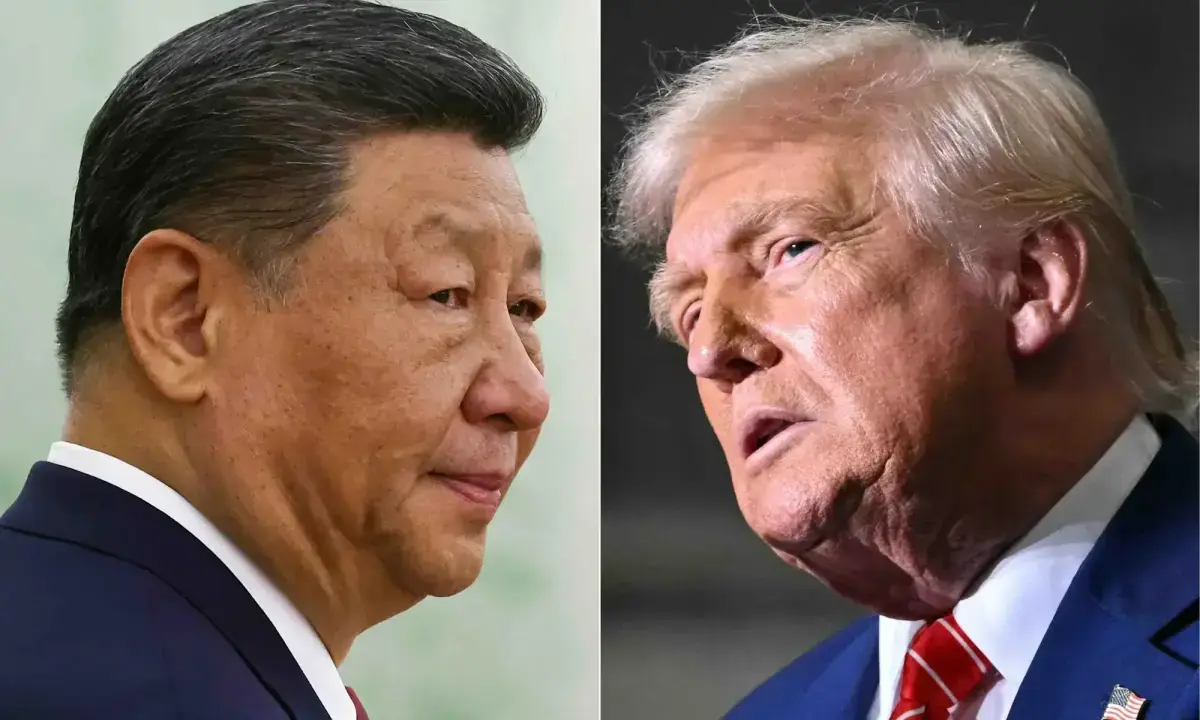
Just over two weeks before President Donald Trump is due to meet his counterpart Xi Jinping in Beijing, Chinese uncertainty over the US leader’s goals and the impact of the Iran war hangs over the highly anticipated state visit.
Trump’s trip, his first to China in his second term, is aimed at sealing a trade war truce the two leaders shook hands on when they met in South Korea in October.
But for Beijing, which likes to carefully choreograph such events to avoid any possibility of embarrassment, Trump’s free-wheeling style is proving a challenge.
A source familiar with negotiations told AFP that Chinese officials were expecting more ambitious preparations for such a summit between the leaders of the rival superpowers.
The White House insisted, however, that preparations were going well for the visit from March 31 to April 2, with regular contacts and interactions with Beijing.
“Unlike the autopen Biden administration that prized performance over outcomes, the Trump administration is very comfortable with trip planning, on both logistics and deliverables,” a White House official told AFP, referring to the accusation that former president Joe Biden used an automated device to sign documents.
“The president looks forward to his visit to China, where he and President Xi will discuss a range of topics of importance to the world’s two largest economies.”
Trump is “intent on levelling the playing field for American farmers, manufacturers, and working families”, the official added.
Trade war
Business leaders, however, have been concerned that, as of earlier this week, invitations had not gone out to be part of the US delegation.
“It’s hard to imagine the president is not going to want to have a robust delegation,” Sean Stein, president of the US-China Business Council, said on Tuesday.
“We think it’s important for that to happen soon.”
Scott Kennedy of the Centre for Strategic and International Studies believes both sides have discussed logistics but made less progress “on substance”. If business leaders are involved too late, that could leave the trip short on deliverables, he warned.
In a sign that both sides want to set the stage for the Trump-Xi talks, US Treasury Secretary Scott Bessent is due to meet with Chinese Vice Premier He Lifeng in Paris this weekend.
The meeting is likely meant to hammer out economic achievements to be announced at the leaders’ summit, Fudan University professor Wu Xinbo told AFP.
The stakes are high, with Washington this week announcing trade investigations into countries including China, opening the door to penalties to replace the Trump tariffs overturned by the US Supreme Court.
The visit follows a turbulent year for US-China ties since Trump returned to the White House in January 2025, as the countries fought an escalating tariffs war after Trump imposed sweeping global duties in April.
Another concern is Taiwan, the self-governing island that some US officials believe Xi wants to invade in 2027. Trump said recently he would decide soon whether to send Taiwan more weapons, despite Xi’s warnings not to.
Iran overshadows?
But perhaps the biggest cloud over the visit is the war in the Middle East.
“If this war carries on to April, then that will be the main talking point in the Trump-Xi meeting,” Benjamin Ho, an assistant professor at the S. Rajaratnam School of International Studies, told AFP.
China has condemned the US-Israeli strikes on Iran, which have hit oil imports to the world’s second-largest economy at a sensitive time.
Yet Beijing has steered clear of concrete action to help Tehran, a long-time ally, or of direct confrontation with Washington.
Trump, too, has played down any rift, instead portraying the war as vital for keeping the Strait of Hormuz clear for oil traffic.
“We’re really helping China here,” Trump said Monday.
China’s investments in the Middle East, and decisions on investments, may be hit, but its perceived neutrality could help ships transit the strait, as happened with the Houthi rebels in Yemen.
Analysts said China is unlikely to play any mediating role, preferring to keep its distance.
Instead, Xi may use the summit to project an image of statesman-like stability, in contrast with the turbulence unleashed by his US visitor — and avoid Iran altogether.
“Chinese officials probably want to avoid any public display of acrimony with Trump,” said Jean-Loup Samaan, senior research fellow at the National University of Singapore’s Middle East Institute.