Listen to this article
Estimated 4 minutes
The audio version of this article is generated by AI-based technology. Mispronunciations can occur. We are working with our partners to continually review and improve the results.
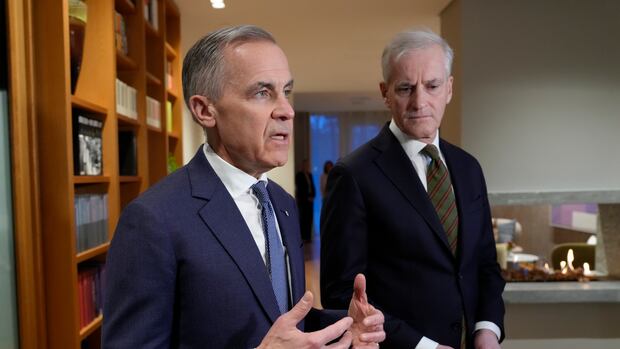
Easing the economic pain in the world oil markets was on the minds of both Prime Minister Mark Carney and his Norwegian counterpart Jonas Gahr Støre as they met in Oslo on Saturday.
The meeting came after the International Energy Agency earlier this week called on its 32 members to release 400 million barrels of oil to prevent global shortages and calm jittery markets, which have been rattled by the U.S.-Israeli war with Iran.
Canada has agreed to contribute 23.6 million barrels, Energy Minister Tim Hodgson announced on Friday.
During a visit to the Holmenkollen Ski Festival in Oslo on Saturday, Carney tried to reinforce a calming message, noting that Canada — as a net exporter of oil — doesn’t hold a strategic reserve and isn’t required to contribute, but will do so nonetheless.
“From Canada’s perspective, we are low-risk producers of oil. We are low-risk producers of natural gas. We’re reliable.”

Prime Minister Mark Carney announced Canada will uphold sanctions on Russian oil during his visit to Norway, where he met with Norwegian and German allies. Canadians are among the 25,000 NATO troops gathered there to deter Russian aggression.
“The oil market is tight. That’s the reality and … the last thing you need in a tight market is to have more problems, and Canada is part of the solution in that regard.”
The United States said it will release 172 million barrels of oil from its strategic petroleum reserve as its contribution to co-ordinated efforts with the IEA. But the U.S. also went its own way in temporarily easing sanctions on Russia’s shadow fleet of tankers, much to the dismay and opposition of other G7 leaders, including Carney.
Norway is a major offshore oil producer, but has not said whether it will up production to help meet the IEA’s call.
Oil prices have surged with tankers being unable to sail through the Strait of Hormuz for fear of attacks by Iran.
Støre says war in Middle East must end
In a joint statement, issued late Saturday after their bilateral meeting, Carney and Støre emphasized their commitment to working together to leverage each country’s position to deliver affordable, secure and sustainable energy, among other things.
Going into dinner at Støre’s official residence, the Norwegian prime minister said the war in the Middle East should end, but instead it is escalating.
“There is no real script on how it’s going to evolve and end,” said Støre, without making direct reference to the United States and Israel.

U.S. forces executed a large-scale precision strike on Iran’s Kharg Island oil hub Friday night, hitting military targets but preserving oil infrastructure. Iranian officials responded with threats that it would unleash more dangerous munitions, potentially on other oil-producing nations in the Middle East allied with the United States and Israel.
“It is escalating with dramatic consequences for people in the region, but also beyond. And I don’t think we have the blueprint for that. I mean, those who are engaged in that war have to take the responsibility for helping it end.”
Carney agreed and said leaders need to discuss what can be done to first de-escalate and then end hostilities.
“We remind all belligerents in this conflict of their responsibilities to adhere to international law,” Carney said. “That means no attacks on civilian infrastructure, and certainly civilians, and care in that regard.”
Both Canada and Norway pledged to increase defence and security co-operation in the Arctic, as well as in space, and to continue their support of Ukraine in its war against Russia.
“We have been through a list of areas … where we can deepen co-operation, in connection with the prime minister’s visit,” said Støre.
“And I was really so positively surprised to see in the really key areas of our times that we have so much we can do together: energy, artificial intelligence, digitalization of our economies, security — we made reference to that — critical minerals. So … the like-mindedness is really based on some key economic foundations.”