Emma Weston-Dimery had run out of options.
Diagnosed with stage 4 colon cancer at just 23 years old after suffering from months-long abdominal pain, she had done every treatment doctors could think of.
The Minnesota native had endured countless rounds of chemotherapy, four years of immunotherapy and 10 major abdominal surgeries, including one where they filled her body with a heated chemotherapy drug, to try to eradicate the cancer.
But 10 years after her diagnosis in 2013, the cancer was still there, and growths kept popping up all over her body.
‘Throughout this whole 10-year journey, there was never a time when I was in remission,’ Weston-Dimery told Daily Mail. ‘Treatment would work on the cancer in some places, but in others it would start to grow again. The scales were never tipped in any one direction.
‘The cancer had spread to my ovaries, fallopian tubes, peritoneum, which is the lining that holds all your intestines together. We were basically playing whack-a-mole with treatments, just waiting for it to spread to an organ that could not be removed.
‘I was starting to feel like I was out of options. I was losing hope.’
It was only then that she was referred to a clinical trial, becoming one of just 12 patients with colon cancer to receive an experimental treatment.
Now, just three years after her first dose, Weston-Dimery, who is now 37, is completely cancer-free. She believes the treatment saved her life and that it will keep the cancer at bay for good.
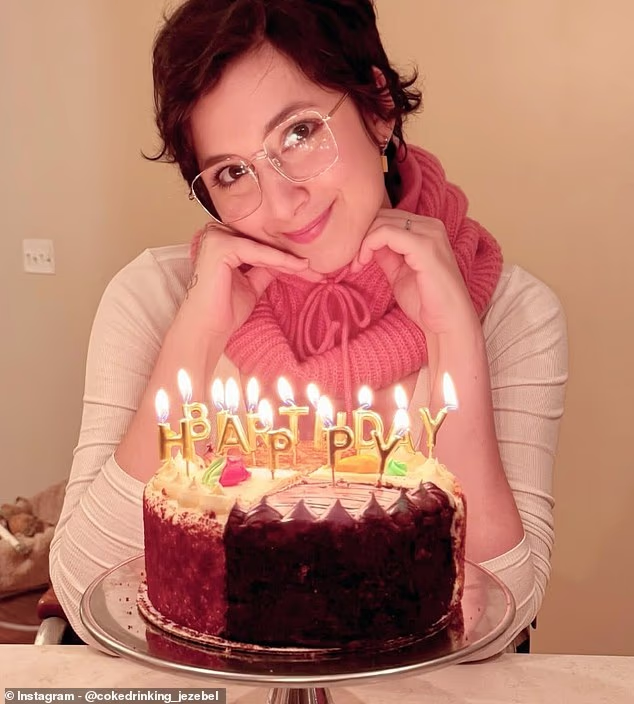
When Emma Weston-Dimery was told she had colon cancer at 23, her world was turned upside down. But, miraculously, she is now cancer-free thanks to a clinical trial
‘Even now, after spending so many of my formative years as a cancer patient, I am hesitant to use the new c-word, which is cured,’ she told Daily Mail, ‘but that is essentially what we are witnessing’.
‘To me, there was no risk in signing up for this trial because I had nothing left to lose. I know it was a big undertaking, and it was hard and there were serious things that could have happened to me. But for me, again, it’s like, I have nothing left to lose.
‘I did not know I was the only one [the experimental treatment] was successful with. It is truly humbling. I just feel nothing but gratitude in the most profound way.’
Weston-Dimery is one of the growing number of young adults being diagnosed with colon cancer, which is now the leading cause of cancer deaths among people under 50.
Although cases have been falling among older adults, in the younger age group, the case rate has risen by about three percent per year on average.
Growing up, Weston-Dimery, had always suffered with gastrointestinal issues and was often woken in the night by intense, painful stomach cramps and vomiting.
She had gone to doctors, but none were able to diagnose what was causing the cramps. Instead, she said, many rationalized the symptoms or explained them away.
Just before Thanksgiving in 2013, however, she developed a new persistent abdominal pain, cramping and constipation, while her skin also turned white.
She thought it was just because she was working two jobs at the time and ‘burning the candle at both ends’. But a month later, at her annual physical, doctors raised concerns after finding she had a very low red blood cell count.
More tests and scans followed, which led to her stage four cancer diagnosis that month, after doctors found two tumors the size of a softball and a golf ball in her colon.

Weston-Dimery endured 10 abdominal surgeries and years of chemotherapy, radiation and immunotherapy before she was referred to the trial. She is shown above in the hospital
According to the American Cancer Society, only about 13 percent of patients with stage four colon cancer live for five years or more after their diagnosis.
‘When I was first diagnosed at 23, I absolutely did not fully understand or absorb the gravity of the diagnosis,’ she told Daily Mail, ‘my mom did, though, she was a mess, more of a mess than I was at the time’.
In December that year, she had her first abdominal surgery to remove the two tumors and was then prescribed chemotherapy every other week for nine months.
Doctors had hoped that would clear the cancer, but after scans showed more growths, she was sent for multiple rounds of radiation.
This did not clear the cancer either, prompting doctors to put her through years more of chemotherapy, immunotherapy and surgery as they tried, and failed, to treat the disease.
In 2015, she had HIPEC surgery, or hyperthermic intraperitoneal chemotherapy surgery, where cancerous tumors are removed and the body’s internal cavity that holds the vital organs is then flooded with heated chemotherapy drugs.
The following year, she had a partial hysterectomy and then also had a breast reduction surgery amid fears the cancer had spread.
Then, doctors prescribed immunotherapy every other week for what would eventually become four years.

Emma Weston-Dimery, now 37 years old, is shown above with the scientist Dr Emil Lou who developed the experimental treatment that she received
She had two more surgeries in 2017 and 2018 to remove hernias in her stomach.
And then, also in 2018, she had surgery to remove the rest of her colon and was fitted with an ileostomy bag. This collects waste from the small intestines, which then led to another round of surgeries due to complications and to have it removed.
In the end, she had been operated on so many times that Weston-Dimery said she had a wound in her chest that just would not heal. She had also lost her belly button.
The situation became so serious that doctors actually marked her as a high surgical risk and said she should not have more surgery unless there were no other options.
But even then, after all these treatments and surgeries, the cancer persisted.
It was at this point, right as she felt her options were running out, that she was referred to a new oncologist at the University of Minnesota who was setting up a clinical trial to test a new colon cancer treatment.
In the Phase 1 trial, patients received an experimental treatment — known as CRISPR-Cas9 gene-edited cell therapy — which worked by re-engineering the body’s own immune system to hunt down cancer.
For the treatment, scientists first remove immune cells from inside the tumor itself. These cells would normally attack the cancer, but have been effectively switched off by chemical signals released by the tumor.

Weston-Dimery endured 10 abdominal surgeries and years of chemotherapy, radiation and immunotherapy before she was referred to the trial. She is shown above in the hospital

Weston-Dimery was diagnosed with the cancer after tests at her annual physical showed she had a very low red blood cell count
In the lab, researchers then used CRISPR gene-editing technology to reprogram the cells, allowing them to ignore the cancer’s suppressive signals and, once again, attack and destroy malignant cells.
After being told about the trial in 2020, Weston-Dimery applied and was approved to receive the experimental treatment. She continued to receive chemotherapy and immunotherapy in the lead-up to the trial.
She had the immune cells extracted from a tumor on her left ovary in late 2022, which was about the size of a bar of soap. It took at least two procedures to extract the cells.
In early 2023, she had them infused back into her body.
When she returned for scans one month later, doctors were shocked. Two out of three visible cancerous nodules had disappeared, while the tumor on her left ovary had shrunk to the size of a quarter. When she returned in the second month, all her cancer had completely disappeared.
It has not been detected since.
Dr Emil Lou, the oncologist at the University of Minnesota who ran the trial, which was revealed in the medical journal The Lancet, said the results were ‘remarkable’.
Out of the 12 patients on the trial, which was sponsored by Intima Bioscience, she was the only one to see her cancer completely disappear and survive.

The above scan, which Weston-Dimery keeps on her refrigerator, shows the tumor on her left ovary before she received the experimental treatment and afterward

She also keeps a copy of this scan on her refrigerator, which shows the growth on her left ovary from a different angle. It shrinks following the experimental treatment
The patients were all very sick and had been battling the cancer for years. But even then, results showed that six, or half, showed no further growth in their cancer a month after treatment. Among these, four showed no further cancer growth after month two.
Deaths on the trial were attributed to the underlying disease and complications it caused. None were linked to the treatment. All the patients had severe reactions to the infusion, including fevers, fatigue and anorexia.
Dr Lou added: ‘I wish I knew why Emma is the only one that survived, it is certainly a line of research that we are pursuing.
‘The trial itself had a lot of applicants. We had about 15 to 20 inquiries from around the world for every spot we had potentially open.’
His team is now working on a Phase 2 trial, set to open in the first half of 2027, that will test administering a pill to patients that they say can also edit the immune system to prompt it to target the cancer.
He hopes this trial will be able to enroll more patients and be more cost-effective for research organizations, saying, in the initial trial, that it cost hundreds of thousands of dollars to gene-edit the cells from each patient.
To get into a clinical trial, he recommended that patients get in contact with advocacy organizations and ask their oncologist about any upcoming clinical trials. For his, he said they had about 15 to 20 applicants globally for every space available.
Weston-Dimery, who now does custom picture framing and archiving, is raising awareness of clinical trials to help other patients.
In February this year, she was recognized in TIME100 Health for her contribution to Scientific research.
‘When it was published last year, I didn’t know I was the only one that survived,’ Weston-Dimery told Daily Mail.
‘That was really, really impactful for me, and truly humbling.
‘I may not be destined to give my life back to the scientific community by getting into nursing or anything like that, but, if this is what I can do, I am more than happy to get the word out.’