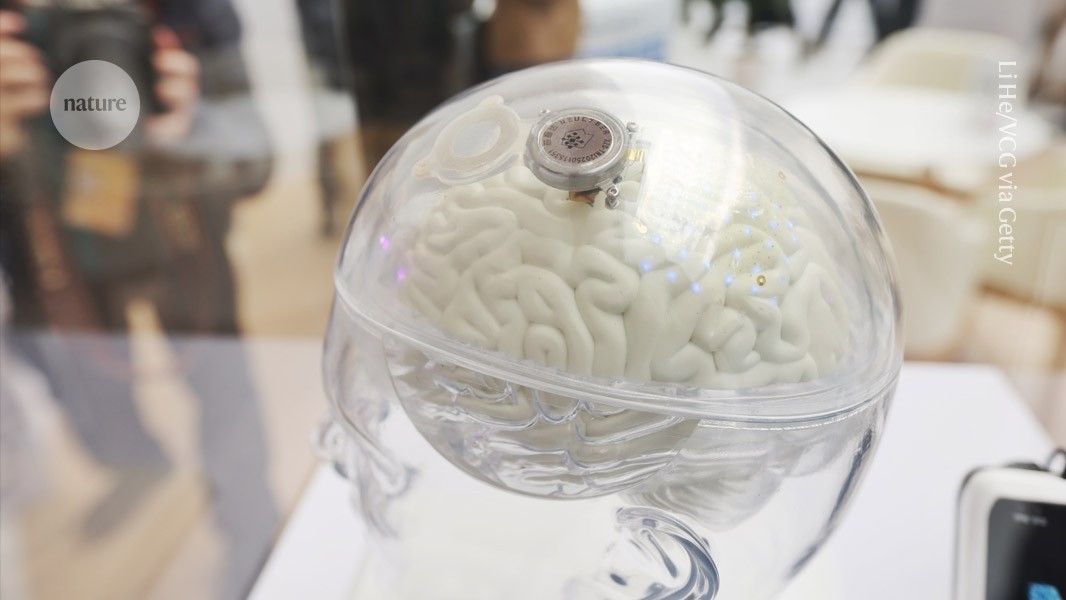
China wants brain-computer interfaces to be a future industry for the country. Credit: Li He/VCG via Getty
China has approved a brain implant for people with severe paralysis to help restore their hand movements. The brain–computer interface (BCI) is the first in the world to be available for wider use outside of clinical trials.
The device, developed by Neuracle Medical Technology in Shanghai, China, was authorized last week by the National Medical Products Administration. It will be available to people aged between 18 and 60 years old who have paralysis that affects all of their limbs and is caused by an injury to the neck area of the spinal cord.
BCI technology is important because there are no effective ways to treat people who have spinal-cord injuries, says Chen Liang, a neurosurgeon at Huashan Hospital at Fudan University in Shanghai, who was involved in the clinical trials of the device, called NEO.
The approval is a milestone for the whole field of BCI research, says Zhengwu Liu, an electrical engineer at the University of Hong Kong who has collaborated with the NEO team.
The research team behind the device has up to 18 months of data showing that the BCI system works. “That kind of long-term evidence is rare in this field, and I think that’s a key reason why this approval was possible,” Liu adds.
Several BCIs are being tested in long-term trials. Last year, Paradromics, a neurotechnology company in Austin, Texas, received approval to trial a BCI that restores speech in two people who were left unable to speak owing to neurological diseases and injuries. Meanwhile, Neuralink, a brain implant company in Fremont, California, founded by entrepreneur Elon Musk, said in January that 21 people were enrolled in trials of its devices, which began in 2024.
Minimally invasive
The coin-sized NEO is embedded in the skull, with eight electrodes placed over one side of the brain to record electrical activity when the person imagines moving their opposite hand. The signals are sent to a computer to be decoded and then used to control a glove, allowing people to pick up and move objects to perform daily functions such as eating and drinking.
In a preprint1 published last year, which has not been peer reviewed, the researchers reported that one person who used the device for nine months was able to eat and drink with their right hand, tasks they could not do before the BCI was implanted. Their ability to grasp, grip, pinch and generally move their right hand improved, and their left hand, which they had not used the glove with, also improved, but to a lesser extent, according to the preprint. The person was part of a clinical trial testing the device’s safety and effectiveness for up to six months after implantation.
Chen says that 32 people have so far received the device and all could perform the grab movement with the help of a soft robotic glove, an action they could not do previously. From this perspective, they have improved, he says. The team is currently writing up the results, Chen adds.
The device seems safe and works, says Avinash Singh, a BCI researcher at the University of Technology Sydney in Australia. But the study cohort is very small, he adds.
Singh says that NEO is different from other devices currently being tested. It is less invasive than Neuralink’s device, which is inserted into the brain. This might explain why NEO has been approved so quickly, while other BCIs are still progressing through clinical trials, Singh adds.