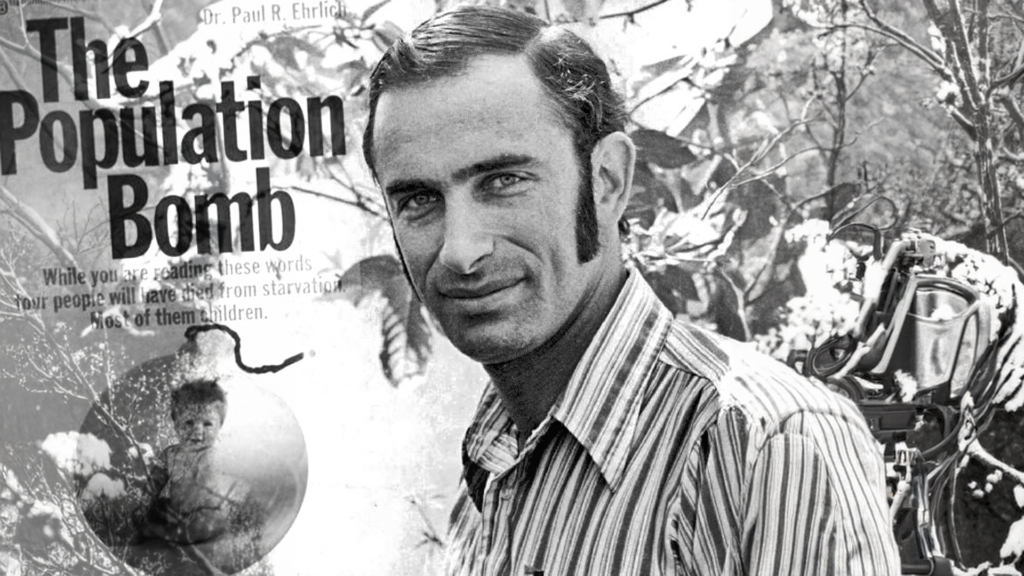
Paul Ehrlich, the leading false prophet of inevitable environmental doom and author of the infamous The Population Bomb, has died at age 93. Why infamous? Consider the prologue to the 1968 edition:
The battle to feed all of humanity is over. In the 1970’s the world will undergo famines—hundreds of millions of people are going to starve to death in spite of any crash programs embarked upon now. At this late date nothing can prevent a substantial increase in the world death rate….We can no longer afford to merely treat the symptoms of the cancer of population growth; the cancer itself must be cut out.
His solution? “We must have population control at home, hopefully through a system of incentives and penalties, but by compulsion if voluntary methods fail,” he argued.
Instead of a population collapse due to mass starvation, the world population grew from 3.5 billion in 1968 to 8.3 billion today. Instead of a substantial increase in the world death rate, it fell from 12 per 1,000 people in 1968 to 8 per 1,000 people in 2023. Farmers deploying modern tech have boosted the number of daily calories per person by more than a third since the 1960s. Consequently, rather than millions starving, the proportion of undernourished people in developing countries declined from 37 percent in 1969–71 to 8.2 percent in 2024. Global average life expectancy at birth rose from 57 years in 1968 to 73 years in 2023.
Nearly 60 years later, overpopulation fears have now been superseded in some quarters by depopulation worries. In over half of all countries where more than two-thirds of the world’s population lives, the fertility level is already below the replacement rate of 2.1 births per woman. The United Nations’ World Population Prospects 2024 report projects that the global population will likely peak at just over 10 billion at around 2080 and begin falling. More moderate scenarios projecting rapid economic development project that the world population could peak at 9.2 billion or so around the middle of this century and fall back to under 8 billion by 2100.
Communist China was one country that notoriously adopted compulsory population control measures limiting families to just one child. Current fertility trends suggest that China’s population will fall from 1.4 billion to less than half of that by 2100.
Ehrlich seemingly never encountered a prediction of doom that he failed to embrace. For example, he was all-in on the projections of imminent economic collapse from nonrenewable resource depletion as argued in the Club of Rome’s 1972 book The Limits to Growth. In fact, Ehrlich was so confident that he bet University of Maryland cornucopian economist Julian Simon that a $1,000 basket of five commodity metals (copper, chromium, nickel, tin, and tungsten) selected by Ehrlich would increase in real prices between 1980 and 1990. If the combined inflation-adjusted prices rose above $1,000, Simon would pay the difference. If they fell below $1,000, Ehrlich would pay Simon the difference. In October 1990, Ehrlich mailed Simon a check for $576.07. The price of the basket of metals chosen by Ehrlich and his cohorts had fallen by more than 50 percent.
Similarly, in 2017, Ehrlich promoted the claim that we are on the brink of “biological annihilation” stemming from a supposed human-caused sixth mass extinction. This alarm is just another in a long line of extinction claims. As I noted earlier:
In 1970, Dr. S. Dillon Ripley, secretary of the Smithsonian Institution, predicted that between 75 and 80 percent of all species of animals would be extinct by 1995. In 1979, the Oxford biologist Norman Myers suggested that the world could “lose one-quarter of all species by the year 2000.” Also in 1979, the Heinz Center biologist Thomas Lovejoy chimed in, estimating that between a seventh and a fifth of global diversity would become extinct by 2000. None of those dire predictions came true.
I also mourn the loss of species, but the global biodiversity situation is much less dire than Ehrlich and his fellow doomsters claim. For example, University of Arizona ecologists published a study last October, finding that over the last 500 years, extinctions in plants, arthropods, and land vertebrates peaked about 100 years ago and have declined since then. “We show that extinction rates are not getting faster towards the present, as many people claim, but instead peaked many decades ago,” John Wiens, the study’s coauthor, said in a press release.
For nearly six decades, Ehrlich persisted in predicting imminent catastrophic doom even as humanity grew both more populous and prosperous.
In Greek mythology, Cassandra was the Trojan priestess who was cursed to utter true prophecies that no one believed. Ehrlich was a reverse Cassandra: He made many false prophecies that were widely believed. Ehrlich died at 93 without seeing any of his prophecies of doom come true.