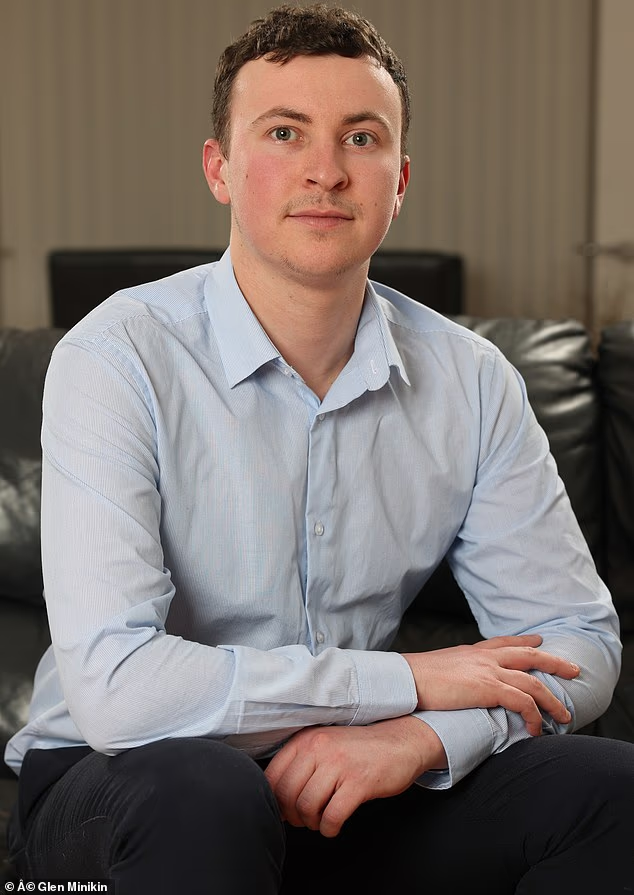
Sam Birchall was shopping with his girlfriend Rachael when he was struck by an intense pain – ‘like an electric shock’ – in his groin and, in particular, his right testicle.
‘Within half an hour I could feel a dull ache and my testicle had swollen enormously. It was about the size of a golf ball,’ recalls the 25-year-old. ‘I told Rachael I was worried – and we went home.’
Hoping it was just inflammation which would settle overnight, he took some ibuprofen. But the next day his right testicle was still badly swollen and aching, so he went to A&E.
‘After an ultrasound scan, I was told there was a clearly visible mass, but that I should wait for a consultant to confirm,’ says guitarist Sam, who, when not playing in his indie band The Lilacs (which last year supported Sting), works in civil engineering sales.
Unlike many other cancers, where a biopsy is needed to confirm a diagnosis before treatment, with testicular cancer the chances of the tumour – especially if greater than 2cm – being benign is very small, so a scan is sufficient.
Sam Birchall was shopping with his girlfriend Rachael when he was struck by an intense pain
Just six days after his symptoms appeared, Sam’s consultant phoned to confirm he had cancer and that they wanted to remove the testicle as soon as possible. Sam had lost his mother to breast cancer while in his teens, so took the news more calmly than might otherwise be expected.
After telling his father Antony and older brother Louis, as well as Rachael, he was ready to start treatment. ‘I’d become quite hardened to things after what happened to my mum and wanted to crack on and have the necessary treatment,’ he says. ‘I’m not someone who gets too stressed.’
He was also fortunate to benefit from a new form of surgery that significantly sped up his recovery time (but more on that later).
Testicular cancer mostly affects younger men, aged 15 to 49. This is thought to be partly down to DNA mutations in the embryonic sperm cells found in the testicles, most likely in puberty, explains Dr Nasim Ali, a consultant medical oncologist at the Clatterbridge Cancer Centre in Liverpool.
And cases are on the rise – since the early 1990s, diagnoses are up 29 per cent (there are now around 2,400 new cases a year, according to Cancer Research UK).
Getting testicular cancer is most likely due to a combination of genetic factors, ‘certainly, if a man’s father has had it, their risk is four times higher’, says Aziz Gulamhusein, a consultant urological surgeon at The Christie NHS Foundation Trust in Manchester.
‘Another possibility is increased exposure to endocrine-disrupting chemicals such as pesticides, especially at an early age. It’s thought these interfere with the body’s hormones, but there is no robust evidence to confirm this.’

Sam is in civil engineering sales and guitarist in band The Lilacs, which has supported Sting
Having had an undescended testicle – where one fails to move from the abdomen to the scrotum before or soon after birth, which affects about one in 25 baby boys – also raises the risk of testicular cancer later in life.
Studies show around 10 per cent of men diagnosed with the disease had previously had one or both undescended testicles.
Dr Ali explains: ‘We know that even if you bring the undescended testicle down [with minor surgery called an orchidopexy, usually done before the age of 18 months], males still have this increased risk of developing testicular cancer. So there could be something that predisposes men to both conditions, which we haven’t identified yet.’
Another risk factor is ethnic background – white men seem to be more at risk than other groups.
Fortunately, says Dr Ali, death rates from testicular cancer are not rising as there is now ‘better treatment’. Cancer Research UK says there are around 70 deaths from testicular cancer a year.
Typical symptoms include a painless lump or swelling, which makes one of the testicles much bigger. In some cases the scrotum might feel heavier or firmer than normal. Sam’s symptoms were more uncommon – he was among the 10 per cent of men who experience pain and swelling, and the speed of these in his case was thought to be due to bleeding.
‘There are broadly two main groups of testicular cancer – a seminoma germ cell tumour and a non-seminoma type [which Sam had],’ says Dr Ali. ‘Non-seminomas tend to be more aggressive and require more intense chemotherapy. But both are very responsive to treatment.’
Removal of the testicle is standard in the vast majority of cases.
Early detection is key. But there is often a reluctance from younger men in particular to seek help, even if they notice a swelling, says Dr Carla Perna, a consultant in clinical oncology at the Royal Surrey County Hospital, Guildford, and the Genesis Care clinic.
‘They have busy lives and so don’t want to get it properly checked,’ she says. ‘There’s also an element of embarrassment.’
But it’s important to seek medical help as testicular cancer ‘is very curable – upwards of 95 per cent, even if it’s diagnosed late and has spread’.
Men should examine themselves regularly. Mr Gulamhusein, who treated Sam, says: ‘We say from about the age of 14, once a month after a warm shower or bath when the scrotum is more relaxed, get a feel of what is normal. If anything changes, see your GP.’
The week following his diagnosis, Sam, from Wigan, underwent a 30-minute operation to remove his right testicle via a small incision in his groin. He went home the same day, needing only paracetamol for pain relief. After this surgery, men are often offered an artificial silicone testicle to give the scrotum a more normal appearance, which can help with self-esteem – but Sam declined as he was ‘not bothered about the visual appearance’.

‘I lost my hair and felt pretty sick, but I didn’t feel worse than others going through it,’ he says
However, he did have some of his sperm stored by the NHS in case of fertility issues in the future due to his treatment.
Dr Ali says: ‘Chemotherapy after surgery can affect the sperm quality and also its production, so that is why we try to store it before treatment begins.’
Following Sam’s surgery, CT scans showed cancer had spread to lymph nodes at the back of his abdomen. He then underwent three four-week cycles of chemotherapy, ending last September.
‘I lost my hair and felt pretty sick and tired, but I don’t think I felt any worse than others going through it,’ he says.
While recovering, Sam was told that although the chemotherapy had killed the vast majority of the tumour, some cancerous cells still remained in the lymph nodes.
To remove them would normally involve open surgery, which could last up to ten hours and involve a large incision from the breastbone to the pelvis. Recovery can take three months, including around ten days in hospital, initially on a high-dependency unit.
But for the past three years, Mr Gulamhusein and his team have been using robotic surgery to carry out this operation, which takes less than three hours.
The Christie hospital in Manchester has so far conducted 35 of these robotic lymph node removal operations for testicular cancer – Sam had his surgery in December.
Through five 8mm incisions below his belly button, eight lymph nodes on either side of his abdomen were removed. He was the first patient in Europe to go home the same day after having this type of robotic procedure.
‘I felt a bit battered afterwards – but not as much as if it was open surgery I’ve been told,’ says Sam. ‘I’m quite competitive, so when I heard I could be the first person in Europe, I was keen to set that record.’
Within six weeks he was well enough to be back playing with his band – and doing his bit to help raise awareness about testicular cancer by talking to the audience about it between songs.
He will continue to have quarterly blood tests and an annual scan – at his latest check-up in January, there were no further signs of cancer.
Sam says: ‘When you speak to a cancer patient like me, it’s usually hard to say it has completely cleared and that’s the end of it.
‘You’re always looking over your shoulder, but I’m now absolutely fine. It’s amazing news.’
For more information and support on testicular cancer, visit orchid-cancer.org.uk