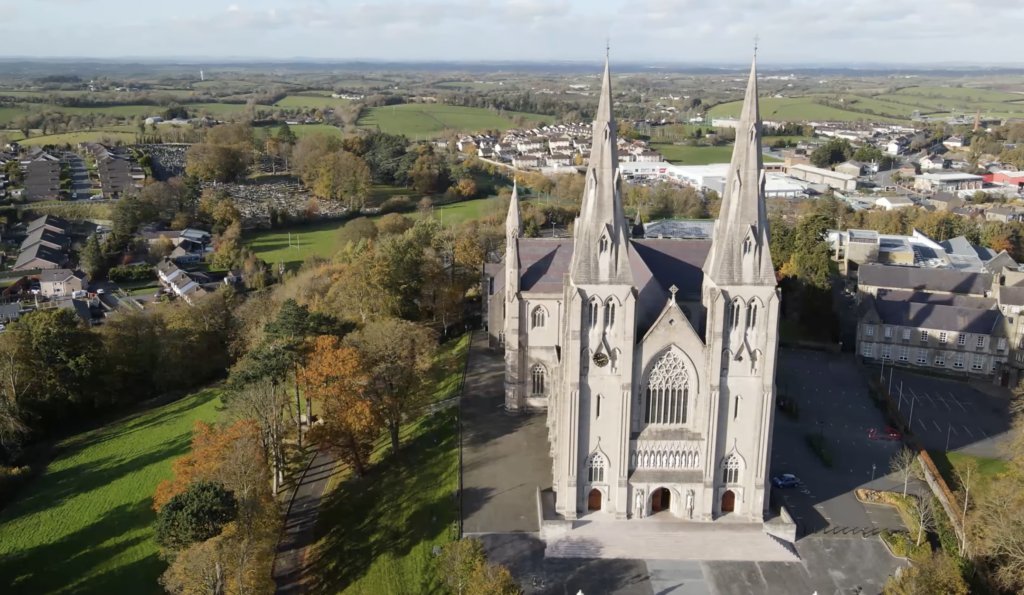
The Ireland of my youth was a land of almost mythical wonder, as I think it was for many Irish-American millennial children, who experienced it through children’s books, cinema, and St. Patrick’s Day celebrations with extended family. The art, the music, and the language possessed an ancient, even prehistoric pedigree pulsing with magic, beckoning to an island of leprechauns and banshees. And, of course, we all knew it was a deeply religious place, imbued with a transcendent spirituality that seemed to surpass anything we possessed in America.
Certainly, there were some indisputable facts to support Ireland’s status as a curiously religious society, as most of the rest of Europe unashamedly embraced secularism. In the 1990s, there were more than one thousand Catholic priests of Irish birth serving in the United States — for several years, one such priest at the parish my family attended shared my name (motivation enough for me to show up!). More than half of Irish residents attended weekly Mass, numbers that far exceeded those of other predominantly Catholic European countries.
Yet by the time I made it to Ireland in 2004 as a sophomore college student on a study abroad program, the Church was visibly in retreat. Mass attendance rates were plummeting. The Irish of my generation, I discovered, were deeply skeptical if not antagonistic toward the Catholic Church, and Christianity more broadly. The Pro-Palestinian “anti-colonial” cause was more likely to get young Irish into the streets than an Eucharistic procession. For many religiously inclined Irish-Americans such as myself, it was impossible not to wonder: What happened? The answer, at least in part, seems to be to a certain degree of complacency by religious authorities.
Ireland Really Was a Twentieth-Century Anomaly in the West
From the beginning of an independent Ireland in 1922, Ireland was devotedly Christian, and predominantly Catholic (with a small Protestant minority), as John Gibney relates in his excellent recent book A Short History of Ireland. A decade after independence, for example, the Irish Free State hosted an enormous international Eucharistic Congress, refuting any accusation that the Catholic Church was coercively imposing its moral authority upon the Irish people. Catholicism imbued Irish society because the Irish people wanted it that way.
In 1937, Ireland adopted a new constitution, which was deeply indebted to Catholic social teaching; clerics had been consulted during its drafting. One article of the constitution even explicitly noted the special position of Catholicism as the majority faith. The document also emphasized the centrality of the family unit and prohibited divorce. In the post-war years, the influence of the Church continued, exemplified in widespread public devotion to the Virgin Mary, as well as an embarrassingly restrictive censorship regime aimed at preserving public morality. Of almost 1,300 books examined by government official Christopher J. O’Reilly, 75 percent were banned, including titles by John Steinbeck, F. Scott Fitzgerald, Truman Capote, Saul Bellow, Bertrand Russell, Samuel Beckett, Raymond Chandler, and Ian Fleming.
Ireland, whose weekly Mass attendance rate was at 90 percent as late as 1970, also served as a priest mill for the United States. In the 1950s, when almost a quarter of Irish-born people were living overseas (mostly in the United Kingdom and the United States) 80 percent of priests in the Diocese of Los Angeles were Irishmen. Though L.A. is an extreme case, high numbers of Irish priests were visible everywhere in America, including even in the majority-Protestant South.
As late as 1983, ten years after Roe v. Wade, the right to life of the unborn was recognized in the Irish constitution via popular referendum. Three years later, a referendum attempting to legalize divorce in limited circumstances failed. Remember, this was in the 1980s. Yet those two results were reversed by subsequent referenda, in 2018 and 1995, respectively. In a single generation, the Church in Ireland had suffered a precipitous, unprecedented decline.
The Clergy Scandal Eviscerated The Church’s Reputation
Though we associate the Catholic sex abuse scandals with the 1990s, there were signs from shortly after Irish independence of widespread sexual crime. The Carrigan committee, established to consider legislative responses to sexual crime, reported in 1931 — less than ten years after independence from the British — that “gross offences are rife throughout the country.” It assessed that sexual assault was commonplace, with most victims under the age of eighteen. The report was suppressed and its recommendations ignored.
Beginning in the 1980s, allegations of sexual abuse of children in Catholic institutions began to receive sporadic coverage. Then, in the 1990s, the floodgates opened, as criminal cases and Irish government inquiries discovered that hundreds of priests had abused thousands of children over many decades. Moreover, Church officials had often attempted to cover up these crimes rather than submit pedophile priests to secular prosecution. There were further revelations that Irish citizens were incarcerated and sexually abused in so-called “Magdalene” institutions and “industrial” and “reform” schools run by the Catholic Church (with state support).
The result of this complacency and corruption on the part of Ireland’s ecclesial hierarchy has been dramatic (Pope Benedict XVI even calling for repentance, fasting, and prayer to atone for the Church’s sins there). Today only about a quarter of Irish citizens attend Mass weekly, and a growing percentage (14 percent) describe themselves as having no religion.
There’s Still Hope for Ireland
In 2021, the incoming class of Catholic seminarians in Ireland was so small it attracted global media attention, reflecting a startling priest shortage. This, from a country that for generations had stocked America’s dioceses with priests. (More recently, incoming classes of seminarians have been marginally bigger). What James Joyce described in “Portrait of the Artist as a Young Man” as the preeminent vocation of cultural power in Irish society now seems peripheral.
Today, Ireland reaps the fruits of terrible decisions made by a privileged hierarchy that became complacent. It is a common enough tale, and one that religious authorities, wherever they have access to political power, should remember. As always, there is only one way through: that of prayer and penitence. Thankfully, with more than a millennium and a half of saints known for their rigorous ascetic practices, the Irish have quite a well of spiritual inspiration from which to draw.
Casey Chalk is a senior contributor at The Federalist and an editor and columnist at The New Oxford Review. He is a regular contributor at many publications and the author of three books, including the upcoming “Wisdom From the Cross: How Jesus’ Seven Last Words Teach Us How to Live (and Die)” (Sophia Institute Press, 2026).