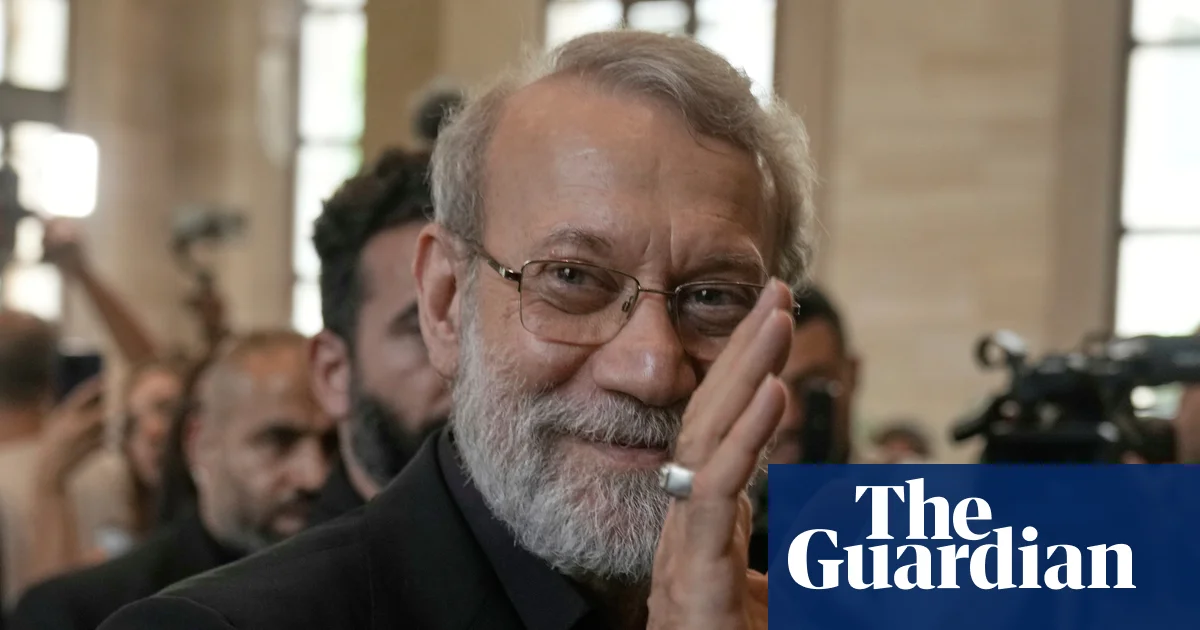
If confirmed, Israel’s assassination of Ali Larijani, the secretary of Iran’s supreme national security council and one of the linchpins of Iranian politics, would be a devastating body blow to the country and probably a bigger reverse than the loss of the supreme leader Ali Khamenei at the outset of the war.
In any attempt to decapitate the Iranian leadership, Larijani would always be the prime target, largely because of his ability to straddle so many levels of Iranian politics and his huge personal influence not just in Iran but with foreign states including China and Russia.
Indeed, there has been probably no greater loss for the Iranian regime since the US assassination of the Islamic Revolutionary Guard Corps (IRGC) leader Qassem Suleimani in Baghdad in January 2020.
The significance of Larijani’s removal also lies in the confirmation that Israel and possibly the US never regarded him as an alternative leader for Iran in the event of the government breaking up, or in effect surrendering. Ellie Geranmayeh, an Iran expert at the European Council on Foreign Relations, said: “[Benjamin] Netanyahu is now focused on blocking Trump’s pathways for a ceasefire and follow-up talks with Iran. Larijani would have been the man to get that job done.”
Donald Trump has frequently spoken of his wish to find an equivalent to Delcy Rodríguez, the deputy to Nicolás Maduro who is from a US point of view proving a highly pragmatic leader of Venezuela after the American capture of Maduro. Trump’s decision to endorse her leadership has in US eyes prevented a civil war.
The assassination of Larijani, 67, an advocate of a nuclear deal with the US and brutal internal repression, not only cuts off the remote chance that he could have played a Rodríguez-type transitional role but also raises questions about whether the US actually has a candidate inside the country.
Trump often casually admits he does not know many of the internal alternative leaders since so many have been killed, but Larijani’s removal would show that the US pool of candidates is very shallow.
Yet Trump is still refusing to endorse Reza Pahlavi, the son of the former shah, saying he prefers an internal candidate. Pahlavi has been taking steps to broaden his leadership team in an effort to assuage fears that if he was made leader then Iran would be switching from a clerical dictatorship back to a monarchical dictatorship.
Larijani’s special attribute, apart from his vast four-generation span of experience in Iranian politics and his international contacts, was that he managed to have the trust of the IRGC while having his differences with hardliners. He played a role in the recent unsuccessful rearguard action designed to prevent Mojtaba Khamenei from succeeding his father as supreme leader.
Mojtaba Khamenei, still yet to appear in public, has been regarded as the candidate who would put the IRGC fully at the helm of Iranian politics, sidelining moderate politicians and spiritual leadership. Larijani was manoeuvring to delay Khamenei’s election by the Assembly of Experts, working with the former president Hassan Rouhani to either postpone the critical meeting of the assembly or find an alternative candidate.
Rouhani had been arguing that it was impossible to know the state of Iranian politics after the war, so it would be wise to defer the appointment of a new supreme leader in case the choice might narrow the country’s postwar options. There was also a dispute whether Ali Khamenei had ever said he wanted his son to succeed him. The Iranian revolution of 1979 had been in part a revolt against hereditary rule.
But once the battle to defer a choice was lost and the transition would take place, Larijani appeared on television and described the appointment as a “manifestation of consensus”. It was typical of his pragmatic approach.
Without the religious training required to be a supreme leader, Larijani instead moved through the halls of Iranian high politics and with his brother became a driving ideological and practical force. His brother Sadeq was head of the judiciary while another, Mohammad Javad, acted as a diplomat and adviser to the supreme leader.
Larijani served as the head of state broadcasting, using the position to lambast the reformist movement. He was then the speaker of parliament for 12 turbulent years between 2008 and 2020. Iranian external politics in those years were dominated by the wisdom of negotiating the nuclear deal struck with the US in 2015, and he was broadly supportive. In a previous stint as secretary of the national security council, in 2006 he had reached out unsuccessfully to the George W Bush administration for talks on Iran’s nuclear programme.
Last August, after the June 2025 Israeli US attacks on Iran, Larijani was put at the heart of the establishment by being made secretary of the supreme national security council (SNSC). Within Iran’s multilayered political structure, the SNSC acts as the key link between the military (IRGC) and the civilian administration. One of his roles was to review the lessons learned from the 12-day war, and the extent to which Iran has prepared better for this second war will be seen as his legacy.
He was influential in devising the strategy of telling Gulf leaders that US bases in their territory would be regarded as legitimate targets if Iran was attacked. Larijani, far more than the president, Masoud Pezeshkian, was regarded as the authentic message carrier to the Gulf leadership.
He stood for the presidency only once, in 2005, when he was heavily defeated by the populist firebrand Mahmoud Ahmadinejad.
Larijani trained as a mathematician at university and was a cerebral intellectual, writing his doctoral dissertation about the 18th-century German philosopher Immanuel Kant. The Israeli liberal newspaper Haaretz recently published a profile of Larijani in which the author, after reading six of Larijani’s books, concluded he was “a brilliant thinker who combines, in an unusual way, a life of contemplation with a life of action – no small feat. In his writings, Larijani tries to defend the basic premises of his extreme religious worldview using the rules of western philosophy, and he often advances arguments that are genuinely thought-provoking.”
In one of his essays, Larijani wrote: “Society has an existential identity separate from the individual. That is, the intertwining of the spirits of individuals within a nation creates an independent collective soul. If we recognise this independent identity, we must also recognise its rights. According to Islamic thought, this collective soul has a direction – it strives for prosperity and redemption.”
After his politics shifted away from conservatism to the Rouhani centre, he and his family found themselves increasingly at odds with those making the decisions in the supreme leader’s office.
To his anger, the 12-strong Guardian Council debarred him from standing in the 2021 and 2024 presidential elections, decisions he did not take lying down. The council unusually was forced to justify its decision, accusing him of contributing to the dire economic conditions under Rouhani’s presidency and of failing to adhere to the principle of state officials pursuing simple personal lives. In reality, a faction in the IRGC wanted to ensure Ebrahim Raisi was elected president, and Larijani was the clearest threat.
So his sudden return to power as secretary of the supreme national security council last August marked a political comeback. His experience in dealing with China, Russia and in preparing Iran for another wave of us attacks was regarded as too invaluable to leave in the wilderness.
Once more he was on his political travels, and he showed no leniency when the January economic riots started, describing the protests as urban terrorist tensions. When Khamenei was killed, he was quick to appear on television offering a reassuring and grounded leadership for those worried Iran had no wartime strategy. For all the repression, he remained the figure most likely to hold back the hardliners.
In an interview in November 2024, he reflected on the enduring impact of the deaths of Suleimani and the Hezbollah leader Hassan Nasrallah. “Their martyrdom still feels surreal to me,” he said. “History repeats itself as great leaders fight, offer themselves as sacrifices for the sake of the cause and pave the way for a new generation of freedom fighters.”
The test now is whether the attrition, and gaping holes in Iran’s intelligence operation, mean Iran cannot find another generation with which to renew itself.