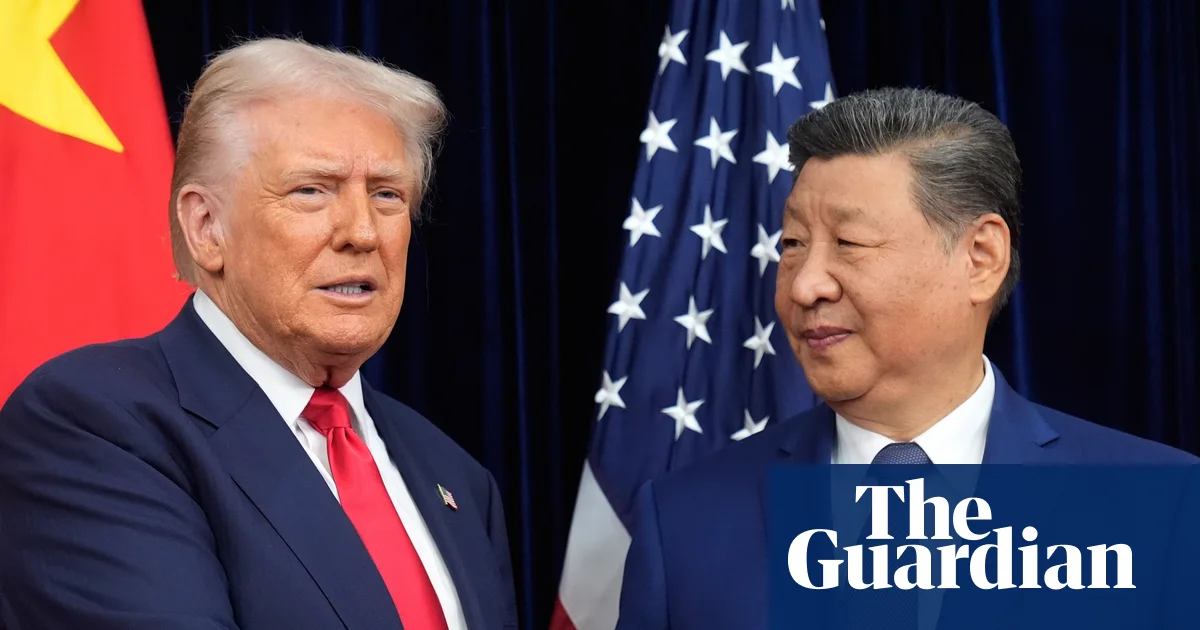
The White House said on Wednesday that China had agreed to postpone Donald Trump’s visit to Beijing, as war in the Middle East rages on, complicating the US president’s position at home and abroad.
China has not yet commented on the delay to the highly anticipated trip, in which Trump and the Chinese president, Xi Jinping, will meet in person for the first time since October. Trump previously said he hoped to delay the trip, originally scheduled to run from 31 March to 2 April, for “five or six weeks”.
The delay underlines the extent to which the war with Iran is influencing geopolitics far beyond the Middle East. Beijing is watching closely to see what the impact will be on US-China relations, as well as on the US midterm elections in November.
A US president keen for electoral success at home may be a more pliable opponent at the negotiating table. But Trump’s unpredictability complicates China’s calculations.
Trump and Xi’s meeting, which is now likely to take place in May, was expected to focus on the next phase in the US-China trade war, which has been under a temporary truce since October. Trump’s war with a China-friendly country in the Middle East is now likely to be on the agenda.
The last-minute delay may come as a relief to Beijing, which never officially confirmed the dates of the original meeting. In recent weeks there have been reports that Chinese officials were “apoplectic” at the lack of US planning for an event that Beijing expects to be tightly choreographed.
It may also put more pressure on Trump to reach a deal in Beijing when he eventually makes the trip, as the war in Iran continues to send oil prices soaring.
A recent poll by NBC News found that more than half of registered US voters disapprove of the strikes on Iran, including more than one-third of non-Maga Republicans.
Neil Thomas, a fellow at Asia Society Policy Institute, said: “Beijing can reasonably assume that Trump wants to avoid a fresh inflation spike heading into the midterms, which gives China some leverage in trade talks.”
But, Thomas added, “that leverage has limits … Trump’s war with Iran shows that he is willing to accept economic costs when he believes other strategic or political priorities matter more”.
Both the US and China have interests in not allowing the last year’s trade war to escalate in 2026.
China’s struggling economy remains heavily dependent on exports, a trend that shows no signs of abating as Chinese exports grew by 22% in January and February.
Although the economic fallout in the US appeared to be limited last year, economists expect more negative effects – including inflation and rising unemployment – to show up in the coming months, especially if Washington and Beijing are unable to reach a deal to avoid high reciprocal tariffs.
Add to that major energy price inflation caused by the war in Iran, and Trump could be heading into November’s midterms with a seriously disgruntled electorate.
Amanda Hsiao, the China director at Eurasia Group, said: “There is a view [in Beijing] that ahead of the midterms Trump may be more motivated to secure economic deals with China as this will help boost his message of economic affordability to voters.”
Beijing knows where to apply the pressure. As soon as Trump launched his trade war against China in April last year, Chinese purchases of US soya beans, a key agricultural export from areas that often have strong levels of support for Trump, evaporated. They resumed only after the truce was agreed in October.
It is a rehearsed tactic. In the 2018 midterms, which were also held amid a US-China trade war, areas that were more exposed to Chinese retaliatory trade measures saw falling vote shares for the Republican party, which ultimately lost control of the House of Representatives that year.
One study estimated that retaliation from China cost the Republicans four seats. With a majority of just four seats in 2026, it is not hard to imagine a similar defeat for Trump this time around.
But a weakened Trump would not necessarily be good for Beijing. Hsiao said: “There are also questions among Chinese observers as to what happens after the midterms and whether a weakened Trump will harden his posture toward China.”
A defeat for Trump could energise the Republican party’s China hawks, who have been sidelined over the past 18 months as Trump has softened the US posture on China. Despite the threat of big tariffs, Trump’s administration has in fact approved the export of some advanced semiconductors to China and delayed weapon sales to Taiwan – key priorities for Beijing.
Yun Sun, the director of the China programme at the Stimson Center thinktank, said: “Overall, China has seen the second Trump term as a positive development for US-China relations. The weakening of Trump’s power could see the hawkish view on China on the rise again. If anything, the Chinese will want to see Trump stay in power, and that means potentially more support of his domestic trade agenda, not less.”
Conflicting pressures mean Beijing’s view on the midterms is not straightforward. But regardless of whether or not a Republican defeat is good for China, many Chinese experts expect that to be the outcome. Wang Wen, the dean of the Chongyang Institute for Financial Studies at Renmin University of China, described Trump’s record in office as “truly dismal”.
Additional research by Yu-Chen Li