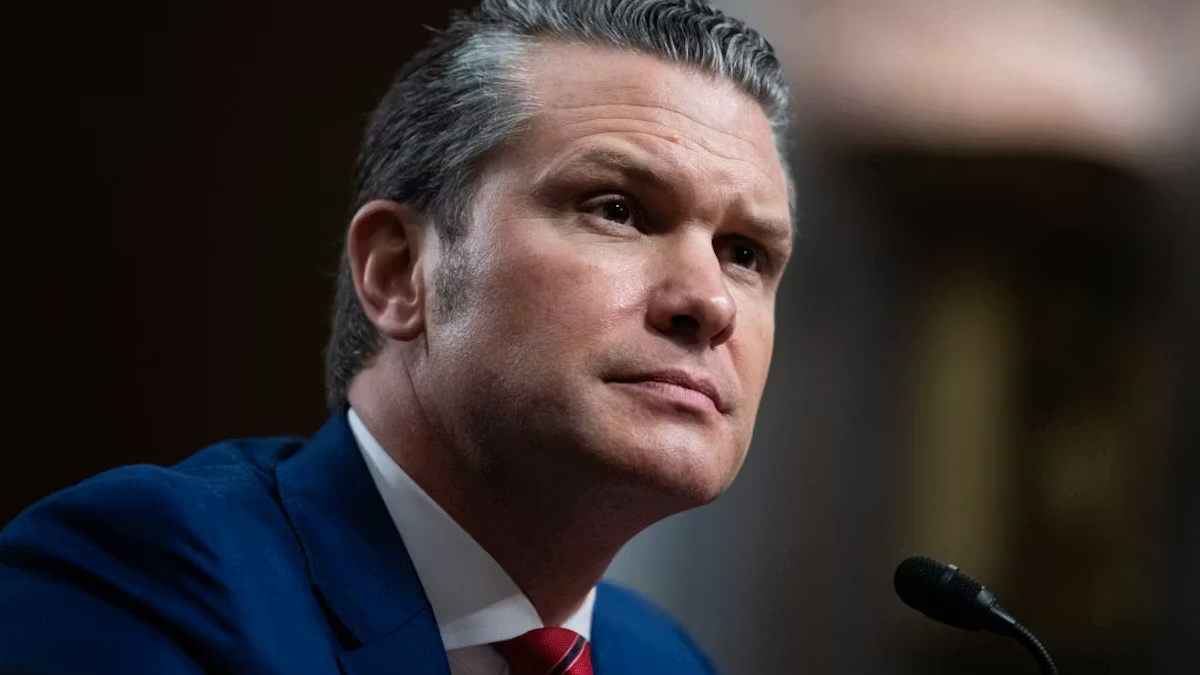
War Secretary Pete Hegseth called on the American public to lift up members of the United States Armed Forces — particularly those who might be in harm’s way — and received immediate criticism from CBS News anchor Margaret Brennan. But Hegseth’s request is far from unprecedented.
“Please pray for them, every day, on bended knee, with your family, in your schools, in your churches, in the name of Jesus Christ,” Hegseth said, closing out a Thursday morning press briefing on Iran alongside other military leaders.
Brennan, anchor of CBS’ “Face the Nation,” responded by saying, “The Secretary of Defense tells the American public to pray for our troops on bended knee and invoke Jesus’ name …”
Brennan also accused the administration of using “religious references as justification for war,” responding to Hegseth’s comments describing the Iranian regime’s strategy as “a violent, messianic Islamist ideology chasing some sort of apocalyptic endgame.”
But prayer on the battlefield — and calls to prayer from both military and political leaders for those engaged in the fight — is nothing new.
On June 6, 1944, then President Franklin Delano Roosevelt gave a radio address during which he invited the American people to join him in prayer for the Allied Forces as they stormed the beaches near Normandy, France. He finished that prayer by asking them to pray continuously for those men, both day and night, until their objective had been reached.
“Almighty God: Our sons, pride of our Nation, this day have set upon a mighty endeavor, a struggle to preserve our Republic, our religion, and our civilization, and to set free a suffering humanity,” Roosevelt began. “Lead them straight and true; give strength to their arms, stoutness to their hearts, steadfastness in their faith.”
Roosevelt went on to pray for strength and courage in battle and acknowledged that many of those for whom he prayed would not ever return home.
“Many people have urged that I call the Nation into a single day of special prayer,” he concluded. “But because the road is long and the desire is great, I ask that our people devote themselves in a continuance of prayer. As we rise to each new day, and again when each day is spent, let words of prayer be on our lips, invoking Thy help to our efforts.”
Months later, with Allied efforts to liberate Europe well underway, General George S. Patton stood ready to lead his Third Army into battle — but the weather was a problem. In early December of 1944, just days before Patton arrived at the besieged town of Bastogne, Belgium, the general called Monsignor James H. O’Neill, the head chaplain: “This is General Patton; do you have a good prayer for weather? We must do something about those rains if we are to win the war.”
Patton’s deputy chief of staff, Colonel Paul Harkins, described the conversation that followed:
Patton: “Chaplain, I want you to publish a prayer for good weather. I’m tired of these soldiers having to fight mud and floods as well as Germans. See if we can’t get God to work on our side.”
O’Neill: “Sir, it’s going to take a pretty thick rug for that kind of praying.”
Patton: “I don’t care if it takes a flying carpet. I want the praying done.”
O’Neill: “Yes, sir. May I say, General, that it usually isn’t a customary thing among men of my profession to pray for clear weather to kill fellow men.”
Patton: “Chaplain, are you trying to teach me theology or are you the Chaplain of the Third Army? I want a prayer.”
The resulting prayer was printed on cards and distributed to as many of Patton’s men as possible: “Almighty and most merciful Father, we humbly beseech Thee, of Thy great goodness, to restrain these immoderate rains with which we have had to contend. Grant us fair weather for Battle. Graciously hearken to us as soldiers who call upon Thee that, armed with Thy power, we may advance from victory to victory, and crush the oppression and wickedness of our enemies and establish Thy justice among men and nations.”
Patton later explained his emphasis on prayer to O’Neill, saying that he believed men could work and plan down to the last detail, but there was always an unknown factor in play: “I call it God. God has his part, or margin, in everything.”
“I wish you would put out a Training Letter on this subject of Prayer to all the chaplains; write about nothing else, just the importance of prayer,” Patton directed O’Neill. “Let me see it before you send it. We’ve got to get not only the chaplains but every man in the Third Army to pray. We must ask God to stop these rains. These rains are that margin that holds defeat or victory. If we all pray, it will be like what Dr. Carrel said, it will be like plugging in on a current whose source is in Heaven. I believe that prayer completes that circuit. It is power.”
When General Dwight D. Eisenhower was elected President of the United States, he too raised the nation and those alongside him in its leadership in private prayer. The handwritten words he prayed before his inauguration in 1953 can be found at his presidential library.
“As we stand here, at this moment, my associates in the Executive Branch of government join me in beseeching that Thou will make full and complete our dedication to the service of the people in this throng and their fellow citizens everywhere. Give us, we pray, the power to discern clearly right from wrong and allow all our words and actions to be governed thereby and by the laws of this land,” he wrote. “Especially we pray that our concern shall be for all the people, regardless of station, race or calling. May cooperation be permitted and be the mutual aim of those who hold to differing political beliefs, so that all may work for the good of our beloved country and for Thy glory. Amen.”
One of the most famous examples of such prayer might be as much myth as historical fact, but the story of then-General George Washington kneeling to pray at Valley Forge has nonetheless persisted as well. The story has several versions throughout history — none of which have ever been definitively confirmed or debunked — all suggesting that Washington knelt alone to pray for his beleaguered troops during the brutal winter as they camped just outside of Philadelphia. Different accounts claim that either the Marquis de Lafayette or a local resident happened upon the general in prayer, but the overall takeaway is the same: multiple accounts agree that Washington was known to leave the camp and spend time in solitude, whether that time was used for prayer or simply quiet reflection.