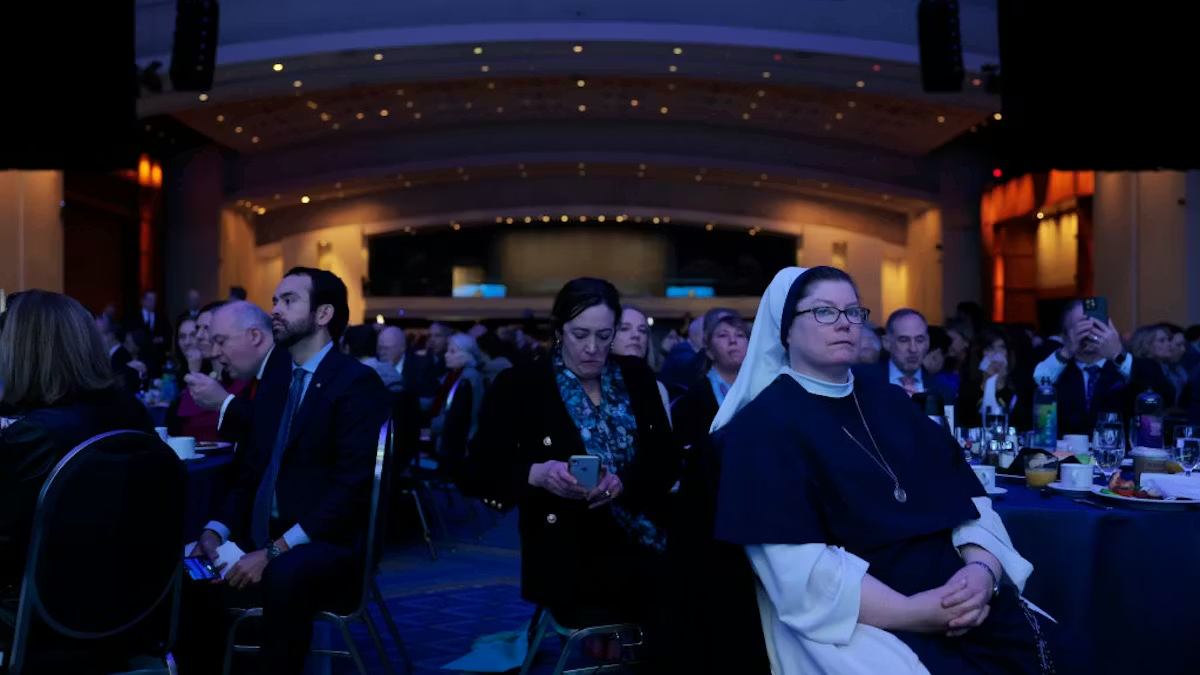
WASHINGTON—The mood at the National Catholic Prayer Breakfast was reverent, polished, and familiar: suits and ties, rosaries tucked into jacket pockets, speeches invoking faith and public life. But just beneath the surface, a different conversation was unfolding.
As bleary-eyed folks chatted at tables before the early-morning event, a growing divide within the conservative Catholic movement came into focus, one shaped by generational change, foreign policy, and competing visions of what the faith demands in public life.
“When I post apologetics on Instagram, I get one of two camps,” Jessica Newell, a Gen Z pro-life operative, told The Daily Wire. “One group who’s skeptical of Israel and brings it to that or the other that is very curious.” Newell described what many younger Catholics at the event see as a widening divide.
“There’s the Nick Fuentes, Candace Owens side of the conservative Catholics and the Matt Walsh, Michael Knowles side,” she said. “And it boils down to transient politics versus eternal values and value judgments.”
At the Prayer Breakfast, the divisions were not visible from the podium. The language there remained unified around faith, life, service, and country.
Daily Wire host Michael Knowles, who delivered the keynote address, took the event as an historic fulfillment. Speaking ahead of the upcoming 250th anniversary of the signing of the Declaration of Independence, Knowles traced the arc of Catholicism in America from marginalization to prominence.
He noted that early American Catholics faced legal discrimination in several states and hostility from movements like the Know-Nothing Party, yet argued that the American system ultimately proved uniquely suited for the faith to take root and flourish. “Here we find ourselves, a quarter millennium later, a people and a place so improbably and perfectly suited for each other that not only can a Catholic become president, but an American can even be the pope,” Knowles said.
Highlighting the increasing presence of Catholics in public life, he pointed to the growing number of Catholic figures in Congress, the judiciary, and the executive branch. “If you count vice presidents and first ladies, we have now had baptized Catholics in the White House for 17 consecutive years,” he added.
In a letter delivered to attendees, Pope Leo XIV offered his “cordial greetings and good wishes,” emphasizing the longstanding Christian tradition of praying for one’s nation. Citing St. Paul, the Holy Father’s message underscored the power of intercession, reminding attendees that prayer for political leaders is both a biblical mandate and a continuing responsibility. “You have gathered for fellowship as well as to pray for the United States,” the message read, adding that such prayer, “united to that of Christ,” remains “powerful and effective.”
A message from President Donald Trump, read by White House Domestic Policy Council Director Vince Haley, struck a similarly affirming tone. The president reiterated his administration’s commitment to religious liberty, writing in a letter to the attendees at the event, “My administration remains firmly committed to defending the right of every Catholic to worship God freely and without fear,” while also marking the celebration of the feast of St. Joseph.
Other speakers reinforced the centrality of faith in both personal and national life. House Majority Leader Steve Scalise (R-LA) reflected on surviving the 2017 congressional baseball shooting, describing how prayer sustained him in the face of possible death. “Prayer is such a powerful thing because it’s a direct conversation with God, and God is listening,” he said.
House Speaker Mike Johnson (R-LA) defended the role of religion in the public square, pushing back on modern interpretations of “separation of church and state.” Referencing Thomas Jefferson’s letter to the Danbury Baptists, Johnson argued the founders intended to protect religious practice from government interference, not to exclude faith from public life altogether. “A free society and a healthy republic depend upon religious and moral virtue,” he said.
Other moments throughout the event pointed to the global and cultural reach of the Catholic community. Claire Lai, daughter of imprisoned Hong Kong publisher and free speech advocate Jimmy Lai, appealed for continued American support for her father’s release. Actor Jonathan Roumie spoke about portraying Christ in “The Chosen” as a deeply spiritual responsibility. And the founders of the Hallow app were honored for their work in expanding digital evangelization.
Taken together, the official program projected unity: a vision of Catholicism as deeply embedded in the American experiment, increasingly influential, and sustained by prayer.
But on the ground, among the next generation of activists, the fault lines are already clear. As the debate sharpens and the coalition pulls apart and collides, the question facing conservative Catholics is no longer whether a divide exists, but what will come of it.
Surveys from Pew Research Center show younger conservatives diverging from older Republicans on foreign policy, particularly on questions of intervention and international alliances. Nowhere is that divide more visible than on Israel.
“We definitely see a lot more people willing to be anti-Israel because the pro-life movement is a bit edgier, more anti-establishment,” said Kristin Dorsey, another Gen Z pro-life advocate.
That shift comes in the wake of frustration following the Supreme Court’s decision in Dobbs v. Jackson Women’s Health Organization, which overturned Roe v. Wade. While the ruling was a major victory for pro-life activists, many younger organizers say Republican politicians failed to seize the moment.
Coverage from Politico and CNN has documented similar frustrations among pro-life leaders, who argue the movement has received little in the way of sustained legislative follow-through.
At the same time, Catholic teaching itself does not mandate political support for any nation-state, including Israel. The Catechism of the Catholic Church emphasizes just war principles, the preservation of human dignity, and prudence in foreign policy. The United States Conference of Catholic Bishops has consistently called for peace and restraint in Middle East conflicts.
That tension has increasingly spilled into conservative politics. Sen. Ted Cruz (R-Texas) was recently criticized for what was described as an attack on Catholics for not embracing Christian Zionism — which, as Matt Fradd recently explained, is contrary to Catholic doctrine. Younger attendees at the breakfast expressed skepticism about the country’s latest foreign entanglement.
“I think it was misguided. I think we lost a lot of steam,” one Zoomer attendee said of U.S. involvement in Iran, declining to give his name but identifying himself as a convert to Catholicism. Reporting from the Associated Press has noted similar debates within conservative circles following escalations involving Iran and Israel.
“I feel like we’re at an inflection point,” said Jack, another Gen Z attendee. “Young men are tired of being put last … and we’re willing to speak out about it, loudly if we have to.”
Despite sharp disagreements on foreign policy and political strategy, there was one issue where attendees showed notable alignment: immigration. “Look, this is a Christian nation,” said Gregory, a millennial convert. “We are going to be just and merciful, but we’re going to enforce our laws.”
While some differed on the scale and method of deportations, none of the attendees interviewed rejected strong border enforcement outright. That consensus exists in tension with broader Church teaching, which emphasizes the dignity of migrants while also recognizing the right of nations to enforce their laws — a balance highlighted in a November 2025 statement from the United States Conference of Catholic Bishops.
For older Catholics, the rising intensity among younger activists is both encouraging and concerning. “They’re going to learn that what they want isn’t as simple as they say it is,” said Pat, a longtime pro-life advocate. “Having principles and being loud is really good — that’s what youth is for. But sometimes discretion is the better part of valor.” Pat also dismissed the centrality of Israel in the debate: “I think they obsess over Israel. I think it’s a non-issue. They’re an allied nation like any other.”
Even among clergy, there is recognition that something is shifting. “The youth and the converts are the future,” one priest said, requesting anonymity. “They’re on fire. I think it’d be wise for the clergy to realize that and try to guide them and help them,” he added.
“They’re the ones who are going to be getting the big political wins when it comes to abortion, same-sex marriage, and everything else going into the future.”