Jonah Feingold is applying startup logic to independent film, which may say more about him than the market. Or it may say where the market is headed.
He’s directed four features, is about to release his fifth, and will start a sixth this summer. Now he is trying to raise $3 million for Romantical.
To be clear, Romantical is not a movie. It’s a pitch for a media company dedicated to romantic comedy and Feingold’s attempt to build infrastructure around it.
Feingold’s first feature, 2021’s “Dating & New York,” premiered at Tribeca Film Festival and sold to IFC Films. It was “one of those experiences that I don’t think happens frequently anymore out of film festivals,” he said.

Since then, he has made rom-coms for Paramount+ (“At Midnight”) and Amazon (“EXmas”), but he also saw a gap in the market.
“Less than 3 percent of movies theatrically released were romantic comedies in the last few years and you have breakout hits like ‘Anyone but You,’” he said. “I basically wanted to put a brand around this and build an ecosystem.”
Not a Film. A Business.
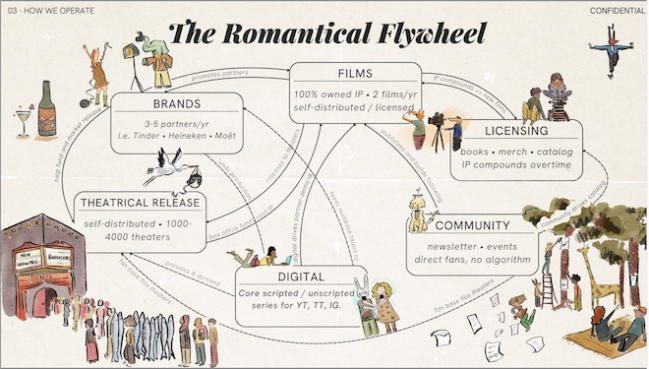
That’s the core of Romantical. The plan is to produce films, digital series, live events, brand partnerships, and licensing, all feeding into a compounding IP engine.
With his 13-page pitch deck, Feingold’s Romantical is made for Y Combinator, not Sundance. For now, Romantical exists as a proof of concept built through branded rom-com shorts made with sponsors like Hinge, Tinder, and BetterHelp.
Traditional independent film asks investors to underwrite a single asset — one film, one release cycle, one outcome. Romantical asks them to underwrite a business.
“The ROI could be a breakout hit movie, or it could be an annual partnership with brands, or the general IP that we build,” he said. “You’re investing in the success of a series of films and digital properties that could have a breakout. Or in five to 10 years, it could just be the success of the brand itself.”
In return, filmmakers get equity in their projects and the possibility of building something that compounds.
More Founder Than Filmmaker
That model requires Feingold to be more founder than filmmaker, and he’s good with that. Describing himself as “equal parts entrepreneurial and creative nut job,” he grew up watching Billy Wilder, Howard Hawks, and Frank Capra, but early jobs included BuzzFeed and Tumblr. “I’ve been exposed to VC people,” he said. “Folks who have exited their tech companies.”
He also says the usual paths never worked especially well for him. He’s rarely been accepted to film festivals and never sold a script to a studio.
“I have always been encouraged to think outside the box to get my way into rooms,” he said. “I’m dyslexic. I could never write a great essay, but I made a movie [instead] in third grade.”
For him, the business side was never a distraction. “In my first movie, I got to start an LLC and understand what an investor agreement looked like,” he said. “I feel incredibly fortunate to have learned those lessons. No one was ever smarter or dumber than me.”
And he does not want dumb money. Rather than the filmmaking fantasy of funders who sign a check and disappear, “I’d rather have someone write a smaller check and have an interesting ecosystem underneath them.”
Conversations so far include a former executive from Resy and AmEx with access to talent and live event infrastructure. Another “is a serial entrepreneur in the paywall space,” Feingold said. “I think he saw an opportunity to get involved in microtransactions.” None are traditional film financiers.
Some filmmakers may like the idea of mini-moguldom. For many others, this is not filmmaking, full stop.
Historically, they’re right. The old system depended on a division of labor: filmmakers made the work, and the system around them handled financing, marketing, and distribution.
As that infrastructure erodes, what replaces it increasingly asks filmmakers to do all of it. Romantical doesn’t solve that problem so much as formalize it.
The Direct Distribution Plays
A version of that model is playing out in Feingold’s upcoming film “Busboys,” which he directed for hire. It was written, produced, and financed by its stars, Theo Von and David Spade. Digital talent management and marketing company Night will release it directly to theaters.
That experience helped shape his thinking about Romantical’s own releases. He wants direct distribution “so that Romantical and its crew members who have equity in the film can see first dollar in, as opposed to these 40 different people that take money off the top in the traditional distribution platform.”
That logic extends to how films might be sold. Last month, Feingold published an open letter to YouTube proposing a native Rent/Buy button for independent creators, allowing filmmakers to sell films directly to audiences without relying on aggregators. He argues that such a tool could also provide data pointing to opportunities for theatrical distribution. (YouTube’s head of Film and TV Partnerships Fede Goldberg responded.)
“Obviously I’m a proponent of the theatrical film experience,” Feingold said. “I have three movies over the past five years that went to theaters, but YouTube can show you who watched it, how long, where they watched it from, how old they were, when did they click out.”
A Different Kind of Bet
Versions of sustainable, multi-platform storytelling businesses already exist in creator-led companies, audience-first media strategies, and genre operations like Blumhouse. What Feingold is proposing is his own hybrid: part film studio, part creator business, part direct-to-audience brand.
By year three, he wants Romantical to produce a breakout theatrical release with shoulder content on YouTube and Instagram. In five years, the goal is a library with output deals and licensing to Netflix, Amazon, and Tubi.
It’s also part of a broader shift already visible in creators who build audiences before projects, and filmmakers experimenting with direct distribution, owned IP, and businesses designed to last longer than a single title.
Feingold said he has started to see himself as “less of a director and more of a creator,” focused on “building ecosystems around movies.” He connected that thinking to the now-classic line from Mark Duplass’ 2015 SXSW keynote: “The cavalry isn’t coming.”
Eleven years later, that line is less a call to arms than a cliché filmmakers can no longer afford to ignore. The open question is which of those ecosystems can be built to last.
FUTURE OF FILMMAKING TOP 5
Weekly Recommendations curated by IndieWire Managing Editor Christian Zilko
5. The Smart Way to Submit to Film Festivals by Brynne Norquist & Tyler Knohl
Submitting to film festivals without a clear plan in place is one of the fastest ways to waste time and money that would be better spent on making your next film. This is a great breakdown of the pitfalls of blind submissions that offers clear steps filmmakers can take to craft a festival strategy that fits their specific project.
4. What is Dark Social & Why it’s Crucial to Your Marketing Mix by Kelli McNeil-Yellen
At this point, we’re all sick of hearing how important social media marketing is (even if it’s still true). But while most of us are well aware that you need a good Instagram page for your movie, this article explains a practice that I was unfamiliar with: Dark Social. The idea is that some of the most valuable social media marketing happens in places that aren’t public: Discord servers, private subreddits, etc. We always hear about building community around our films, but this convincingly makes the case that each filmmaker has to try and build something even more potent: a subculture.
3. Cinema’s Big Bang by Jake S. Weisman
After a particularly grueling year of award season discourse, I’d be content to never hear the words “ballet” or “opera” ever again. But if you’re going to wade into the conversation one last time, do it with this story, which articulates a viewpoint that’s fairly close to mine. Namely that Chalamet’s poorly phrased worst case scenario about cinema is already coming true, but that it’s a good thing. Weisman explains that in an increasingly fragmented culture, practicing an art form with built-in institutional legitimacy and a small but loyal audience that’s willing to spend real money to support it is a workable model.
2. Semper Infidelis: The Generative AI Quandary by Jon Stahl
Jon Stahl has been an In Development favorite for quite some time (he just launched a fun web series too), and offers some thoughts on generative AI in film that diverge from typical black-and-white thinking. He explains that this is arguably the first technology development in entertainment history that doesn’t work to make footage more life-like — in fact, it tends to do the opposite. Rather than simply bemoan the change, he explains why that new paradigm might change our concept of what is valuable in film.
1. Why Historians Will Study 2025 Cinema by Ed William
For all the (largely deserved) doom and gloom about the state of the industry, I think 2025 was a fantastic year for movies. Probably the best one since I started covering them professionally. This post-Oscars recap gives me reason to be excited about the future of the medium. William argues that 2025 was the first year that artists started to actually reckon with our post-pandemic, AI-filled new normal and the loss of shared reality that came with it. There’s plenty more material to mine, and I couldn’t be more excited to see what my favorite filmmakers do with it.