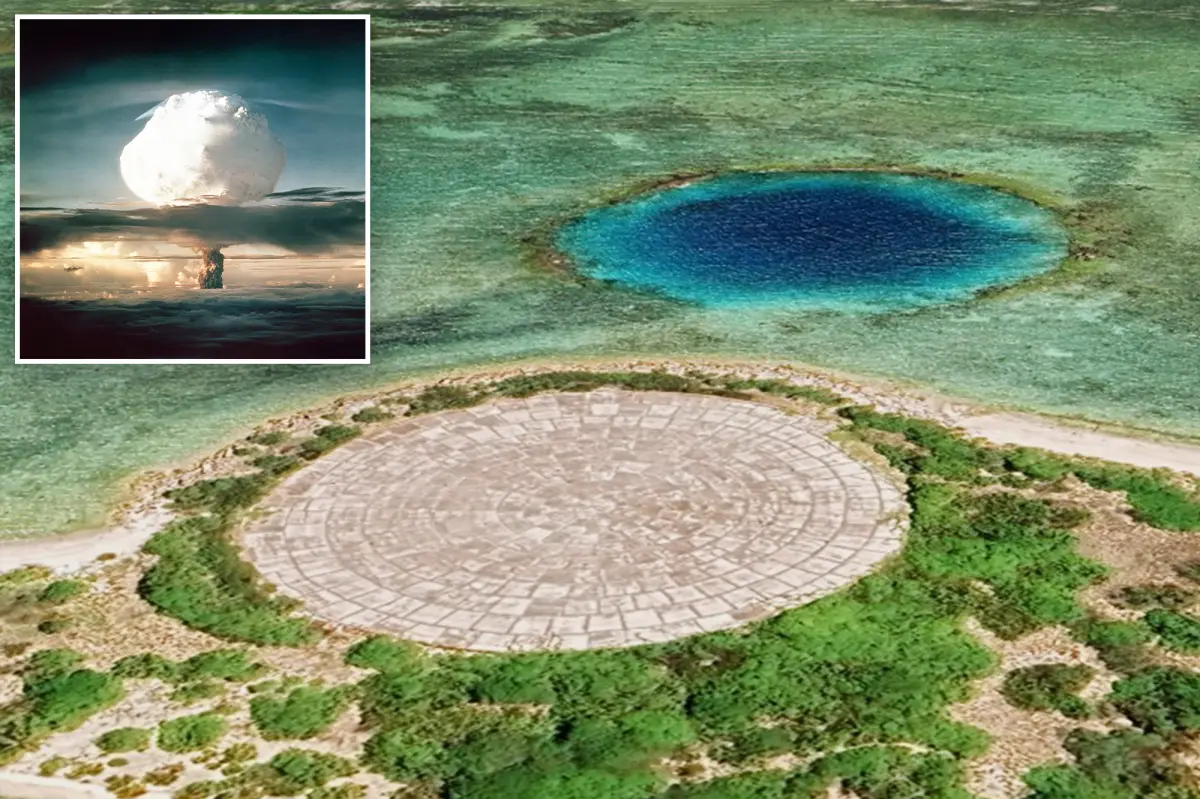
Experts are having a nuclear meltdown.
Cracks in a dome over a contaminated nuclear blast site have sparked fears that the containment area has sprung a dangerous leak — which could snowball amid rising seas.
“We worry the integrity of the dome could be in jeopardy,” Columbia University chemistry professor Ivana Nikolic-Hughes, who witnessed the cracks while measuring radiation levels in 2018, told the Australian Broadcasting Corporation.
The fiasco can be traced back to 1958, when the US dropped an 18-kiloton bomb on the Marshall Islands’ Runit Island as part of a series of nuclear tests that were conducted on South Pacific Islands in the 1940s and ’50s.
Now, 50 years on, experts have become concerned that cracks in the dome could demonstrate how susceptible the site is to rising sea levels on Runit’s narrow shores.
Groundwater has already seeped into the crater. While porous coral sediment underneath it is responsible for the lion’s share of the leaks, experts fear that certain portions of the nuclear tomb could be submerged before long.
“Outside of covering it with cement and doing studies, they really haven’t done a lot to shore it up or fix it,” lamented former Marshallese health secretary Jack Niedenthal. “So as we get these rising sea levels where everything is only a few feet above the water at high tide, it’s pretty concerning.”
Known as the Cactus Test, the detonation dry run obliterated part of the tropical isle, sending a mushroom cloud nearly four miles into the air above the Enewetak Atoll.
The over-30-foot blast crater would become the landfill for all 120,000 tons of contaminated debris from the tests, including lethal amounts of plutonium, as part of a military cleanup effort.
The containment area was sealed with a concrete dome, measuring 377 feet wide and 1½ feet thick, that was constructed between 1977 and 1980.
Experts say it was akin to sweeping one’s atomic problems under the rug.
“We didn’t do a good job,” said Robert Celestial, a former United States Army truck driver who was one of the troops tasked with filling the hole, reportedly without being briefed on the true nature of the gig.
“We didn’t know what the plan was, so a lot of the equipment and hot stuff we just dumped into the lagoon.”
Professor Nikolic-Hughes, who found elevated radiation levels in the soil surrounding the dome, said she fears that intensifying storms could further threaten its integrity. A United Nations report observed that the structure was not watertight.
The United States Department of Energy claimed that the cracks were a natural part of aging, adding that the radioactive debris had been contained and that the contamination risk was negligible.
However, Nikolic-Hughes disputed their statement, wondering, “If there’s so much more waste in the lagoon, why build a dome at all?
“If you have things like chunks of plutonium, that can be extremely dangerous, it could kill you if you come into contact with it,” the researcher added.
She said the fallout could be “potentially devastating,” given that “Runit is about 20 miles from where people live and they use the lagoon.”
Thankfully, so far, the radioactive leaching has been relatively small.
“As long as the plutonium stays put under the dome, it won’t be a large new source of radiation to the Pacific Ocean,” Woods Hole Oceanographic Institute marine radioactivity expert Ken Buesseler told the Los Angeles Times in 2020. “But a lot depends on future sea-level rise and how things like storms and seasonal high tides affect the flow of water in and out of the dome.”
He emphasized the “need to monitor it more regularly to understand what’s happening, and get the data directly to the affected communities in the region.”
Unfortunately, in many cases, the damage has already been done. Of the 4,000 troops who formed the Runit Island cleanup crew, just a few hundred are alive today, per former Army driver Celestial, who noted that many of the victims died of cancer.
“I’m the lucky one because I don’t have cancer yet,” quipped the veteran, who nonetheless didn’t emerge from the incident unscathed.
Celestial served for only seven years before retiring for medical reasons, after which he suffered from a host of physical issues ranging from brittle bones to liver problems.
Many of his symptoms persist to this day, although it’s unclear whether his issues were caused by the cleanup.